Sun Xiaoruo, Ali Mehbab, Jalali Shima, Vaheb Abolfazl, Asad Asad, Dolez Patricia I, Hogan James D, Sameoto Dan
Department of Mechanical Engineering, University of Alberta, Edmonton, Canada.
Department of Human Ecology, University of Alberta, Edmonton, Canada.
Interface Focus. 2024 Jun 7;14(3):20230073. doi: 10.1098/rsfs.2023.0073. eCollection 2024 Jun.
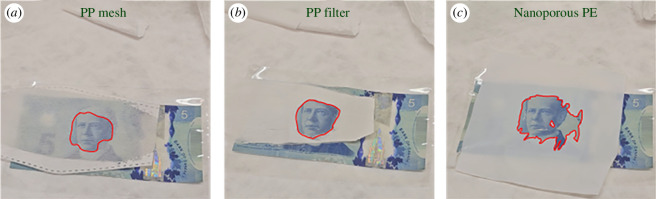
In this study, we explore the innovative application of biological principles of scattering foams and structural colouration of white materials to manipulate the transmission properties of thermal infrared (IR) radiation, particularly within the 8-14 μm wavelength range in polyolefin materials. Inspired by the complex skin of organisms such as chameleons, which can dynamically change colour through structural alterations, as well as more mundane technologies such as Buddha Boards and magic water colouring books, we are developing methods to control thermal IR transmission using common thermoplastic materials that are semi-transparent to thermal IR radiation. Polyethylene and polypropylene, known for their versatility and cost-effectiveness, can be engineered into microstructured sheets with feature sizes spanning from 5 to 100 μm. By integrating these precisely moulded microstructures with index-matching fluids, specifically IR transparent oils, we achieve a reversible modification of the thermal transmission properties. This novel approach not only mimics the adaptive functionality of natural systems but also offers a practical and scalable solution for dynamic thermal management. Our results indicate a promising pathway for the development of new materials that can adapt their IR properties in real time, paving the way for smarter thermal management solutions via radiative emission/absorption.
在本研究中,我们探索了散射泡沫的生物学原理和白色材料的结构着色在操纵热红外(IR)辐射传输特性方面的创新应用,特别是在聚烯烃材料中8 - 14μm波长范围内。受变色龙等生物体复杂皮肤的启发,其可通过结构改变动态变色,以及诸如水写布和魔术水彩书等更为常见的技术的启发,我们正在开发使用对热红外辐射半透明的普通热塑性材料来控制热红外传输的方法。以其多功能性和成本效益著称的聚乙烯和聚丙烯,可被加工成特征尺寸范围为5至100μm的微结构片材。通过将这些精确模制的微结构与折射率匹配流体(特别是红外透明油)相结合,我们实现了热传输特性的可逆改性。这种新颖的方法不仅模仿了自然系统的自适应功能,还为动态热管理提供了一种实用且可扩展的解决方案。我们的结果表明了开发能够实时调整其红外特性的新材料的一条有前景的途径,为通过辐射发射/吸收实现更智能的热管理解决方案铺平了道路。