Saland Jeffrey M, Lieske John C, Groothoff Jaap W, Frishberg Yaacov, Shasha-Lavsky Hadas, Magen Daniella, Moochhala Shabbir H, Simkova Eva, Coenen Martin, Hayes Wesley, Hogan Julien, Sellier-Leclerc Anne-Laure, Willey Richard, Gansner John M, Hulton Sally-Anne
Jack and Lucy Clark Department of Pediatrics, Mount Sinai Kravis Children's Hospital, Icahn School of Medicine at Mount Sinai, New York, New York, USA.
Division of Nephrology and Hypertension, Mayo Clinic, Rochester, Minnesota, USA.
Kidney Int Rep. 2024 Apr 26;9(7):2037-2046. doi: 10.1016/j.ekir.2024.04.048. eCollection 2024 Jul.
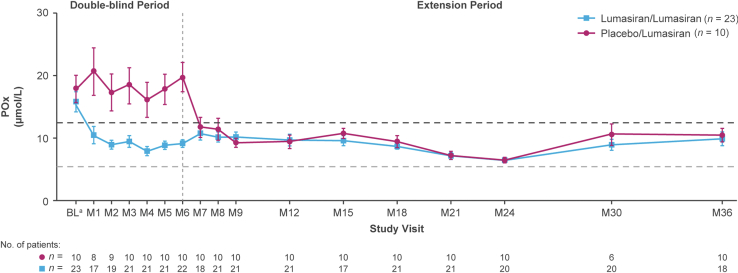
Patients with primary hyperoxaluria type 1 (PH1), a genetic disorder associated with hepatic oxalate overproduction, frequently experience recurrent kidney stones and worsening kidney function. Lumasiran is indicated for the treatment of PH1 to lower urinary and plasma oxalate (POx).
ILLUMINATE-A (NCT03681184) is a phase III trial in patients aged ≥6 years with PH1 and estimated glomerular filtration rate (eGFR) ≥30 ml/min per 1.73 m. A 6-month double-blind placebo-controlled period is followed by an extension period (≤54 months; all patients receive lumasiran). We report interim data through month 36.
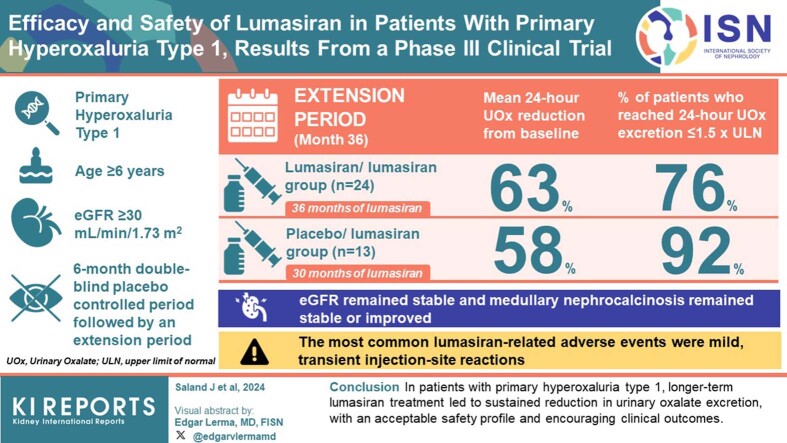
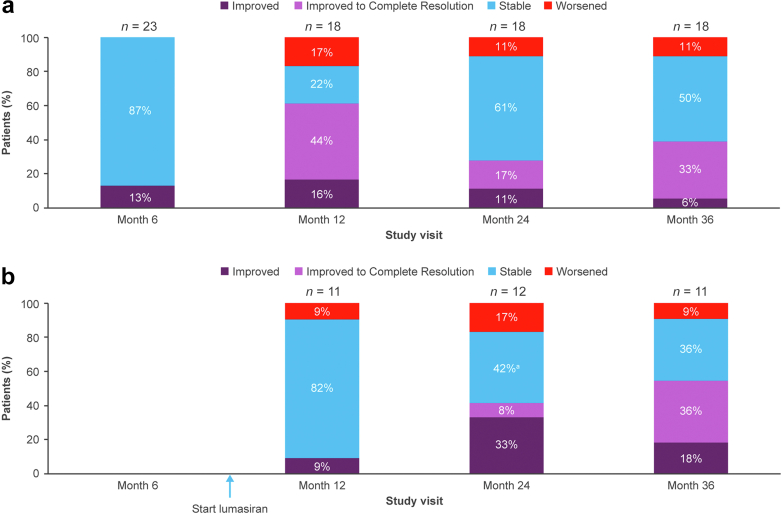
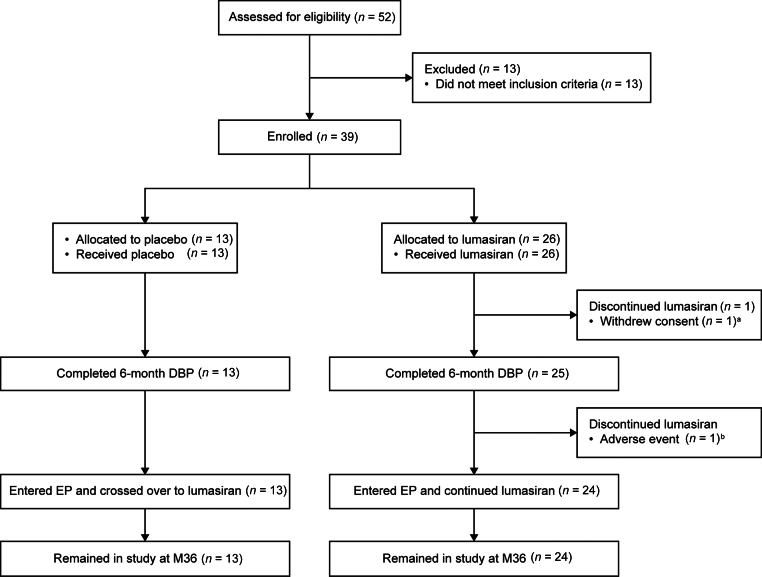
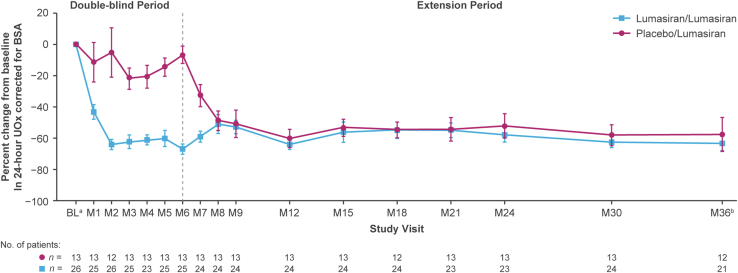
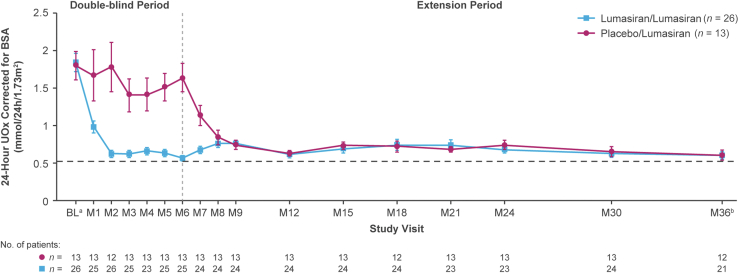
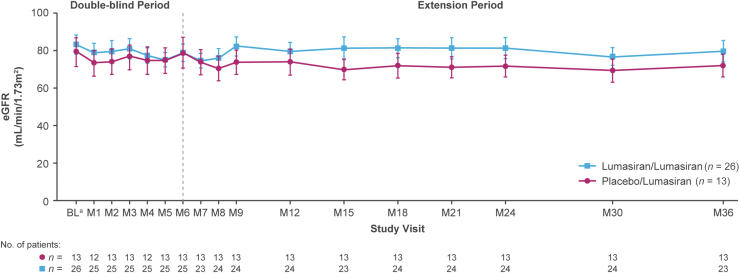
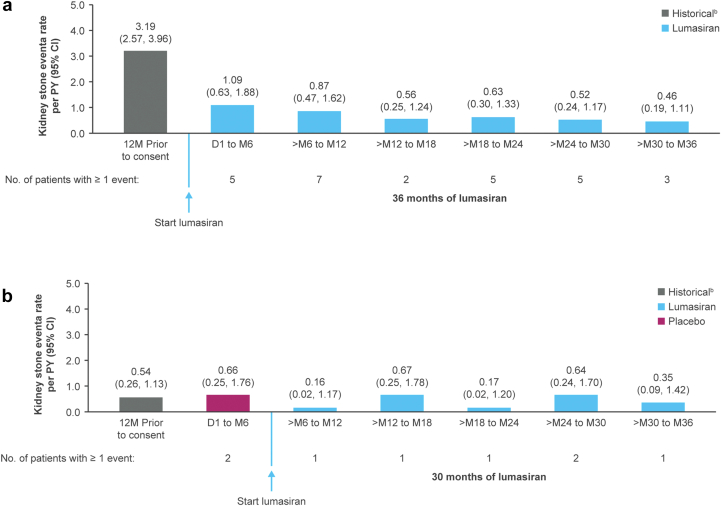
Of 39 patients enrolled, 24 of 26 (lumasiran/lumasiran group) and 13 of 13 (placebo/lumasiran group) entered and continue in the extension period. At month 36, in the lumasiran/lumasiran group (36 months of lumasiran treatment) and placebo/lumasiran group (30 months of lumasiran treatment), mean 24-hour urinary oxalate (UOx) reductions from baseline were 63% and 58%, respectively; 76% and 92% of patients reached a 24-hour UOx excretion ≤1.5× the upper limit of normal (ULN). eGFR remained stable. Kidney stone event rates decreased from 2.31 (95% confidence interval: 1.88-2.84) per person-year (PY) during the 12 months before consent to 0.60 (0.46-0.77) per PY during lumasiran treatment. Medullary nephrocalcinosis generally remained stable or improved; approximately one-third of patients (both groups) improved to complete resolution. The most common lumasiran-related adverse events (AEs) were mild, transient injection-site reactions.
In patients with PH1, longer-term lumasiran treatment led to sustained reduction in UOx excretion, with an acceptable safety profile and encouraging clinical outcomes.See for Video Abstract.
1型原发性高草酸尿症(PH1)患者是一种与肝脏草酸盐过度产生相关的遗传性疾病,经常经历复发性肾结石和肾功能恶化。鲁马西单抗被批准用于治疗PH1,以降低尿液和血浆草酸盐(POx)水平。
ILLUMINATE-A(NCT03681184)是一项针对年龄≥6岁、估计肾小球滤过率(eGFR)≥30 ml/(min·1.73 m²)的PH1患者的III期试验。为期6个月的双盲安慰剂对照期之后是延长期(≤54个月;所有患者均接受鲁马西单抗治疗)。我们报告了截至第36个月的中期数据。
在39名入组患者中,26名接受鲁马西单抗治疗的患者中有24名(鲁马西单抗/鲁马西单抗组)以及13名接受安慰剂治疗的患者中有13名(安慰剂/鲁马西单抗组)进入并继续延长期。在第36个月时,鲁马西单抗/鲁马西单抗组(接受鲁马西单抗治疗36个月)和安慰剂/鲁马西单抗组(接受鲁马西单抗治疗30个月)中,24小时尿草酸(UOx)较基线的平均降低幅度分别为63%和58%;76%和92%的患者24小时UOx排泄量≤正常上限(ULN)的1.5倍。eGFR保持稳定。肾结石事件发生率从入组前12个月的每人年(PY)2.31(95%置信区间:1.88 - 2.84)降至鲁马西单抗治疗期间的每人年0.60(0.46 - 0.77)。髓质肾钙质沉着症总体保持稳定或有所改善;大约三分之一的患者(两组)改善至完全消退。最常见的与鲁马西单抗相关的不良事件(AE)为轻度、短暂的注射部位反应。
在PH1患者中,长期使用鲁马西单抗治疗可使UOx排泄持续降低,安全性可接受,临床结果令人鼓舞。见视频摘要。