Wei Shijia, Tan Jingyi, Huang Xueshan, Zhuang Kai, Qiu Weijian, Chen Mei, Ye Xiaoxia, Wu Minhua
The First Clinical Medical College, Guangdong Medical University, Zhanjiang, 524000, China.
School of Pharmacy, Guangdong Medical University, Zhanjiang, 524000, China.
J Transl Med. 2024 Jul 31;22(1):711. doi: 10.1186/s12967-024-05493-0.
Hepatocellular carcinoma (HCC) is the most common type of primary liver cancer and second leading cause of cancer-related deaths worldwide. The heightened mortality associated with HCC is largely attributed to its propensity for metastasis, which cannot be achieved without remodeling or loss of the basement membrane (BM). Despite advancements in targeted therapies and immunotherapies, resistance and limited efficacy in late-stage HCC underscore the urgent need for better therapeutic options and early diagnostic biomarkers. Our study aimed to address these gaps by investigating and evaluating potential biomarkers to improve survival outcomes and treatment efficacy in patients with HCC.
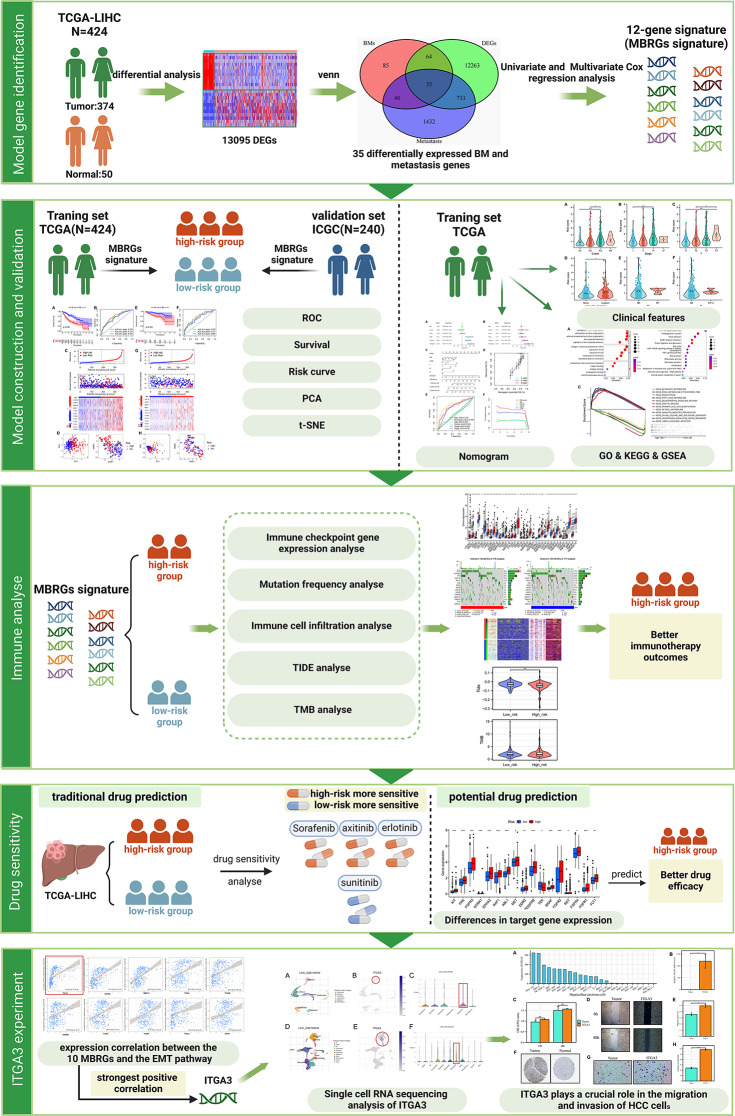
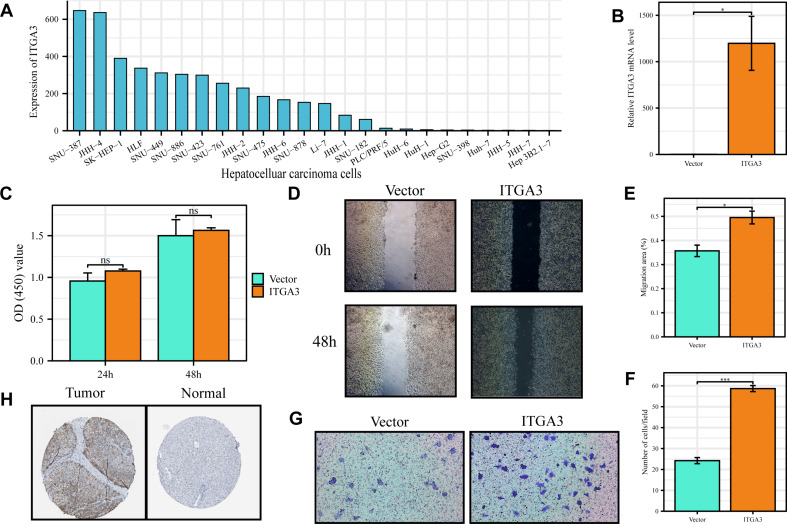
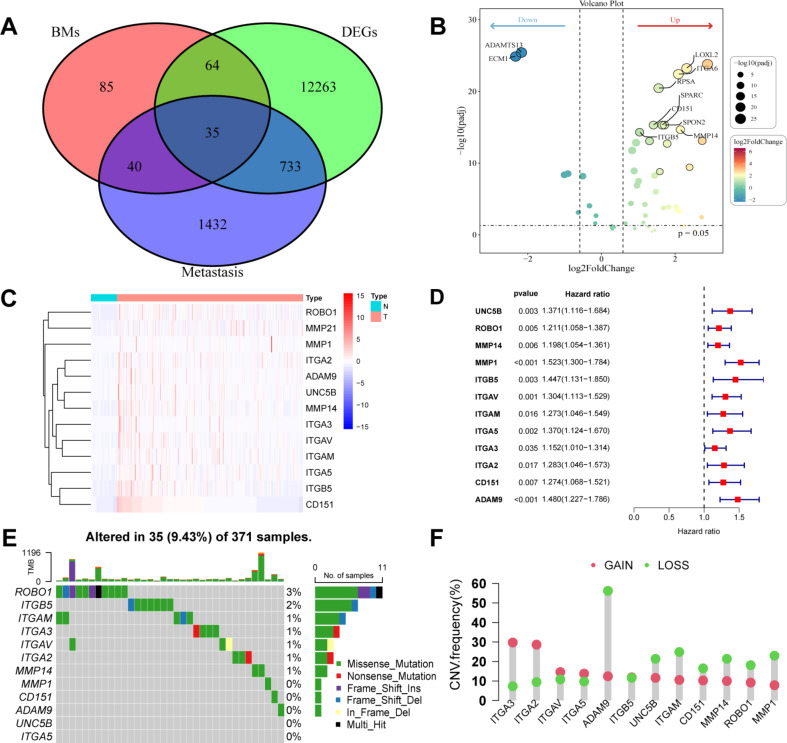
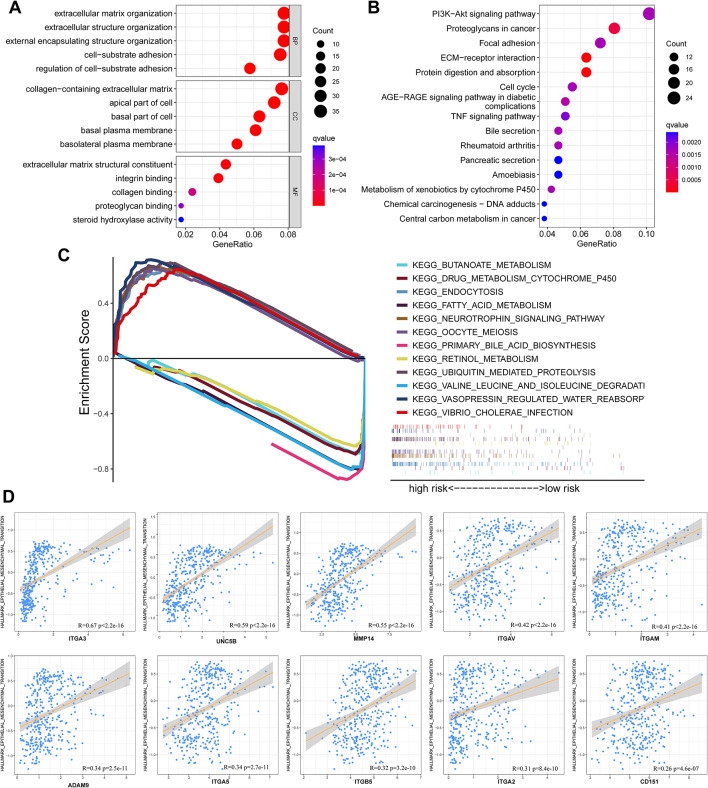
In this study, we collected the transcriptome sequencing, clinical, and mutation data of 424 patients with HCC from The Cancer Genome Atlas (TCGA) and 240 from the International Cancer Genome Consortium (ICGC) databases. We then constructed and validated a prognostic model based on metastasis and basement membrane-related genes (MBRGs) using univariate and multivariate Cox regression analyses. Five immune-related algorithms (CIBERSORT, QUANTISEQ, MCP counter, ssGSEA, and TIMER) were then utilized to examine the immune landscape and activity across high- and low-risk groups. We also analyzed Tumor Mutation Burden (TMB) values, Tumor Immune Dysfunction and Exclusion (TIDE) scores, mutation frequency, and immune checkpoint gene expression to evaluate immune treatment sensitivity. We analyzed integrin subunit alpha 3 (ITGA3) expression in HCC by performing single-cell RNA sequencing (scRNA-seq) analysis using the TISCH 2.0 database. Lastly, wound healing and transwell assays were conducted to elucidate the role of ITGA3 in tumor metastasis.
Patients with HCC were categorized into high- and low-risk groups based on the median values, with higher risk scores indicating worse overall survival. Five immune-related algorithms revealed that the abundance of immune cells, particularly T cells, was greater in the high-risk group than in the low-risk group. The high-risk group also exhibited a higher TMB value, mutation frequency, and immune checkpoint gene expression and a lower tumor TIDE score, suggesting the potential for better immunotherapy outcomes. Additionally, scRNA-seq analysis revealed higher ITGA3 expression in tumor cells compared with normal hepatocytes. Wound healing scratch and transwell cell migration assays revealed that overexpression of the MBRG ITGA3 enhanced migration of HCC HepG2 cells.
This study established a direct molecular correlation between metastasis and BM, encompassing clinical features, tumor microenvironment, and immune response, thereby offering valuable insights for predicting clinical outcomes and immunotherapy responses in HCC.
肝细胞癌(HCC)是原发性肝癌最常见的类型,也是全球癌症相关死亡的第二大主要原因。与HCC相关的死亡率升高主要归因于其转移倾向,而这离不开基底膜(BM)的重塑或丧失。尽管靶向治疗和免疫治疗取得了进展,但晚期HCC的耐药性和疗效有限凸显了对更好的治疗选择和早期诊断生物标志物的迫切需求。我们的研究旨在通过调查和评估潜在的生物标志物来填补这些空白,以改善HCC患者的生存结果和治疗效果。
在本研究中,我们从癌症基因组图谱(TCGA)收集了424例HCC患者的转录组测序、临床和突变数据,并从国际癌症基因组联盟(ICGC)数据库收集了240例患者的数据。然后,我们使用单变量和多变量Cox回归分析构建并验证了基于转移和基底膜相关基因(MBRG)的预后模型。随后,利用五种免疫相关算法(CIBERSORT、QUANTISEQ、MCP counter、ssGSEA和TIMER)来研究高风险和低风险组的免疫格局和活性。我们还分析了肿瘤突变负荷(TMB)值、肿瘤免疫功能障碍和排除(TIDE)评分、突变频率和免疫检查点基因表达,以评估免疫治疗敏感性。我们使用TISCH 2.0数据库通过单细胞RNA测序(scRNA-seq)分析来分析HCC中整合素亚基α3(ITGA3)的表达。最后,进行伤口愈合和Transwell实验以阐明ITGA3在肿瘤转移中的作用。
根据中位数将HCC患者分为高风险和低风险组,风险评分越高表明总生存期越差。五种免疫相关算法显示,高风险组中免疫细胞,特别是T细胞的丰度高于低风险组。高风险组还表现出更高的TMB值、突变频率和免疫检查点基因表达以及更低的肿瘤TIDE评分,表明免疫治疗效果可能更好。此外,scRNA-seq分析显示肿瘤细胞中ITGA3的表达高于正常肝细胞。伤口愈合划痕和Transwell细胞迁移实验表明,MBRG ITGA3的过表达增强了HCC HepG2细胞的迁移。
本研究建立了转移与BM之间的直接分子关联,涵盖临床特征、肿瘤微环境和免疫反应,从而为预测HCC的临床结果和免疫治疗反应提供了有价值的见解。