Lau Nancy, Steineck Angela, Walsh Casey, Fladeboe Kaitlyn M, Yi-Frazier Joyce P, Rosenberg Abby R, Barton Krysta
Center for Child Health, Behavior and Development, Seattle Children's Research Institute, 1920 Terry Ave, Seattle, WA, 98101, USA.
Department of Psychiatry and Behavioral Sciences, University of Washington School of Medicine, Seattle, WA, USA.
BMC Palliat Care. 2024 Jul 31;23(1):193. doi: 10.1186/s12904-024-01527-y.
Adolescents and Young Adults (AYAs) with cancer are an at-risk group with unique palliative and supportive care needs. Social support in AYAs with cancer is associated with better coping, quality of life, and psychosocial well-being. Here, we extend existing research to examine the sources and types of support received by AYAs with advanced cancer.
AYAs participated in a semi-structured, 1:1 interview on communication and psychosocial support needs. The present analysis focused on social support experiences for AYAs with advanced cancer. Directed content analysis was used to develop the codebook. Established social support constructs provided a coding framework. We presented our qualitative findings as a code frequency report with quantified frequency counts of all "source of support" and "type of support" codes. We assigned a global "sufficiency of support code" to each AYA.
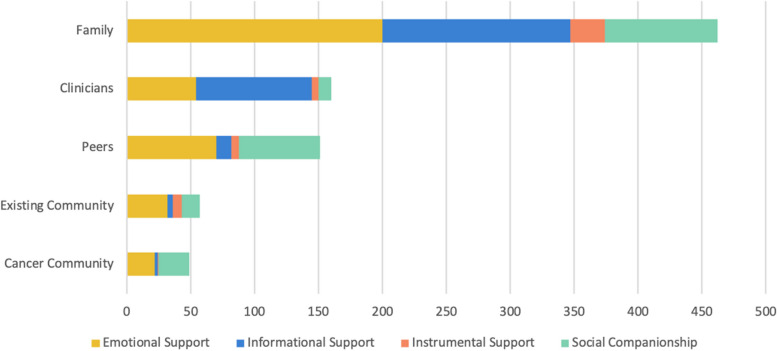
We interviewed 32 AYAs with advanced cancer (Mage = 18, SDage = 3.2, 41% female). Most AYAs identified family (namely, caregivers) as their primary source of support and stated that family universally provided all types of support: emotional, informational, instrumental, and social companionship. They received informational and emotional support from clinicians, and received emotional support and social companionship from healthy peers, cancer peers, and their existing community. One-third of participants were coded as having "mixed support" and described a lack of support in some domains.
AYAs with advanced cancer described caregivers as their universal source of support, and that other support sources provided support for specific needs. Future research should continue to evaluate social support needs and family-based palliative and supportive care interventions to bolster social support resources in this high-risk group.
患有癌症的青少年和青年(AYA)是一个有特殊姑息治疗和支持性护理需求的高危群体。患有癌症的AYA群体中的社会支持与更好的应对方式、生活质量及心理社会幸福感相关。在此,我们拓展现有研究,以探究晚期癌症AYA所获得支持的来源和类型。
AYA参与了关于沟通及心理社会支持需求的半结构化一对一访谈。目前的分析聚焦于晚期癌症AYA的社会支持经历。采用定向内容分析法来制定编码手册。已确立的社会支持结构提供了一个编码框架。我们将定性研究结果呈现为一份编码频率报告,其中包含所有“支持来源”和“支持类型”编码的量化频率计数。我们为每位AYA分配了一个总体的“支持充足性编码”。
我们访谈了32名晚期癌症AYA(年龄中位数 = 18岁,标准差 = 3.2岁,41%为女性)。大多数AYA将家人(即照料者)视为其主要支持来源,并表示家人普遍提供了所有类型的支持:情感支持、信息支持、工具性支持和社会陪伴。他们从临床医生那里获得信息支持和情感支持,从健康同龄人、癌症病友及他们现有的社区获得情感支持和社会陪伴。三分之一的参与者被编码为“混合支持”,并表示在某些领域缺乏支持。
患有晚期癌症的AYA将照料者描述为他们普遍的支持来源,而其他支持来源则满足特定需求。未来的研究应继续评估社会支持需求以及基于家庭的姑息治疗和支持性护理干预措施,以增强这一高危群体的社会支持资源。