Gros Beatriz, Ross Hannah, Nwabueze Maureen, Constantine-Cooke Nathan, Derikx Lauranne A A P, Lyons Mathew, O'Hare Claire, Noble Colin, Arnott Ian D, Jones Gareth-Rhys, Lees Charlie W, Plevris Nikolas
Edinburgh IBD Unit, Western General Hospital, Edinburgh, Scotland, UK.
Department of Gastroenterology; Liver and Digestive Diseases Networking Biomedical Research Centre (CIBEREHD), Madrid, Spain and Hepatology, Reina Sofía University Hospital, Córdoba, Spain.
Therap Adv Gastroenterol. 2024 Jul 30;17:17562848241258372. doi: 10.1177/17562848241258372. eCollection 2024.
Long-term vedolizumab (VDZ) outcomes in real-world cohorts have been largely limited to 1-year follow-up, with few bio-naïve patients or objective markers of inflammation assessed.
We aimed to assess factors affecting VDZ persistence including clinical, biochemical and faecal biomarker remission at 1, 3 and 5 years.
We performed a retrospective, observational, cohort study.
All adult inflammatory bowel disease (IBD) patients who had received VDZ induction for ulcerative colitis (UC)/IBD-unclassified (IBDU) were included. Baseline phenotype and follow-up data were collected a review of electronic medical records.
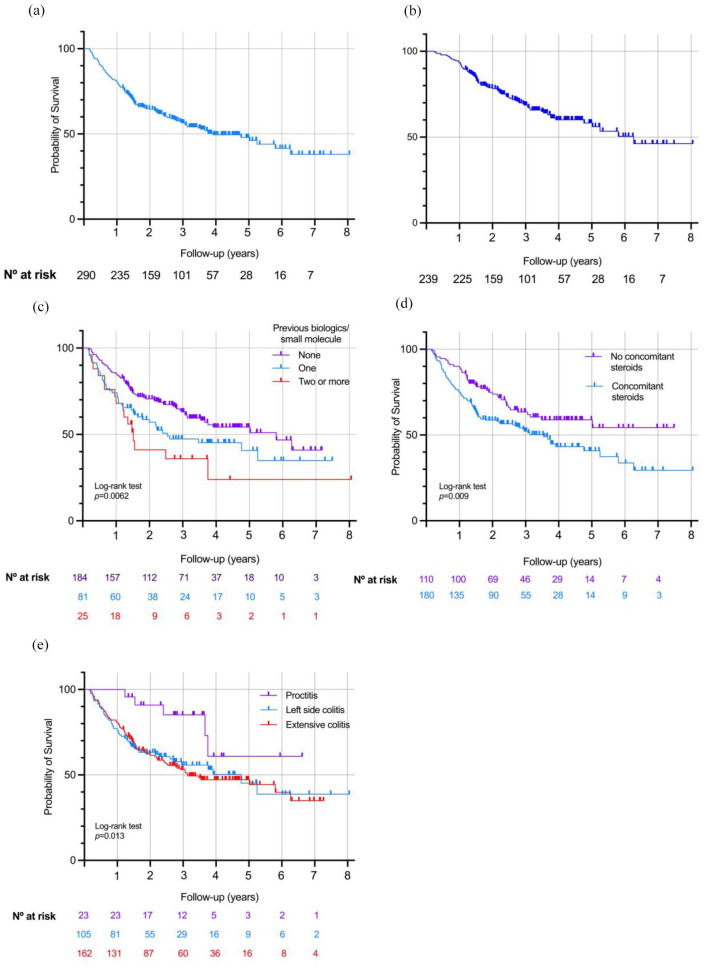
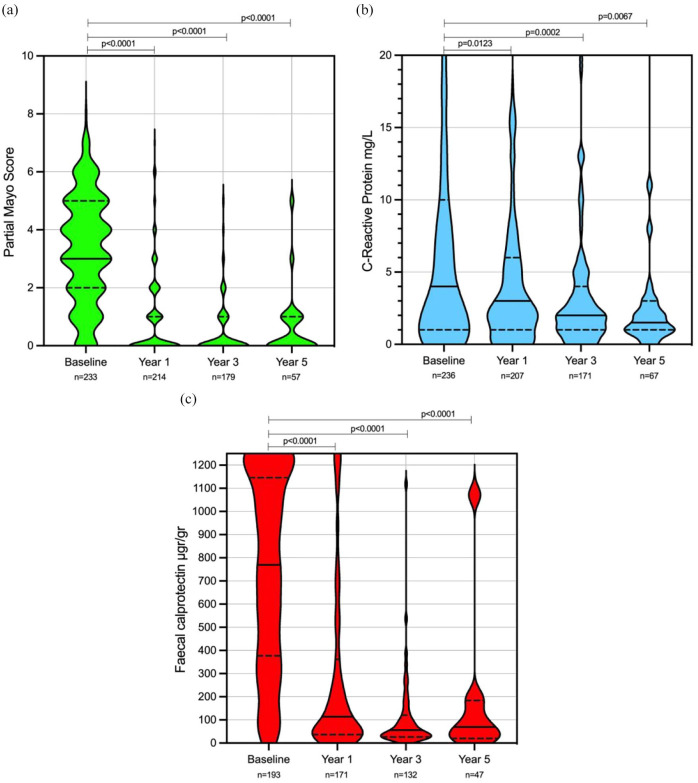
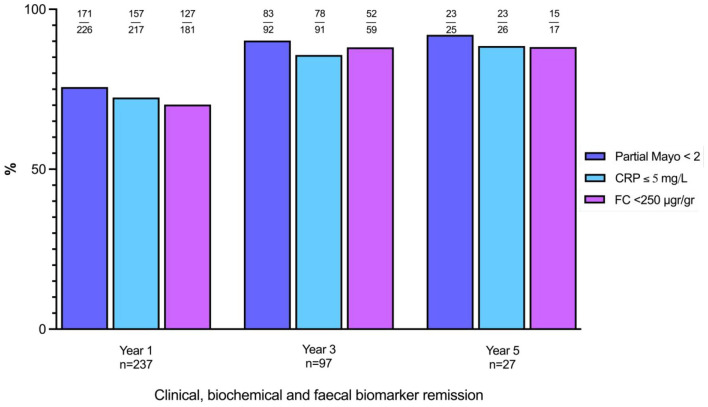
We included 290 patients [UC = 271 (93.4%), IBDU = 19 (6.6%)] with a median time on VDZ of 27.6 months (interquartile range: 14.4-43.2). At the end of follow-up, a total of 157/290 (54.1%) patients remained on VDZ. The median time to discontinuation was 14.1 months (7.0-23.3). Previous exposure to ⩾1 advanced therapy, steroid use at baseline and disease extension (E3 and E2 E1) were independent predictors for worse VDZ persistence. Clinical remission (partial Mayo < 2) was 75.7% (171/226), 72.4% (157/217) and 70.2% (127/181) at years 1, 3 and 5, respectively. Steroid use during maintenance VDZ therapy occurred in 31.7% (92/290), hospitalization in 15.5% (45/290) and surgery in 3.4% (10/291). The rate of serious adverse events was 1.2 per 100 patient-years of follow-up.
VDZ effectiveness appears enduring with favourable long-term safety profile. VDZ persistence was influenced by previous exposure to biologics/small molecules, disease distribution and steroid use at baseline in our study.
在真实世界队列中,维多珠单抗(VDZ)的长期疗效主要局限于1年的随访,评估的初治患者和炎症客观标志物较少。
我们旨在评估影响VDZ持续使用的因素,包括1年、3年和5年时的临床、生化和粪便生物标志物缓解情况。
我们进行了一项回顾性观察性队列研究。
纳入所有接受VDZ诱导治疗溃疡性结肠炎(UC)/未分类炎症性肠病(IBDU)的成年炎症性肠病(IBD)患者。通过回顾电子病历收集基线表型和随访数据。
我们纳入了290例患者[UC = 271例(93.4%),IBDU = 19例(6.6%)],VDZ治疗的中位时间为27.6个月(四分位间距:14.4 - 43.2)。随访结束时,共有157/290例(54.1%)患者仍在使用VDZ。停药的中位时间为14.1个月(7.0 - 23.3)。既往接受过≥1种先进治疗、基线时使用类固醇以及疾病扩展(E3和E2>E1)是VDZ持续使用情况较差的独立预测因素。1年、3年和5年时临床缓解(部分梅奥评分<2)分别为75.7%(171/226)、72.4%(157/217)和70.2%(127/181)。维持VDZ治疗期间使用类固醇的比例为31.7%(92/290),住院比例为15.5%(45/290),手术比例为3.4%(10/291)。严重不良事件发生率为每100患者年随访1.2例。
VDZ疗效似乎持久,长期安全性良好。在我们的研究中,VDZ的持续使用受到既往生物制剂/小分子药物暴露、疾病分布和基线时类固醇使用的影响。