Cao Xia, Yi Xuanzi, Chen Hui, Tian Yusheng, Li Sihong, Zhou Jiansong
Health Management Center, The Third Xiangya Hospital of Central South University, No. 138, Tongzipo Road, Changsha, 410013, China.
Department of General Practice, The Third Xiangya Hospital of Central South University, No. 138, Tongzipo Road, Changsha, 410013, China.
Aging Clin Exp Res. 2024 Aug 1;36(1):157. doi: 10.1007/s40520-024-02816-5.
The concept of intrinsic capacity (IC) was introduced to define healthy aging and active aging based on functional capacity, yet there is limited understanding of the risk of IC decline at a population level.
To consolidate existing evidence for rates of IC decline and risk factors among community-dwelling adults 60 years or older.
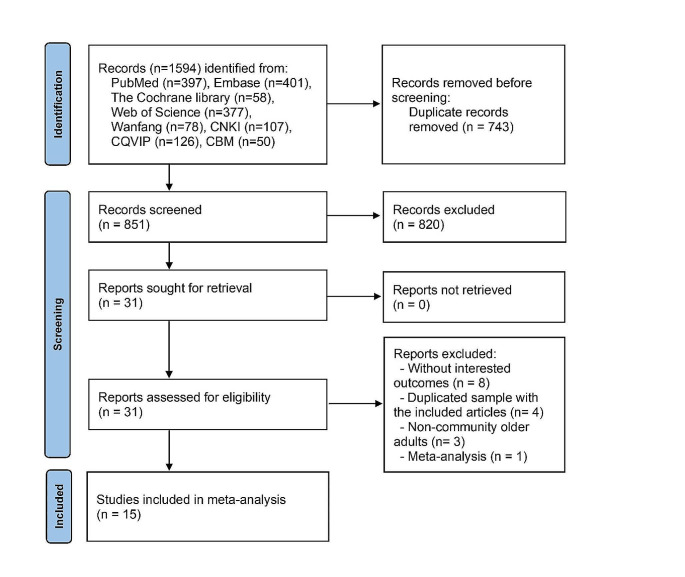
According to the PRISMA guidelines, the literature search was independently conducted by two researchers in 8 databases from inception to January 2024 without language restrictions using combinations of free words and subject words. Qualities of included studies were assessed using Joanna Briggs Institute's (JBI's) critical appraisal checklist for prevalence studies. To pool the data, a random-effect meta-analysis was performed, followed by subgroup analysis and sensitivity analysis. All analyses were performed by Stata14.0.
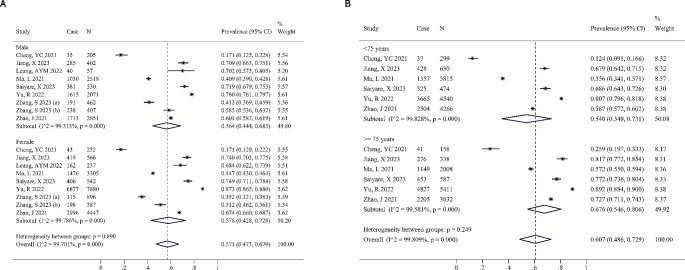
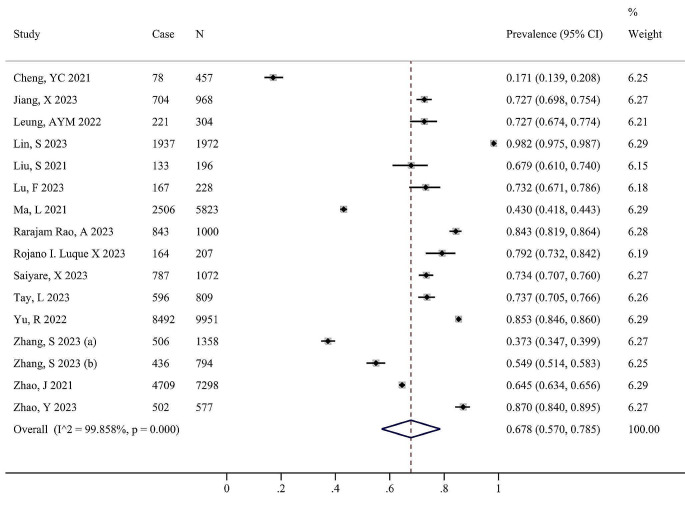
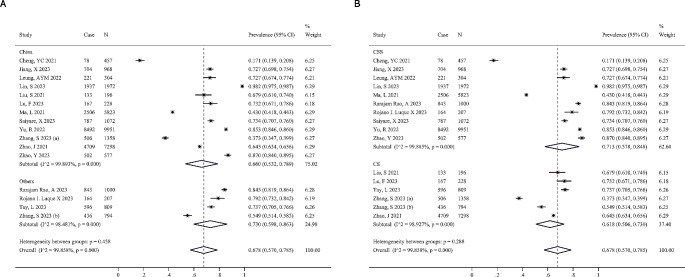
From 1594 records, 15 studies were extracted with 33,070 participants for meta-analysis. The pooled prevalence of IC decline in community settings was 67.8% (95% CI: 57.0-78.5%; P < 0.001). The prevalence of IC decline in China (66.0%; 95% CI: 53.2-78.9%) was found to be slightly lower than in other countries/regions (73.0%; 95% CI: 59.8-86.3%); however, this difference was not statistically significant. Other subgroup analyses revealed no statistically significant differences in prevalence. Age, hypertension, diabetes, gender, education level, living status, smoking, regular exercise, marital status, and osteoarthritis are associated with IC decline.
More than two-thirds of older adults in the community are affected by IC decline, and age, hypertension, diabetes, female sex, low education level, living alone, smoking, irregular exercise, unmarried, and osteoarthritis are all risk factors for IC decline.
内在能力(IC)的概念被引入,以基于功能能力来定义健康老龄化和积极老龄化,但在人群层面上,对IC下降风险的了解有限。
整合关于60岁及以上社区居住成年人IC下降率和风险因素的现有证据。
根据PRISMA指南,两名研究人员于2024年1月前在8个数据库中独立进行文献检索,检索不限语言,使用自由词和主题词组合。采用乔安娜·布里格斯研究所(JBI)的患病率研究批判性评价清单评估纳入研究的质量。为汇总数据,进行了随机效应荟萃分析,随后进行亚组分析和敏感性分析。所有分析均使用Stata14.0进行。
从1594条记录中,提取了15项研究,共33,070名参与者进行荟萃分析。社区环境中IC下降的汇总患病率为67.8%(95%CI:57.0 - 78.5%;P < 0.001)。发现中国IC下降的患病率(66.0%;95%CI:53.2 - 78.9%)略低于其他国家/地区(73.0%;95%CI:59.8 - 86.3%);然而,这种差异无统计学意义。其他亚组分析显示患病率无统计学显著差异。年龄、高血压、糖尿病、性别、教育水平、生活状况、吸烟、规律运动、婚姻状况和骨关节炎与IC下降相关。
社区中超过三分之二的老年人受到IC下降的影响,年龄、高血压、糖尿病、女性、低教育水平、独居、吸烟、不规律运动、未婚和骨关节炎都是IC下降的风险因素。