School of Natural Sciences, Macquarie University, 4 Wally's Walk, NSW-2109, Macquarie Park, Sydney, Australia.
Institute for Glyco-core Research (iGCORE), Nagoya University, Furocho, Chikusa Ward, Nagoya, 464-8601, Aichi, Japan.
Glycobiology. 2024 Sep 30;34(11). doi: 10.1093/glycob/cwae057.
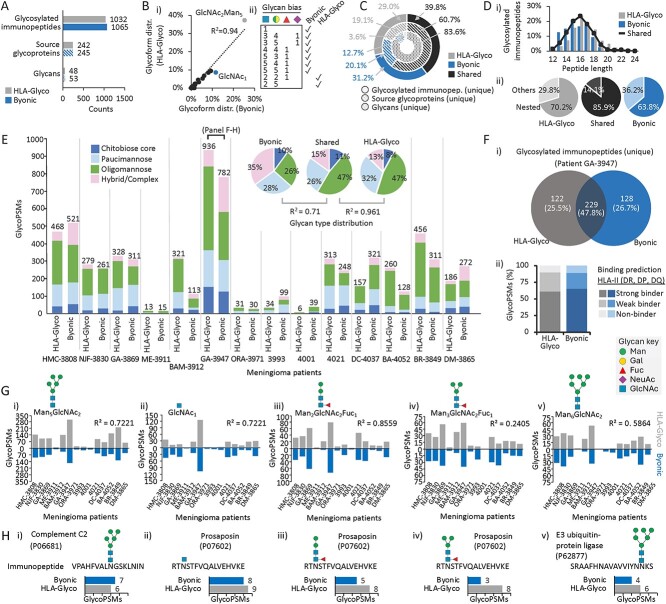
Immunopeptides are cell surface-located protein fragments that aid our immune system to recognise and respond to pathogenic insult and malignant transformation. In this two-part communication, we firstly summarise and reflect on our recent discovery documenting that MHC-II-bound immunopeptides from immortalised cell lines prevalently carry N-glycans that differ from the cellular glycoproteome (Goodson, Front Immunol, 2023). These findings are important as immunopeptide glycosylation remains poorly understood in immunosurveillance. The study also opened up new technical and biological questions that we address in the second part of this communication. Our study highlighted that the performance of the search engines used to detect glycosylated immunopeptides from LC-MS/MS data remains untested and, importantly, that little biochemical in vivo evidence is available to document the nature of glycopeptide antigens in tumour tissues. To this end, we compared the N-glycosylated MHC-II-bound immunopeptides that were reported from tumour tissues of 14 meningioma patients in the MSFragger-HLA-Glyco database (Bedran, Nat Commun, 2023) to those we identified with the commercial Byonic software. Encouragingly, the search engines produced similar outputs supporting that N-glycosylated MHC-II-bound immunopeptides are prevalent in meningioma tumour tissues. Consistent also with in vitro findings, the tissue-derived MHC-II-bound immunopeptides were found to predominantly carry hyper-processed (paucimannosidic- and chitobiose core-type) and hypo-processed (oligomannosidic-type) N-glycans that varied in prevalence and distribution between patients. Taken together, evidence is emerging suggesting that α-mannosidic glycoepitopes abundantly decorate MHC-II-bound immunopeptides presented in both immortalised cells and tumour tissues warranting further research into their functional roles in immunosurveillance.
免疫肽是位于细胞表面的蛋白片段,有助于我们的免疫系统识别和应对病原体侵袭和恶性转化。在这两部分的交流中,我们首先总结和反思了我们最近的发现,即从永生化细胞系中发现的 MHC-II 结合免疫肽主要携带与细胞糖蛋白组不同的 N-聚糖(Goodson, Front Immunol, 2023)。这些发现很重要,因为免疫肽糖基化在免疫监视中仍然了解甚少。该研究还提出了一些新的技术和生物学问题,我们将在本通讯的第二部分进行讨论。我们的研究强调,用于从 LC-MS/MS 数据中检测糖基化免疫肽的搜索引擎的性能仍未经过测试,重要的是,用于在肿瘤组织中记录糖肽抗原性质的体内生化证据很少。为此,我们将从 MSFragger-HLA-Glyco 数据库中报告的 14 名脑膜瘤患者的肿瘤组织中报道的 N-糖基化 MHC-II 结合免疫肽与我们使用商业 Byonic 软件识别的免疫肽进行了比较(Bedran, Nat Commun, 2023)。令人鼓舞的是,搜索引擎产生了相似的结果,支持 N-糖基化 MHC-II 结合免疫肽在脑膜瘤肿瘤组织中普遍存在。与体外研究结果一致,组织衍生的 MHC-II 结合免疫肽主要携带高加工(低甘露糖型和壳二糖核心型)和低加工(寡甘露糖型)N-聚糖,这些聚糖在患者之间的流行程度和分布上存在差异。综上所述,有证据表明,α-甘露糖苷糖基化表位大量修饰在永生细胞和肿瘤组织中呈递的 MHC-II 结合免疫肽,这值得进一步研究它们在免疫监视中的功能作用。