School of Natural Sciences, Macquarie University, Sydney, NSW 2109, Australia.
Institute for Glyco-core Research, Nagoya University, Nagoya 464-8601, Japan.
Proc Natl Acad Sci U S A. 2023 Sep 5;120(36):e2303867120. doi: 10.1073/pnas.2303867120. Epub 2023 Aug 28.
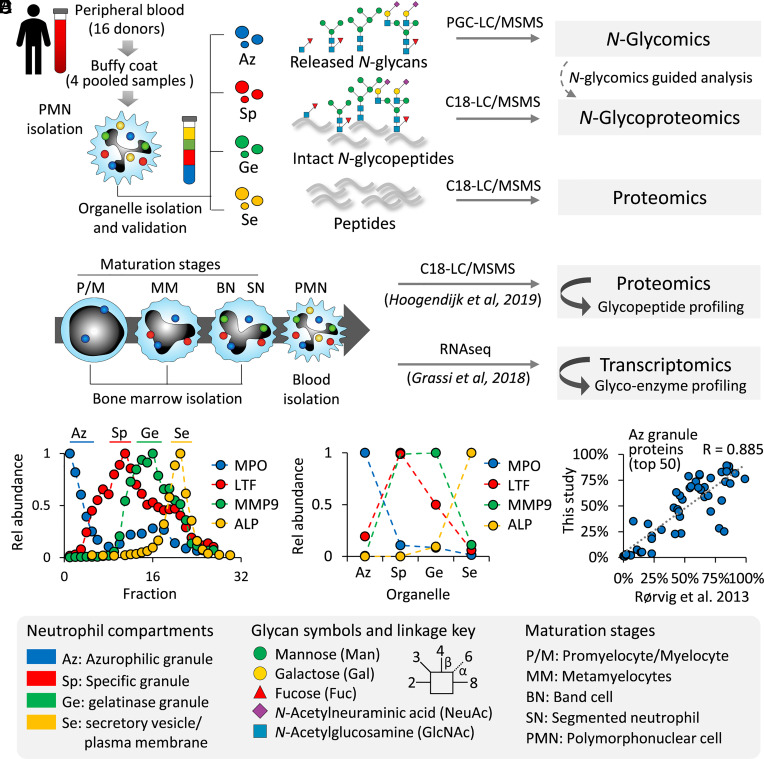
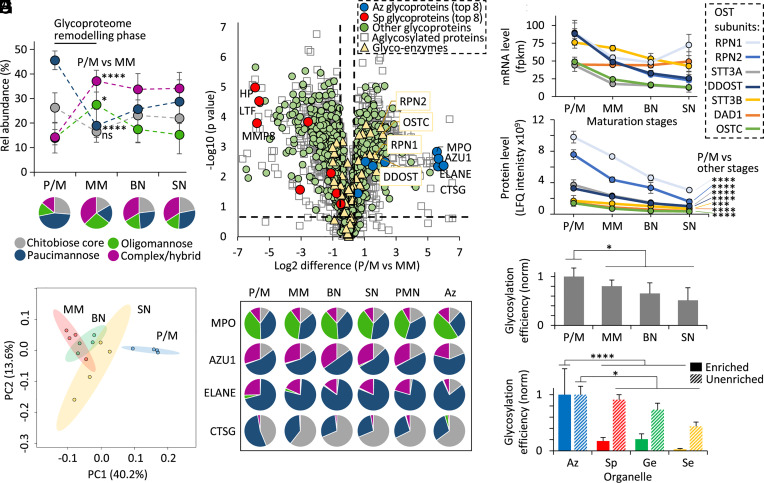
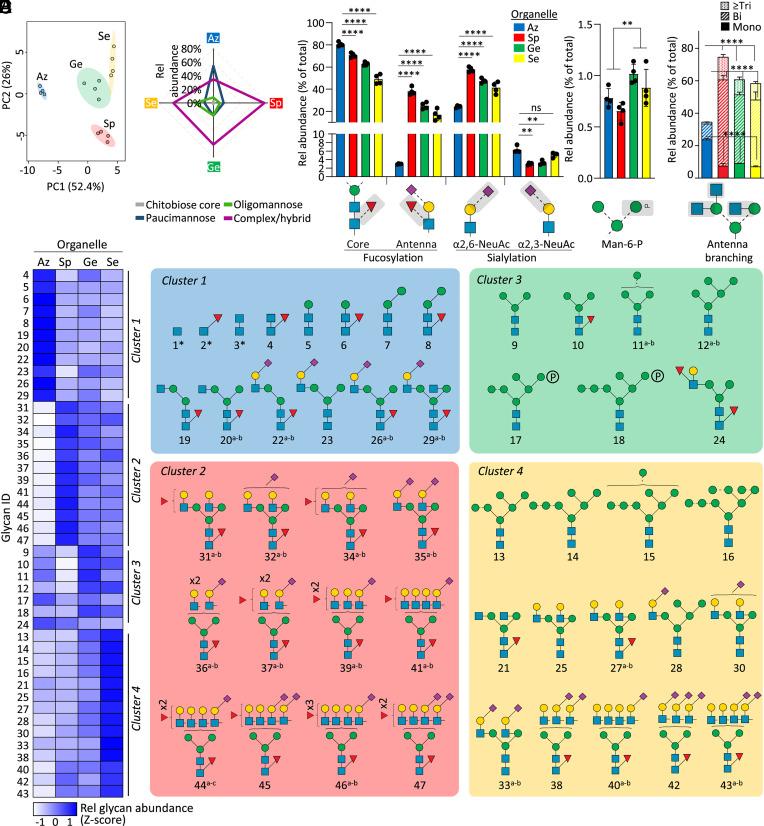
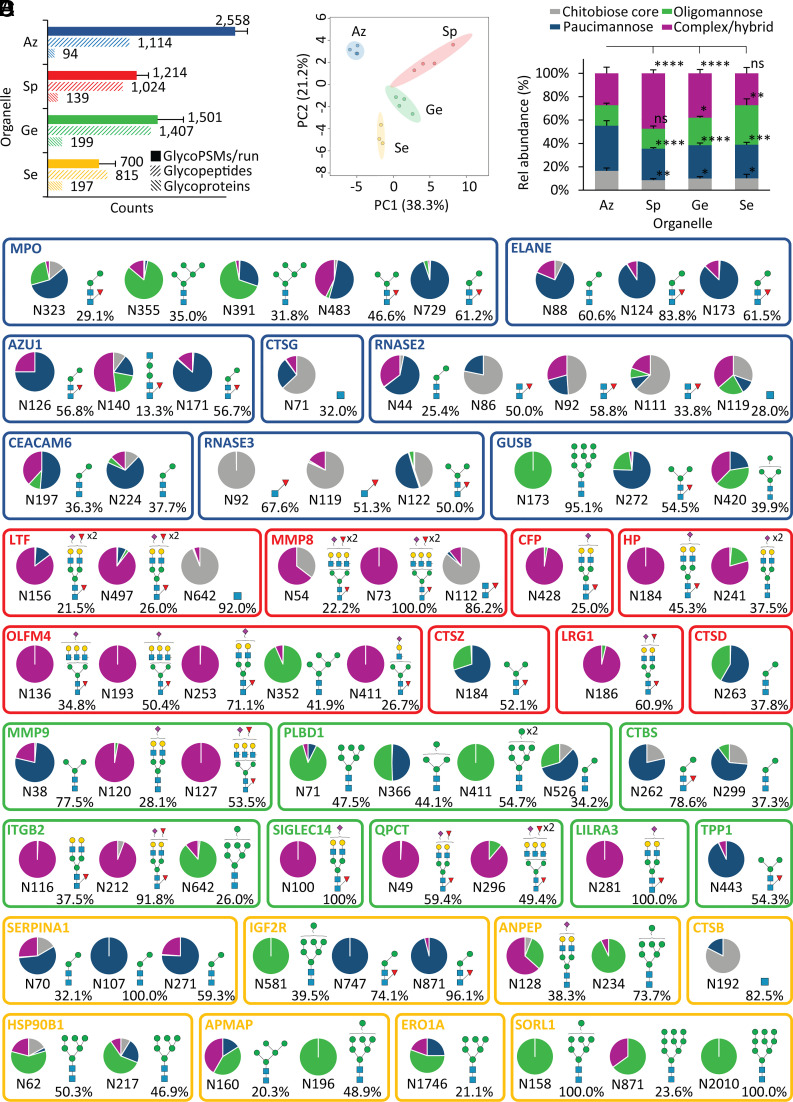
Neutrophils store microbicidal glycoproteins in cytosolic granules to fight intruding pathogens, but their granule distribution and formation mechanism(s) during granulopoiesis remain unmapped. Herein, we comprehensively profile the neutrophil -glycoproteome with spatiotemporal resolution by analyzing four key types of intracellular organelles isolated from blood-derived neutrophils and during their maturation from bone marrow-derived progenitors using a glycomics-guided glycoproteomics approach. Interestingly, the organelles of resting neutrophils exhibited distinctive glycophenotypes including, most strikingly, highly truncated -glycans low in α2,6-sialylation and Lewis fucosylation decorating a diverse set of microbicidal proteins (e.g., myeloperoxidase, azurocidin, neutrophil elastase) in the azurophilic granules. Excitingly, proteomics and transcriptomics data from discrete myeloid progenitor stages revealed that profound glycoproteome remodeling underpins the promyelocytic-to-metamyelocyte transition and that the glycophenotypic differences are driven primarily by dynamic changes in protein expression and less by changes within the glycosylation machinery. Notable exceptions were the oligosaccharyltransferase subunits responsible for initiation of -glycoprotein biosynthesis that were strongly expressed in early myeloid progenitors correlating with relatively high levels of glycosylation of the microbicidal proteins in the azurophilic granules. Our study provides spatiotemporal insights into the complex neutrophil -glycoproteome featuring intriguing organelle-specific -glycosylation patterns formed by dynamic glycoproteome remodeling during the early maturation stages of the myeloid progenitors.
中性粒细胞将杀菌糖蛋白储存在细胞溶质颗粒中以抵御入侵的病原体,但它们的颗粒分布和形成机制在粒细胞生成过程中仍未被描绘。在此,我们通过分析从血液来源的中性粒细胞和骨髓来源的前体细胞中分离的四种关键类型的细胞内细胞器,并使用糖基化导向糖蛋白质组学方法在其成熟过程中进行分析,全面地以时空分辨率描绘了中性粒细胞的糖蛋白组。有趣的是,静止中性粒细胞的细胞器表现出独特的糖表型,最显著的是,高度截断的-α2,6-唾液酸化和 Lewis 岩藻糖基化低聚糖修饰了一系列杀菌蛋白(例如髓过氧化物酶、天青杀素、中性粒细胞弹性蛋白酶)在嗜天青颗粒中。令人兴奋的是,来自离散髓样前体细胞阶段的蛋白质组学和转录组学数据表明,深刻的糖蛋白质组重塑是原始粒细胞向晚幼粒细胞过渡的基础,糖表型差异主要是由蛋白质表达的动态变化驱动的,而不是糖基化机制内的变化。值得注意的例外是负责起始-β-糖蛋白生物合成的寡糖基转移酶亚基,它们在早期髓样祖细胞中强烈表达,与嗜天青颗粒中杀菌蛋白的相对较高水平的糖基化相关。我们的研究提供了时空上的见解,揭示了复杂的中性粒细胞糖蛋白组,其特征是在髓样前体细胞的早期成熟阶段,通过动态糖蛋白质组重塑形成有趣的细胞器特异性-β-糖基化模式。