Chen Xianghui, Chen Zhao, Du Yan, Tian Xuefei, Fu Rongguo
Department of Nephrology, the Second Affiliated Hospital of Xi'an Jiaotong University, Xi'an, China.
Department of Nephrology, the First Affiliated Hospital of Xi'an Medical University, Xi'an, China.
AME Case Rep. 2024 May 27;8:66. doi: 10.21037/acr-23-201. eCollection 2024.
Catheter malfunction is a common problem following the placement of a peritoneal dialysis (PD) catheter, and it is characterized by inadequate dialysate drainage, which can also limit infusion. Common causes include constipation, catheter migration, catheter kinking, omental wrapping, and fibrin obstruction. However, catheter obstruction by other intra-abdominal organs has been observed infrequently.
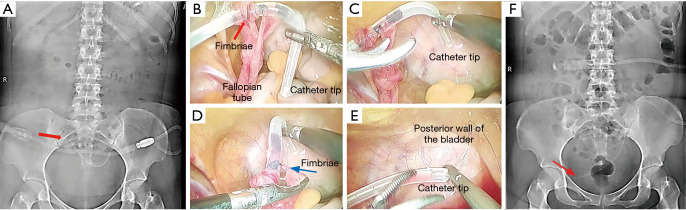
We present two cases of female PD patients experiencing catheter dysfunction after catheter implantation. The first case involves a 28-year-old female who suffered from problematic drainage and infusion of dialysate 1 month after catheter insertion, evidenced by catheter displacement from the pelvis on abdominal X-ray. The second case concerns a 49-year-old female PD patient who also encountered a bidirectional catheter malfunction 40 days post-implantation. Conservative methods failed to restore the catheter function in both patients. Laparoscopic examination revealed fallopian tube, not the omentum, was tightly wrapped around the PD catheter in both cases. Finally, laparoscopic surgery with catheter fixation restored the catheter function, enabling continued continuous ambulatory peritoneal dialysis (CAPD) with favorable outcomes.
Our findings indicate that healthcare providers should consider fallopian tube wrapping as a potential cause of catheter dysfunction. Prompt consideration and utilization of laparoscopy with catheter fixation can play an important role in restoring catheter function and improving patient outcomes.
导管故障是腹膜透析(PD)导管置入后常见的问题,其特征为透析液引流不充分,这也可能限制灌注。常见原因包括便秘、导管移位、导管扭结、网膜包裹和纤维蛋白阻塞。然而,腹腔内其他器官导致的导管阻塞鲜有报道。
我们报告两例女性腹膜透析患者在导管植入后出现导管功能障碍的病例。第一例为一名28岁女性,在导管插入1个月后出现透析液引流和灌注问题,腹部X线显示导管已从盆腔移位。第二例是一名49岁的女性腹膜透析患者,在植入导管40天后也出现了双向导管故障。保守方法未能恢复两名患者的导管功能。腹腔镜检查显示,两例患者的腹膜透析导管均被输卵管而非网膜紧紧包裹。最后,通过腹腔镜手术固定导管恢复了导管功能,使患者能够继续进行持续性非卧床腹膜透析(CAPD),并取得了良好的效果。
我们的研究结果表明,医护人员应将输卵管包裹视为导管功能障碍的潜在原因。及时考虑并采用腹腔镜下导管固定术对于恢复导管功能和改善患者预后具有重要作用。