Slepneva Natalya, Basich-Pease Genevieve, Reid Lee, Frank Adam C, Norbu Tenzin, Krystal Andrew D, Sugrue Leo P, Motzkin Julian C, Larson Paul S, Starr Philip A, Morrison Melanie A, Lee A Moses
Weill Institute for Neurosciences, University of California, San Francisco.
Department of Psychiatry and Behavioral Sciences, University of California, San Francisco.
bioRxiv. 2024 Jul 24:2024.07.21.601827. doi: 10.1101/2024.07.21.601827.
Deep brain stimulation (DBS) of the anterior limb of the internal capsule (ALIC) is an emerging treatment for severe, refractory obsessive-compulsive disorder (OCD). The therapeutic effects of DBS are hypothesized to be mediated by direct modulation of a distributed cortico-striato-thalmo-cortical network underlying OCD symptoms. However, the exact underlying mechanism by which DBS exerts its therapeutic effects still remains unclear.
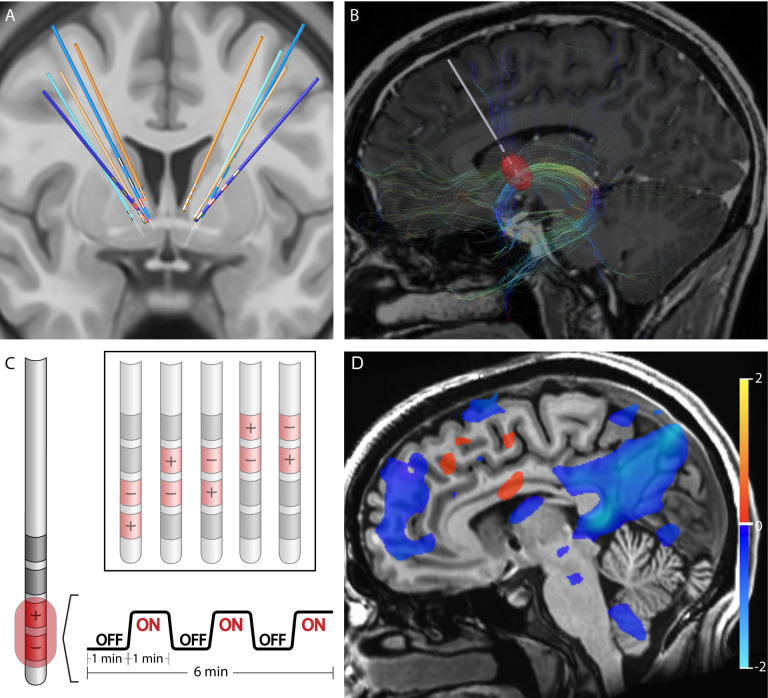
In five participants receiving DBS for severe, refractory OCD (3 responders, 2 non-responders), we conducted a DBS On/Off cycling paradigm during the acquisition of functional MRI to determine the network effects of stimulation across a variety of bipolar configurations. We also performed tractography using diffusion-weighted imaging (DWI) to relate the functional impact of DBS to the underlying structural connectivity between active stimulation contacts and functional brain networks.
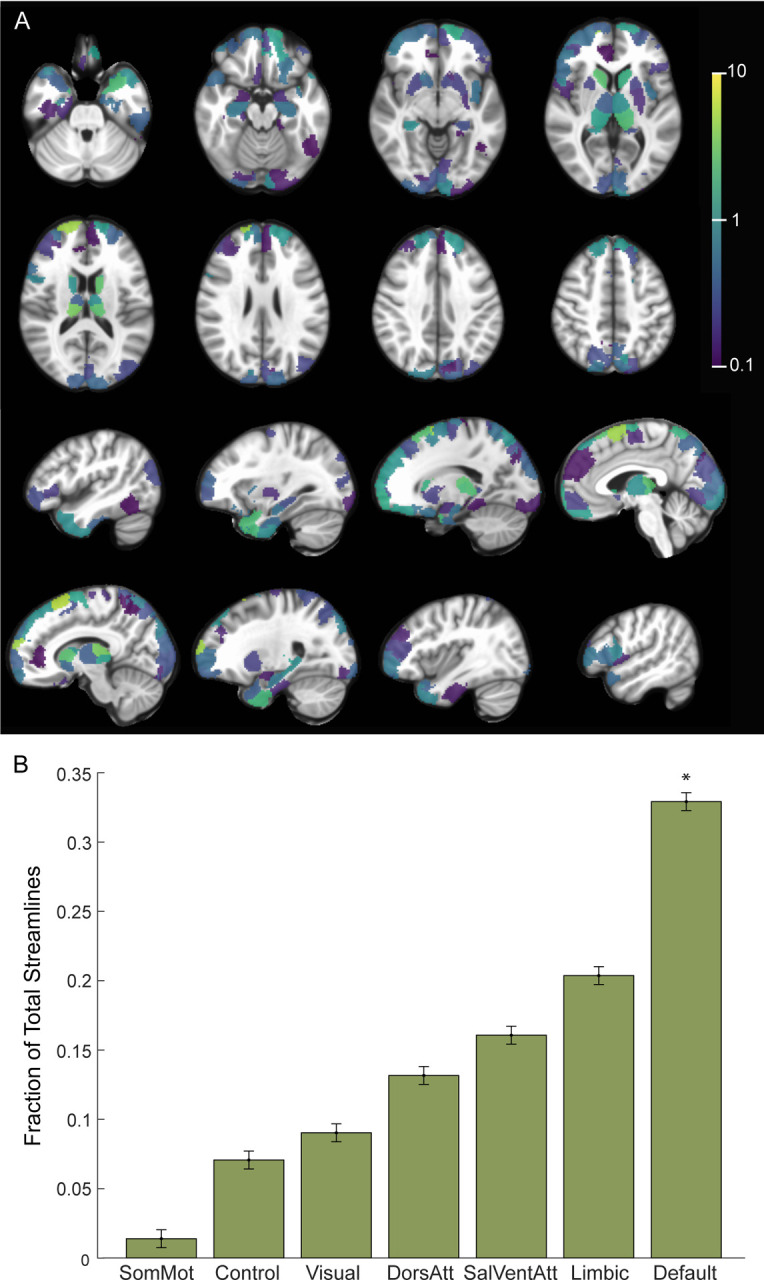
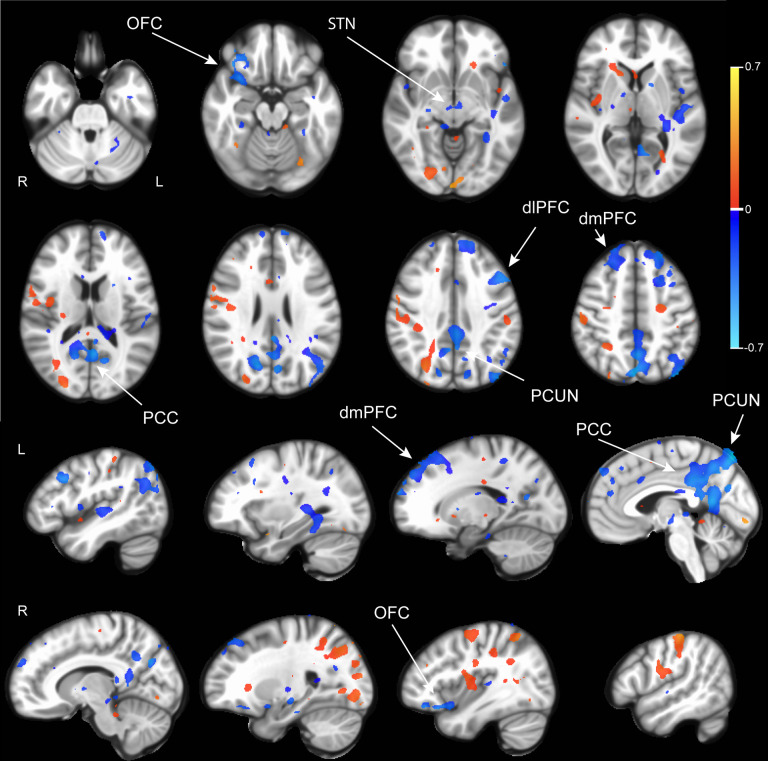
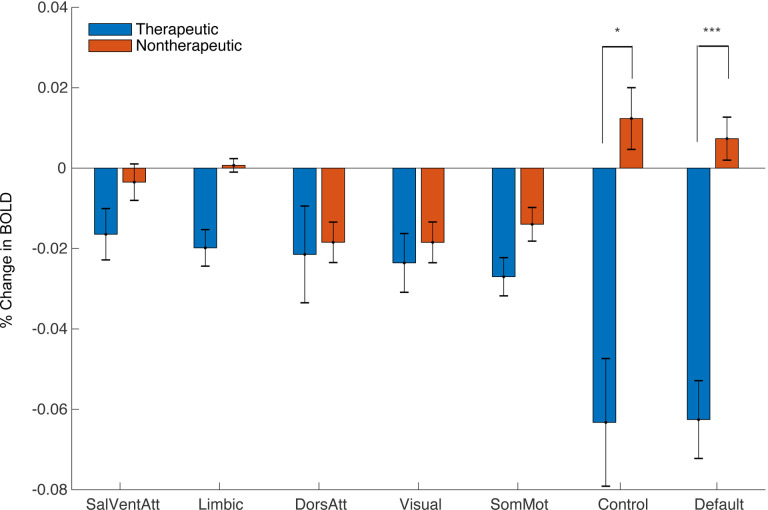
We found that therapeutic DBS had a distributed effect, suppressing BOLD activity within regions such as the orbitofrontal cortex, dorsomedial prefrontal cortex, and subthalamic nuclei compared to non-therapeutic configurations. Many of the regions suppressed by therapeutic DBS were components of the default mode network (DMN). Moreover, the estimated stimulation field from the therapeutic configurations exhibited significant structural connectivity to core nodes of the DMN.
Therapeutic DBS for OCD suppresses BOLD activity within a distributed set of regions within the DMN relative to non-therapeutic configurations. We propose that these effects may be mediated by interruption of communication through structural white matter connections surrounding the DBS active contacts.
内囊前肢(ALIC)的深部脑刺激(DBS)是一种针对重度难治性强迫症(OCD)的新兴治疗方法。DBS的治疗效果被认为是通过直接调节OCD症状背后的分布式皮质-纹状体-丘脑-皮质网络来介导的。然而,DBS发挥其治疗作用的确切潜在机制仍不清楚。
在五名接受DBS治疗重度难治性OCD的参与者(3名有反应者,2名无反应者)中,我们在功能磁共振成像采集期间进行了DBS开/关循环范式,以确定各种双极配置下刺激的网络效应。我们还使用扩散加权成像(DWI)进行了纤维束成像,以将DBS的功能影响与有源刺激触点和功能性脑网络之间的潜在结构连接联系起来。
我们发现,与非治疗性配置相比,治疗性DBS具有分布式效应,可抑制眶额皮质、背内侧前额叶皮质和丘脑底核等区域内的BOLD活动。许多被治疗性DBS抑制的区域是默认模式网络(DMN)的组成部分。此外,治疗性配置的估计刺激场与DMN的核心节点表现出显著的结构连接。
相对于非治疗性配置,用于OCD的治疗性DBS抑制了DMN内一组分布式区域内的BOLD活动。我们提出,这些效应可能是由通过DBS有源触点周围的结构白质连接中断通信介导的。