Kandoor Alekhya, Martinez Gabrielle, Hitchcock Julianna M, Angel Savannah, Campbell Logan, Rizvi Saqib, Naegle Kristen M
Department of Biomedical Engineering and the Center for Public Health Genomics, University of Virginia, Charlottesville, Virginia, United States of America.
bioRxiv. 2024 Jul 22:2024.07.18.604100. doi: 10.1101/2024.07.18.604100.
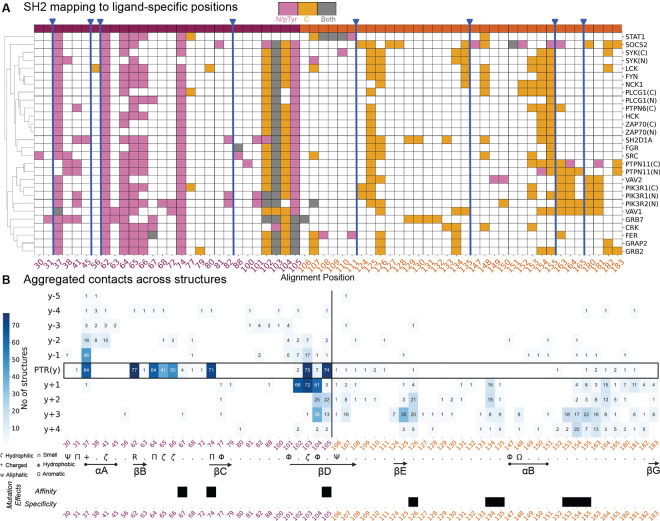
Protein domains are conserved structural and functional units and are the functional building blocks of proteins. Evolutionary expansion means that domain families are often represented by many members in a species, which are found in various configurations with other domains, which have evolved new specificity for interacting partners. Here, we develop a structure-based interface analysis to comprehensively map domain interfaces from available experimental and predicted structures, including interfaces with other macromolecules and intraprotein interfaces (such as might exist between domains in a protein). We hypothesized that a comprehensive approach to contact mapping of domains could yield new insights. Specifically, we use it to gain information about how domains selectivity interact with ligands, whether domain-domain interfaces of repeated domain partnerships are conserved across diverse proteins, and identify regions of conserved post-translational modifications, using relationship to interaction interfaces as a method to hypothesize the effect of post-translational modifications (and mutations). We applied this approach to the human SH2 domain family, an extensive modular unit that is the foundation of phosphotyrosine-mediated signaling, where we identified a novel approach to understanding the binding selectivity of SH2 domains and evidence that there is coordinated and conserved regulation of multiple SH2 domain binding interfaces by tyrosine and serine/threonine phosphorylation and acetylation, suggesting that multiple signaling systems can regulate protein activity and SH2 domain interactions in a regulated manner. We provide the extensive features of the human SH2 domain family and this modular approach, as an open source Python package for COmprehensive Domain Interface Analysis of Contacts (CoDIAC).
蛋白质结构域是保守的结构和功能单位,是蛋白质的功能构建块。进化扩展意味着结构域家族在一个物种中通常由许多成员代表,它们与其他结构域以各种组合形式存在,这些结构域已经进化出与相互作用伙伴的新特异性。在这里,我们开发了一种基于结构的界面分析方法,以全面绘制来自可用实验和预测结构的结构域界面,包括与其他大分子的界面和蛋白质内界面(例如蛋白质中结构域之间可能存在的界面)。我们假设一种全面的结构域接触图谱方法可以产生新的见解。具体而言,我们使用它来获取有关结构域如何选择性地与配体相互作用、重复结构域伙伴关系的结构域 - 结构域界面在不同蛋白质中是否保守的信息,并利用与相互作用界面的关系作为推测翻译后修饰(和突变)影响的方法,识别保守的翻译后修饰区域。我们将这种方法应用于人类SH2结构域家族,这是一个广泛的模块化单元,是磷酸酪氨酸介导信号传导的基础,在那里我们确定了一种理解SH2结构域结合选择性的新方法,并证明酪氨酸和丝氨酸/苏氨酸磷酸化以及乙酰化对多个SH2结构域结合界面存在协调和保守的调节,这表明多个信号系统可以以一种受调控的方式调节蛋白质活性和SH2结构域相互作用。我们提供了人类SH2结构域家族的广泛特征以及这种模块化方法,作为一个用于接触的综合结构域界面分析(CoDIAC)的开源Python包。