Paolicelli Damiano, Borriello Giovanna, Clerici Raffaella, Colombo Elena, Croce Davide, D'Amico Emanuele, De Rossi Nicola, Di Sapio Alessia, Fenu Giuseppe, Maimone Davide, Marfia Girolama A, Moccia Marcello, Perini Paola, Piscaglia Maria G, Razzolini Lorenzo, Riccaboni Massimo, Signoriello Elisabetta, Agostoni Gianluca, Farina Alberto, Mondino Margaret, Berruto Francesco, Tettamanti Alessia, Donnaloja Francesca, Tortorella Carla
Department of Translational Biomedicines and Neurosciences, University of Bari Aldo Moro, Bari, Italy.
Multiple Sclerosis Center, San Pietro Fatebenefratelli Hospital, Rome, Italy.
Neurol Ther. 2024 Oct;13(5):1415-1430. doi: 10.1007/s40120-024-00644-3. Epub 2024 Aug 2.
Multiple sclerosis (MS) is a chronic neurodegenerative disease that leads to impaired cognitive function and accumulation of disability, with significant socioeconomic burden. Serious unmet need in the context of managing MS has given rise to ongoing research efforts, leading to the launch of new drugs planned for the near future, and subsequent concerns about the sustainability of healthcare systems. This study assessed the changes in the Italian MS market and their impact on the expenditures of the Italian National Healthcare Service between 2023 and 2028.
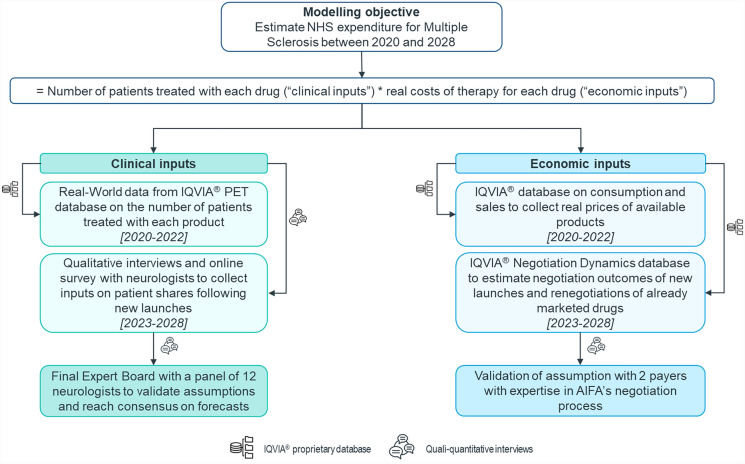
A horizon-scanning model was developed to estimate annual expenditure from 2023 to 2028. Annual expenditure for MS was calculated by combining the number of patients treated with each product (clinical inputs) and the yearly costs of therapy (economic inputs). Baseline inputs (2020-2022) were collected from IQVIA real-world data, while input estimation for the 5-year forecast was integrated with analog analyses and the insights of clinicians and former payers.
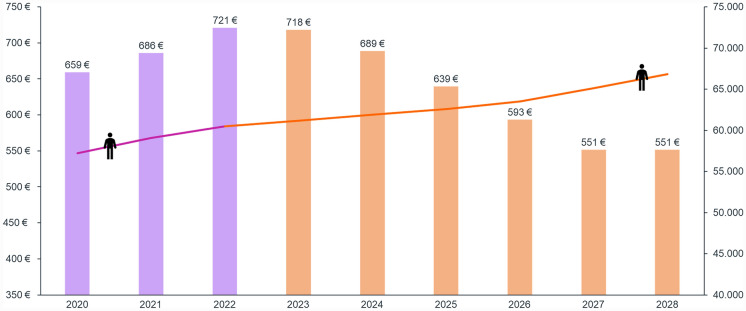
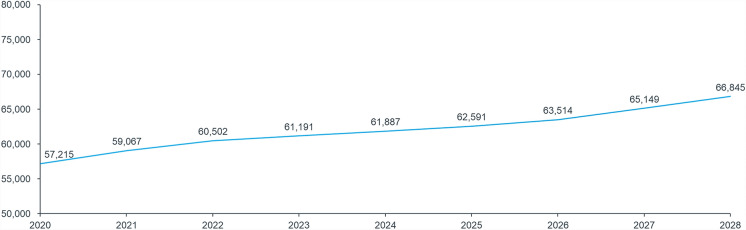
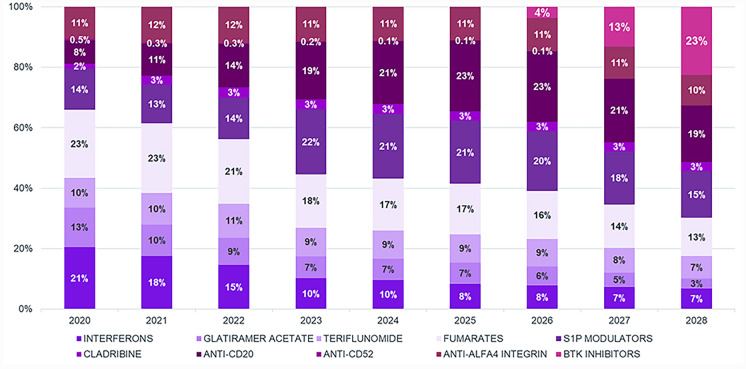
The number of equivalent patients treated in 2028 in Italy was estimated at around 67,000, with an increase of 10% versus 2022. In terms of treatment pattern evolution, first-line treatments are expected to reduce their shares from 47% in 2022 to 27% in 2028, and Bruton tyrosine kinase inhibitors are expected to reach 23% of patient shares. Overall, expenditure for MS is estimated to decrease from €721 million in 2022 to €551 million in 2028, mainly due to losses of exclusivity and renegotiation of drug prices.
Despite the increase in the number of patients treated for MS and the launch of new molecules that will reach high market penetration, the model confirmed sustainability for the Italian National Healthcare Service.
多发性硬化症(MS)是一种慢性神经退行性疾病,会导致认知功能受损和残疾累积,带来巨大的社会经济负担。在多发性硬化症管理方面存在严重未满足的需求,这引发了持续的研究努力,促成了计划在不久的将来推出新药,以及随后对医疗保健系统可持续性的担忧。本研究评估了2023年至2028年意大利多发性硬化症市场的变化及其对意大利国家医疗服务支出的影响。
开发了一种前瞻性扫描模型来估计2023年至2028年的年度支出。通过结合每种产品治疗的患者数量(临床投入)和年度治疗成本(经济投入)来计算多发性硬化症的年度支出。基线投入(2020 - 2022年)从艾昆纬的真实世界数据中收集,而5年预测的投入估计则与类比分析以及临床医生和前支付方的见解相结合。
预计2028年意大利接受等效治疗的患者数量约为67,000人,与2022年相比增加了10%。在治疗模式演变方面,一线治疗预计将其份额从2022年的47%降至2028年的27%,布鲁顿酪氨酸激酶抑制剂预计将达到患者份额的2