Division of Noncommunicable Diseases (NCD), Indian Council of Medical Research (ICMR) - National Institute of Epidemiology (NIE), Chennai, India.
India Hypertension Control Initiative (IHCI) Project, District NCD Cell, World Health Organization (WHO), Pune, India.
BMC Health Serv Res. 2024 Aug 2;24(1):884. doi: 10.1186/s12913-024-11354-9.
The India Hypertension Control Initiative (IHCI) emphasizes decentralized patient-centric care to boost hypertension control in public healthcare facilities. We documented the decentralization process, enrolment pattern by facility type, and treatment outcomes in nine districts of Punjab and Maharashtra states, India, from 2018-2022.
We detailed the shift in hypertension care from higher facilities to Health and Wellness Centres (HWCs) using the World Health Organization (WHO) health system pillar framework. We reviewed hypertension treatment records in 4,045 public facilities from nine districts in the two states, focusing on indicators including registration numbers, the proportion of controlled, uncontrolled blood pressure (BP), and missed visits among those under care.
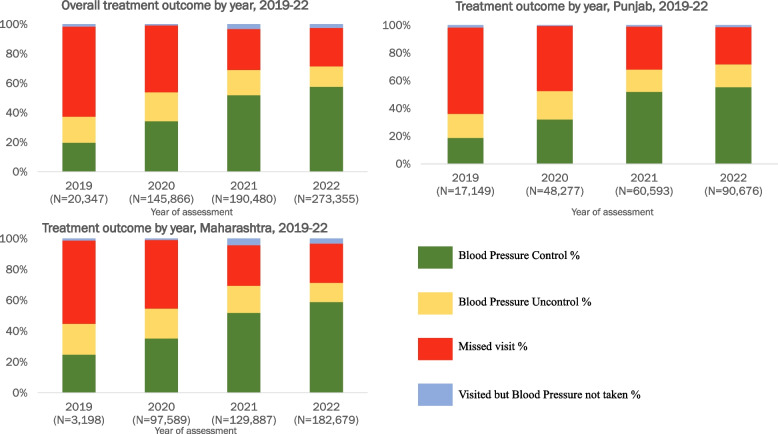
The decentralization process involved training, treatment protocol provision, supervision, and monitoring. Among 394,038 individuals registered with hypertension from 2018-2021, 69% were under care in 2022. Nearly half of those under care (129,720/273,355) received treatment from HWCs in 2022. Care of hypertensive individuals from district hospitals (14%), community health centres (20%), and primary health centres (24%) were decentralized to HWCs. Overall BP control rose from 20% (4,004/20,347) in 2019 to 58% (157,595/273,355) in 2022, while missed visits decreased from 61% (12,394/20,347) in 2019 to 26% (70,894/273,355) in 2022. This trend was consistent in both states. HWCs exhibited the highest BP control and the lowest missed visits throughout the study period compared to other facility types.
We documented an increase in decentralized access to hypertension treatment and improved treatment outcomes over four years. We recommend operationalizing hypertension care at HWCs to other districts in India to improve BP control.
印度高血压控制倡议(IHCI)强调去中心化的以患者为中心的护理,以提高公共医疗设施中的高血压控制水平。我们记录了 2018-2022 年期间印度旁遮普邦和马哈拉施特拉邦九个地区的去中心化过程、按设施类型进行的登记模式以及治疗结果。
我们使用世界卫生组织(WHO)卫生系统支柱框架详细说明了高血压护理从较高设施向健康与保健中心(HWCs)的转移。我们审查了来自这两个邦的九个地区的 4045 个公共设施的高血压治疗记录,重点关注登记人数、控制血压(BP)比例、未控制血压比例和受照顾人群中的漏诊率等指标。
去中心化过程涉及培训、治疗方案提供、监督和监测。在 2018-2021 年间登记的 394038 名高血压患者中,2022 年有 69%在接受治疗。在 2022 年接受治疗的患者中,近一半(129720/273355)来自 HWCs。来自地区医院(14%)、社区卫生中心(20%)和初级保健中心(24%)的高血压患者的护理被分散到 HWCs。整体血压控制从 2019 年的 20%(4004/20347)上升到 2022 年的 58%(157595/273355),而漏诊率从 2019 年的 61%(12394/20347)下降到 2022 年的 26%(70894/273355)。这一趋势在两个邦都很一致。与其他设施类型相比,HWCs 在整个研究期间显示出最高的血压控制率和最低的漏诊率。
我们记录了四年中高血压治疗的去中心化程度增加和治疗结果的改善。我们建议在印度其他地区将高血压护理纳入 HWCs 以提高血压控制率。