Chengdu Women's and Children's Central Hospital, School of Medicine, University of Electronic Science and Technology of China, Chengdu, 611731, China.
School of Nursing, Chengdu university, Chengdu, China.
J Orthop Surg Res. 2024 Aug 2;19(1):461. doi: 10.1186/s13018-024-04960-0.
Trigger thumb is a prevalent hand condition observed in children, and its management remains a topic of considerable debate, ranging from mere observation to surgical intervention. In recent times, there has been a growing interest in exploring nonoperative treatments as alternatives to surgical procedures for managing pediatric trigger thumb. Gaining insight into the prevalence of spontaneous resolution in pediatric trigger thumb is of paramount importance. However, the literature presents a wide variation in estimates regarding the prevalence of this spontaneous resolution, highlighting the need for further investigation and consensus. The aim of this review was to estimate the overall prevalence of spontaneous resolution among pediatric trigger thumb.
This study meticulously followed the PRISMA guidelines and registered in the PROSPERO. The PubMed, Embase, and Cochrane Library databases were searched for all relevant studies up to May 2024.Inclusion criteria were studies reported only observation spontaneous resolution pediatric trigger thumb, aged up to 14 years, reported at least 10 thumbs and followed up time at least 3 months. Confounded intervention treatment measure studies were excluded. To synthesize the prevalence rates from individual studies, we employed a random-effects meta-analysis. In order to uncover the sources of heterogeneity and to compare prevalence estimates across different groups, we performed sensitivity and subgroup analyses. To meticulously evaluate the quality of the included studies, the Joanna Briggs Institute's quality assessment checklist was employed. Furthermore, to assess the heterogeneity among the studies, both Cochran's Q test and the I² statistic were utilized.
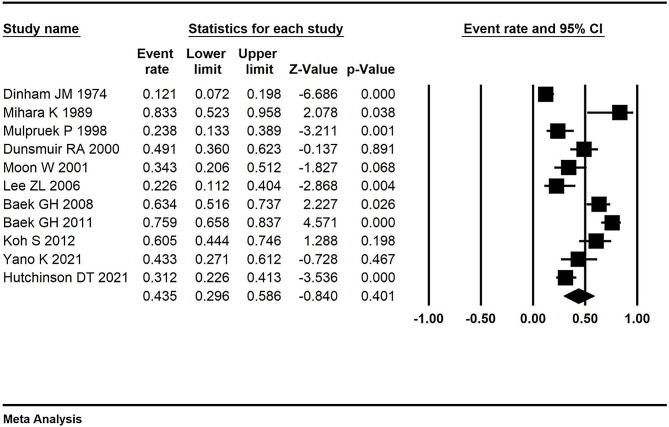
A total of eleven studies were included for the final analysis, with 599 pediatric trigger thumbs. Our final meta-analysis showed that more than one-third of these pediatric trigger thumb cases resolved spontaneously, with a resolution rate of 43.5% (95% CI 29.6-58.6). Subgroup analyses showed that in terms of age at the first visit, the prevalence of spontaneous resolution in the less than 24 months group and in the 24 months or older group was 38.7%(95% CI 18.1-64.4)and 45.8%(95% CI 27.4-65.4), respectively. There was no significant difference between the two groups(P = 0.690). When analyzing follow up time, the prevalence of spontaneous resolution in the 24 months or longer group and in the less than 24 months group was 58.9%(95% CI 41.6-74.2)and 26.8%(95% CI 14.7-43.8), respectively.There was significant statistical differences between the two groups(P = 0.009). Based on the initial severity of interphalangeal (IP) joint flexion contracture, the prevalence of spontaneous resolution in the 30 degrees or less group and in the other measurements group was 54.1%(95% CI 31.5-75.1)and 37.1%(95% CI 21.9-55.4), respectively.There was no significant difference between the two groups(P = 0.259).
Our study demonstrates that a significant proportion of pediatric trigger thumbs resolve spontaneously. This finding highlights the benefits of early observation in managing this condition. By prioritizing non-operative observation, both parents and surgeons are better equipped to make informed decisions regarding the treatment of pediatric trigger thumb, potentially reducing the need for surgical intervention.

扳机指是儿童中常见的手部疾病,其治疗方法一直是一个备受争议的话题,从单纯观察到手术干预都有。最近,人们越来越关注探索非手术治疗作为小儿扳机指手术治疗的替代方法。了解小儿扳机指自然缓解的发生率至关重要。然而,文献中关于这种自然缓解发生率的估计存在很大差异,这突显了进一步研究和达成共识的必要性。本综述的目的是评估小儿扳机指自然缓解的总体发生率。
本研究严格遵循 PRISMA 指南,并在 PROSPERO 中进行了注册。检索了 PubMed、Embase 和 Cochrane Library 数据库,以获取截至 2024 年 5 月的所有相关研究。纳入标准为仅报告观察性自然缓解的小儿扳机指的研究,年龄在 14 岁以下,至少报告了 10 个拇指,并随访时间至少 3 个月。排除混杂干预治疗措施的研究。为了从个体研究中综合发生率,我们采用了随机效应荟萃分析。为了揭示异质性的来源,并比较不同组之间的发生率估计,我们进行了敏感性和亚组分析。为了仔细评估纳入研究的质量,我们使用了 Joanna Briggs 研究所的质量评估清单。此外,我们使用 Cochran's Q 检验和 I² 统计量来评估研究之间的异质性。
共有 11 项研究纳入最终分析,涉及 599 例小儿扳机指。我们的最终荟萃分析显示,这些小儿扳机指中有超过三分之一自发缓解,缓解率为 43.5%(95%CI 29.6-58.6)。亚组分析显示,就首次就诊时的年龄而言,小于 24 个月组和 24 个月或以上组的自然缓解发生率分别为 38.7%(95%CI 18.1-64.4)和 45.8%(95%CI 27.4-65.4),两组之间无显著差异(P=0.690)。当分析随访时间时,24 个月或以上组和小于 24 个月组的自然缓解发生率分别为 58.9%(95%CI 41.6-74.2)和 26.8%(95%CI 14.7-43.8),两组之间有显著的统计学差异(P=0.009)。根据指间关节(IP)屈曲挛缩的初始严重程度,30 度或以下组和其他测量组的自然缓解发生率分别为 54.1%(95%CI 31.5-75.1)和 37.1%(95%CI 21.9-55.4),两组之间无显著差异(P=0.259)。
我们的研究表明,相当一部分小儿扳机指会自发缓解。这一发现强调了在管理这种疾病时早期观察的益处。通过优先选择非手术观察,父母和外科医生都能够更好地做出关于小儿扳机指治疗的知情决策,可能减少手术干预的需求。