Yuan Tian-Jun, Luo Hong-Mei, Su Kai-Mei, Li Shu-Hong, Raspé Olivier
School of Science, Mae Fah Luang University, Chiang Rai 57100, Thailand Mae Fah Luang University Chiang Rai Thailand.
Institute of Biotechnology and Germplasm Resources, Yunnan Academy of Agricultural Sciences, Kunming 650223, Yunnan, China Institute of Biotechnology and Germplasm Resources, Yunnan Academy of Agricultural Sciences Kunming China.
MycoKeys. 2024 Jul 26;107:141-160. doi: 10.3897/mycokeys.107.123565. eCollection 2024.
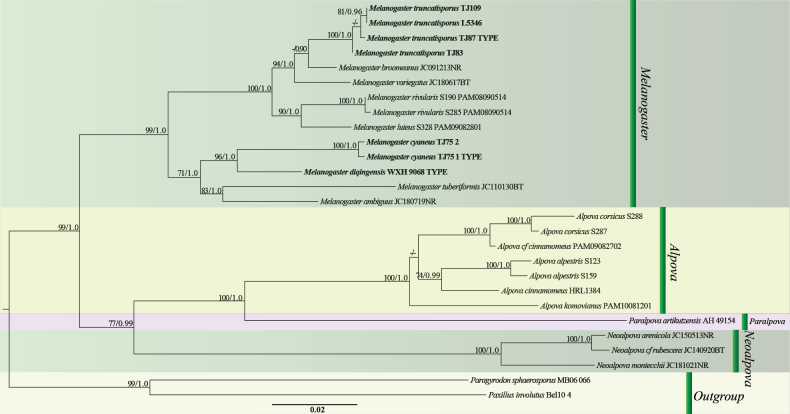
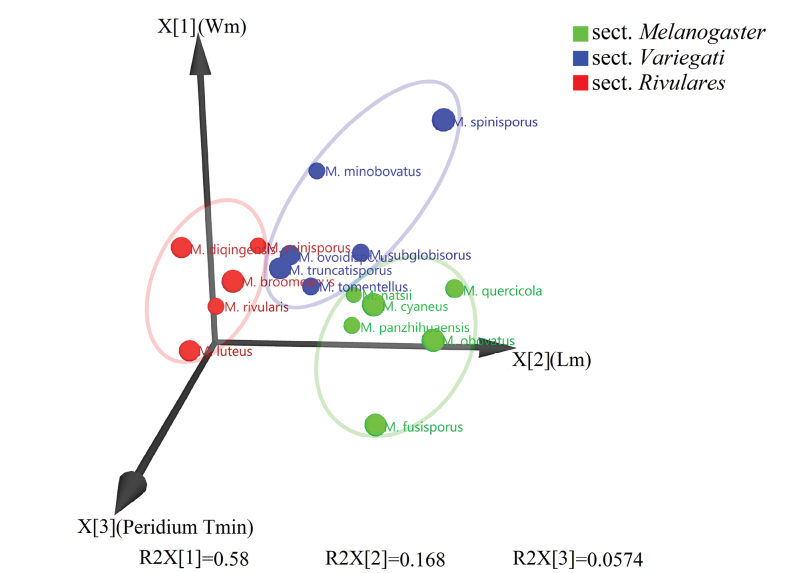
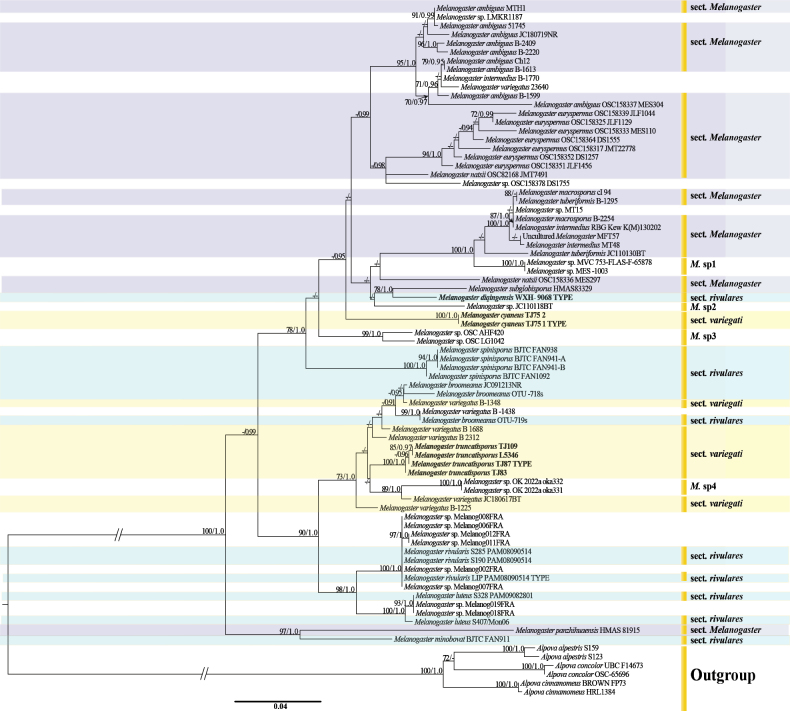
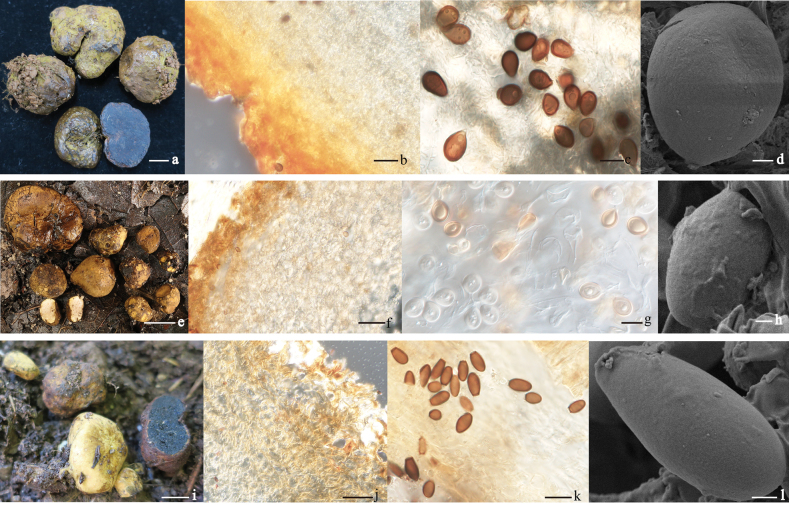
Three newly discovered species, namely , , and , are introduced and illustrated based on both morphological and molecular data from Sichuan and Yunnan provinces in China. A multigene phylogenetic analysis (nrITS, nrLSU, and ) was performed mainly to verify the placement of the new species in . A second, nrITS-only phylogenetic analysis comprising more species for which only ITS sequences were available, was used to infer the relationship between the new species and as many known species as possible. Specimens of , , and formed three independent clades in a phylogenetic tree inferred from the ITS data set. The robust support from ITS for these clades and genetic similarity with other species being lower than 93.2% suggest that these three species are indeed distinct from the other species in the phylogeny. Morphologically, is characterized by its blue or bluish gleba, light brown to yellowish brown peridium, and subglobose to globose basidiospores, 6.2-15 × 4.6-9.0 μm. is distinguished from other species by its pale yellow to brown-yellow peridium and obovate to subglobose basidiospores, 3.0-5.1 × 2.0-4.0 μm. is diagnosed by its subglobose to globose or irregularly elongate-pyriform basidiomata, pale yellow to deeply orange-yellow peridium, and subglobose to globose or pyriform, truncate basidiospores. Additionally, infrageneric classification based on the number of peridium layers, the average thickness of the peridium, and the average length and width of basidiospores was tested with , , and . Orthogonal partial least squares discriminant (OPLS-DA) analysis placed the three new species within the , , and sections, respectively. However, the morphologically circumscribed sections were not monophyletic in the phylogenetic tree. Therefore, the current infrageneric classification should be abandoned.
基于来自中国四川和云南省的形态学和分子数据,介绍并阐述了三个新发现的物种,即[物种名1]、[物种名2]和[物种名3]。进行了多基因系统发育分析(nrITS、nrLSU和[基因名]),主要目的是验证新物种在[属名]中的位置。第二次分析仅基于nrITS,纳入了更多仅ITS序列可用的物种,用于推断新物种与尽可能多的已知[属名]物种之间的关系。在从ITS数据集推断出的系统发育树中,[物种名1]、[物种名2]和[物种名3]的标本形成了三个独立的分支。ITS对这些分支的有力支持以及与其他物种的遗传相似性低于93.2%,表明这三个物种在系统发育中确实与其他[属名]物种不同。在形态学上,[物种名1]的特征是其蓝色或蓝绿色的孢体、浅棕色至黄棕色的包被以及近球形至球形的担孢子,大小为6.2 - 15×4.6 - 9.0μm。[物种名2]与其他[属名]物种的区别在于其浅黄色至棕黄色的包被以及倒卵形至近球形的担孢子,大小为3.0 - 5.1×2.0 - 4.0μm。[物种名3]的诊断特征为其近球形至球形或不规则伸长梨形的担子果、浅黄色至深橙黄色的包被以及近球形至球形或梨形、截形的担孢子。此外,基于包被层数、包被平均厚度以及担孢子的平均长度和宽度对[属名]进行的属下分类,在[物种名1]、[物种名2]和[物种名3]上进行了测试。正交偏最小二乘判别分析(OPLS - DA)将这三个新物种分别置于[属内分类单元1]、[属内分类单元2]和[属内分类单元3]组中。然而,在系统发育树中,形态学界定的组并非单系类群。因此,当前的属下分类应该摒弃。