Fueyo Álvaro, Sánchez Omar, Carleos Carlos, Escudero Amando, Cordón Javier, Granero-Castro Javier, Borrell Yaisel Juan
Environment and Sustainability Area, Taxus Medio Ambiente Oviedo Spain.
Department of Functional Biology, Genetics University of Oviedo Oviedo Spain.
Ecol Evol. 2024 Aug 1;14(8):e70110. doi: 10.1002/ece3.70110. eCollection 2024 Aug.
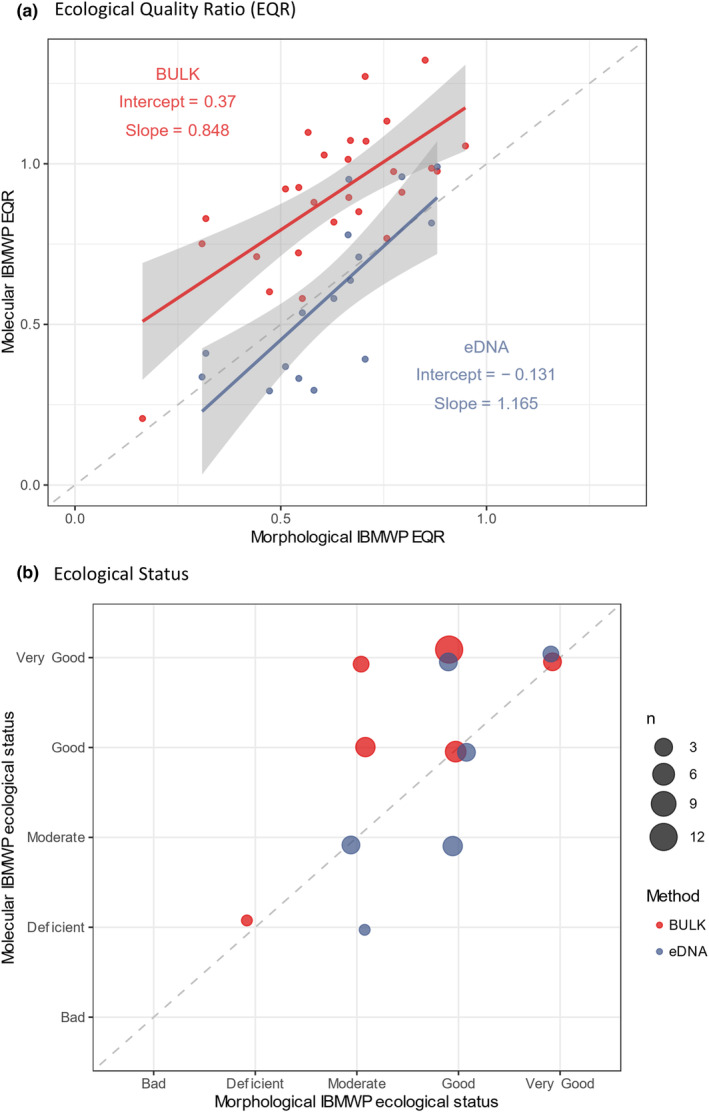
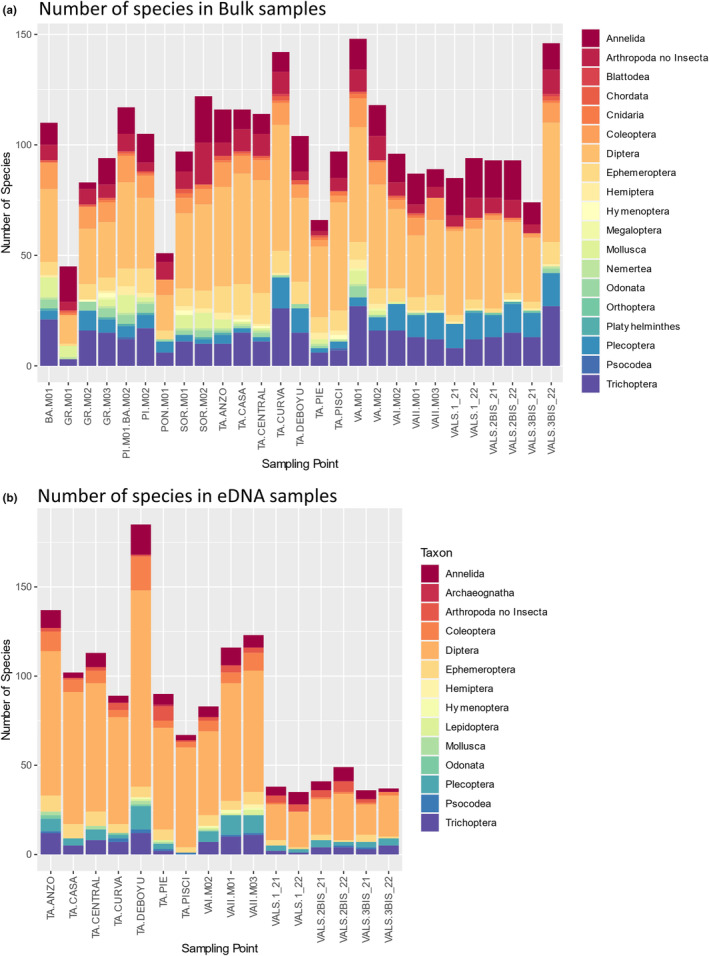
Rivers are crucial ecosystems supporting biodiversity and human well-being, yet they face increasing degradation globally. Traditional river biomonitoring methods based on morphological identification of macroinvertebrates present challenges in terms of taxonomic resolution and scalability. This study explores the application of DNA metabarcoding analysis in both bulk and environmental DNA (eDNA) samples for comprehensive assessment of macrozoobenthic biodiversity, detection of invasive and endangered species, and evaluation of river ecological status in northwestern Spain. DNA metabarcoding of homogenized bulk samples and water eDNA revealed a mean of 100 and 87 macrozoobenthos species per sample respectively. However, the specific composition was significantly different with only 27.3% of the total species being shared. It was not possible to identify all the OTUs to species level; only 17.43% and 49.4% of the OTUs generated could be identified to species level in the bulk and eDNA samples, respectively. Additionally, a total of 11 exotic species (two first records for the Iberian Peninsula and another three first records for Asturias region) and one endangered species were detected by molecular tools. Molecular methods showed significant correlations with morphological identification for EQR values (Ecological Quality Ratio) of IBMWP index, yet differences in inferred river ecological status were noted, with bulk samples tending to indicate higher status. Overall, DNA metabarcoding offers a promising approach for river biomonitoring, providing insights into biodiversity, invasive species, and ecological status within a single analysis. Further optimization and intercalibration are required for its implementation in routine biomonitoring programmes, but its scalability and multi-tasking capabilities position it as a valuable tool for integrated monitoring of river ecosystems.
河流是支持生物多样性和人类福祉的关键生态系统,但全球范围内它们正面临日益严重的退化。基于大型无脊椎动物形态学鉴定的传统河流生物监测方法在分类分辨率和可扩展性方面存在挑战。本研究探索了DNA宏条形码分析在混合样本和环境DNA(eDNA)样本中的应用,以全面评估大型底栖动物的生物多样性、检测入侵和濒危物种,并评估西班牙西北部河流的生态状况。对均质化混合样本和水体eDNA进行的DNA宏条形码分析显示,每个样本平均分别有100种和87种大型底栖动物。然而,具体组成存在显著差异,共有物种仅占27.3%。无法将所有操作分类单元(OTUs)鉴定到物种水平;在混合样本和eDNA样本中,分别只有17.43%和49.4%的生成OTUs能够鉴定到物种水平。此外,通过分子工具共检测到11种外来物种(两种为伊比利亚半岛首次记录,另外三种为阿斯图里亚斯地区首次记录)和1种濒危物种。分子方法与IBMWP指数的生态质量比(EQR)值的形态学鉴定显示出显著相关性,但在推断的河流生态状况方面存在差异,混合样本往往显示出更高的状况。总体而言,DNA宏条形码分析为河流生物监测提供了一种有前景的方法,可在一次分析中深入了解生物多样性、入侵物种和生态状况。在常规生物监测计划中实施时,需要进一步优化和相互校准,但其可扩展性和多任务能力使其成为河流生态系统综合监测的宝贵工具。