Xia Yiqing, Caya Chelsea, Morin Véronique, Singh Ameeta E, Serhir Bouchra, Libman Michael, Goldfarb David M, Wong Tom, Xiu Fanyu, Bélanger Richard, Touchette Jean-Sébastien, Yansouni Cédric P, Maheu-Giroux Mathieu
Department of Epidemiology and Biostatistics, School of Population and Global Health, McGill University, Montréal, Québec, Canada.
Research Institute of the McGill University Health Centre, Montréal, Québec, Canada.
Lancet Reg Health Am. 2024 Jul 20;37:100845. doi: 10.1016/j.lana.2024.100845. eCollection 2024 Sep.
Canadian Arctic communities have experienced sustained syphilis transmission, with diagnoses rates 18-times higher than the national average. Remoteness from laboratory facilities leads to delays between syphilis screening and treatment, contributing to onward transmission. Rapid diagnostic tests can eliminate treatment delays via testing at the point-of-care. This study aims to describe syphilis diagnostic gaps and to estimate the impact of introducing rapid diagnostic tests at the point-of-care on syphilis transmission.
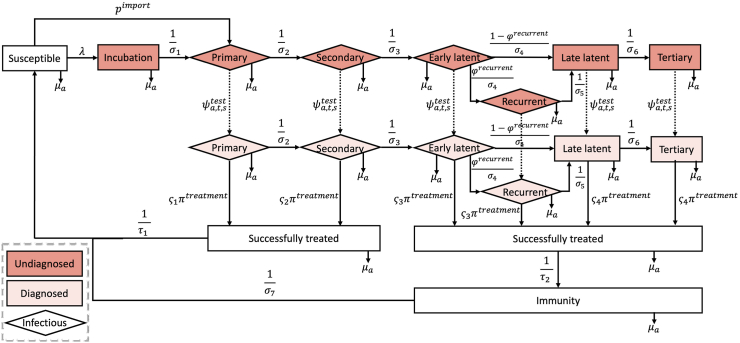
To assess the population-level impact of deploying rapid diagnostic tests, an individual-based model was developed using detailed surveillance data, population surveys, and a prospective diagnostic accuracy field study. The model was calibrated to syphilis diagnoses (2017-2022) from a community of approximately 1,050 sexually active individuals. The impacts of implementing rapid diagnostic tests using whole blood (sensitivity: 92% for infectious and 81% for non-infectious syphilis; specificity: 99%) from 2023 onward was calculated using the annual median fraction of cumulative new syphilis infections averted over 2023-2032.
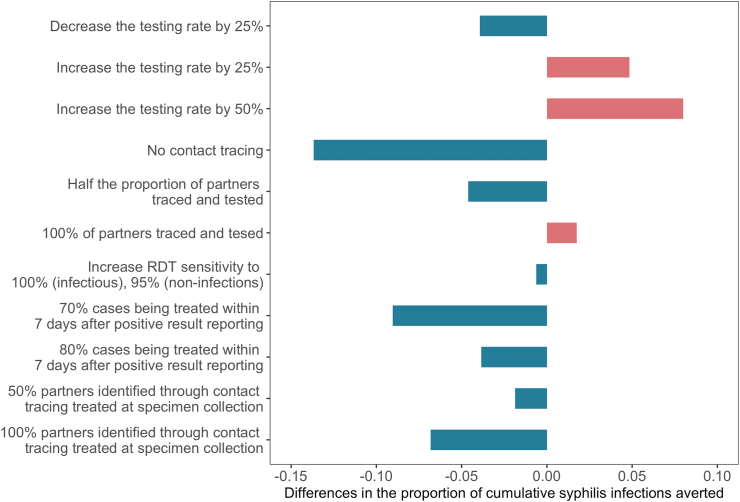
The median modeled syphilis incidence among sexually active individuals was 44 per 1,000 in 2023. Males aged 16-30 years exhibited a 51% lower testing rate than that of their female counterparts. Maintaining all interventions constant at their 2022 levels, implementing rapid diagnostic tests could avert a cumulative 33% (90% credible intervals: 18-43%) and 37% (21-46%) of new syphilis infections over 5 and 10 years, respectively. Increasing testing rates and contact tracing may enhance the effect of rapid diagnostic tests.
Implementing rapid diagnostic tests for syphilis in Arctic communities could reduce infections and enhance control of epidemics. Such effective diagnostic tools could enable rapid outbreak responses by providing same-day testing and treatment at the point-of-care.
Canadian Institutes of Health Research.
加拿大北极地区的社区梅毒传播持续存在,诊断率比全国平均水平高18倍。由于距离实验室设施较远,梅毒筛查和治疗之间会出现延迟,这助长了疾病的进一步传播。快速诊断测试可以通过即时检测消除治疗延迟。本研究旨在描述梅毒诊断方面的差距,并估计在即时护理点引入快速诊断测试对梅毒传播的影响。
为评估部署快速诊断测试对人群层面的影响,利用详细的监测数据、人口调查和一项前瞻性诊断准确性现场研究开发了一个基于个体的模型。该模型根据一个约有1050名性活跃个体的社区的梅毒诊断情况(2017 - 2022年)进行了校准。使用2023 - 2032年期间避免的累积新梅毒感染的年度中位数比例,计算了从2023年起使用全血进行快速诊断测试(敏感性:感染性梅毒为92%,非感染性梅毒为81%;特异性:99%)的影响。
2023年性活跃个体中梅毒发病率的模拟中位数为每1000人中有44例。16 - 30岁的男性检测率比女性低51%。在所有干预措施维持在2022年水平不变的情况下,实施快速诊断测试在5年和10年内分别可避免33%(90%可信区间:18 - 43%)和37%(21 - 46%)的新梅毒感染。提高检测率和接触者追踪可能会增强快速诊断测试的效果。
在北极社区实施梅毒快速诊断测试可以减少感染并加强疫情控制。这种有效的诊断工具可以通过在即时护理点提供当日检测和治疗来实现对疫情的快速应对。
加拿大卫生研究院。