Nakajima Tadashi, Tamura Shuntaro, Kawabata-Iwakawa Reika, Itoh Hideki, Hasegawa Hiroshi, Kobari Takashi, Harasawa Shun, Sekine Akiko, Nishiyama Masahiko, Kurabayashi Masahiko, Imoto Keiji, Kaneko Yoshiaki, Nakatani Yosuke, Horie Minoru, Ishii Hideki
Department of Cardiovascular Medicine, Gunma University Graduate School of Medicine, Maebashi, Japan.
Division of Integrated Oncology Research, Gunma University Initiative for Advanced Research, Maebashi, Japan.
Front Physiol. 2024 Jul 19;15:1401822. doi: 10.3389/fphys.2024.1401822. eCollection 2024.
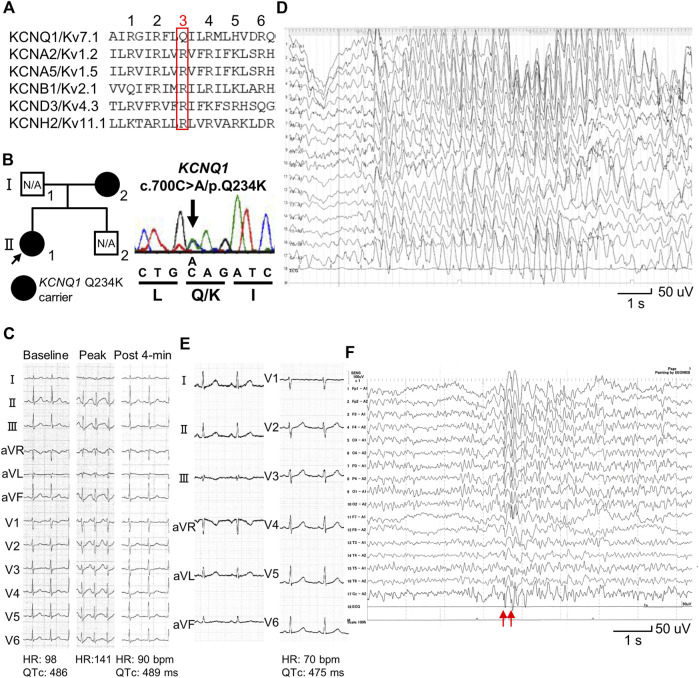
KCNQ1 and KCNE1 form slowly activating delayed rectifier potassium currents (I). Loss-of-function of I by variants causes type-1 long QT syndrome (LQTS). Also, some variants are reported to cause epilepsy. Segment 4 (S4) of voltage-gated potassium channels has several positively-charged amino acids that are periodically aligned, and acts as a voltage-sensor. Intriguingly, KCNQ1 has a neutral-charge glutamine at the third position (Q3) in the S4 (Q234 position in KCNQ1), which suggests that the Q3 (Q234) may play an important role in the gating properties of I. We identified a novel Q234K (substituted for a positively-charged lysine) variant in patients (a girl and her mother) with LQTS and epileptiform activity on electroencephalogram. The mother had been diagnosed with epilepsy. Therefore, we sought to elucidate the effects of the Q234K on gating properties of I.
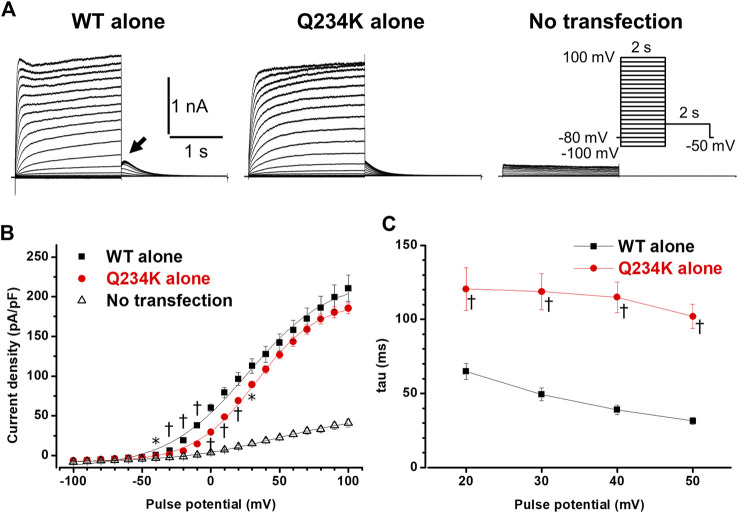
Wild-type (WT)-KCNQ1 and/or Q234K-KCNQ1 were transiently expressed in tsA201-cells with KCNE1 (E1) (WT + E1-channels, Q234K + E1-channels, and WT + Q234K + E1-channels), and membrane currents were recorded using whole-cell patch-clamp techniques.
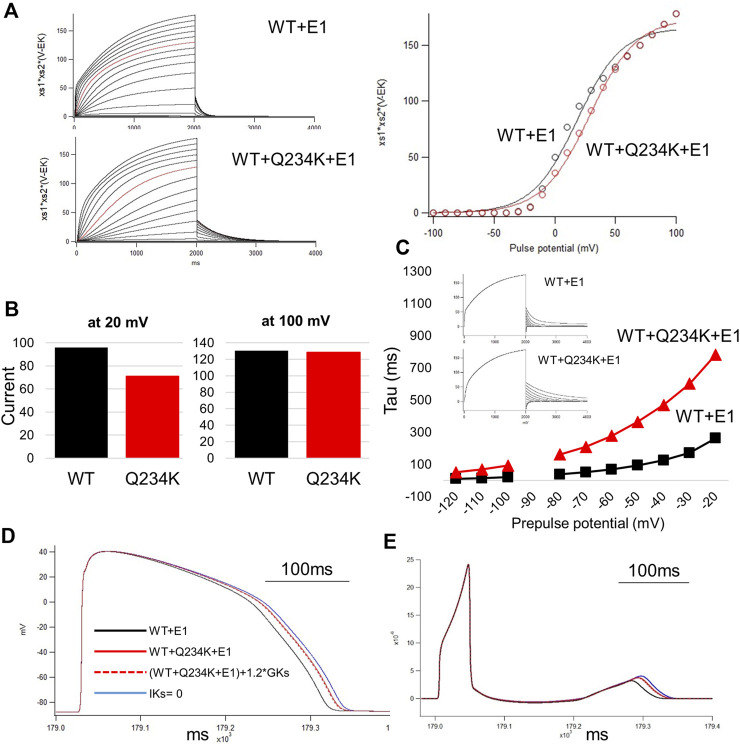
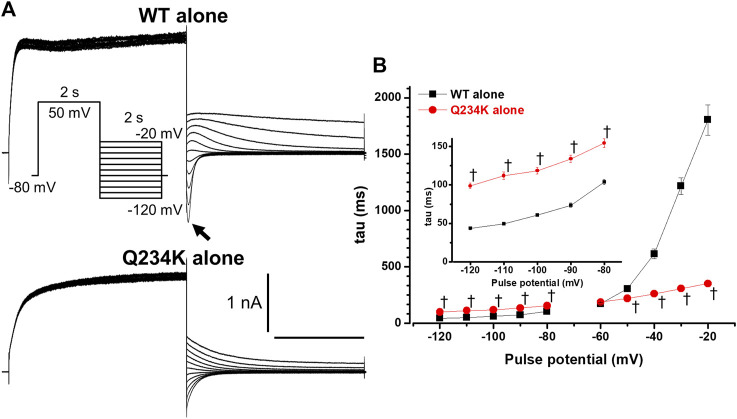
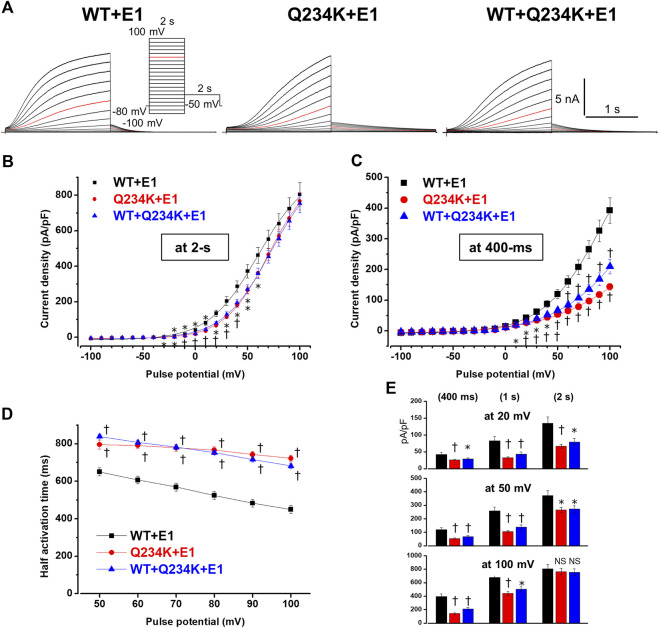
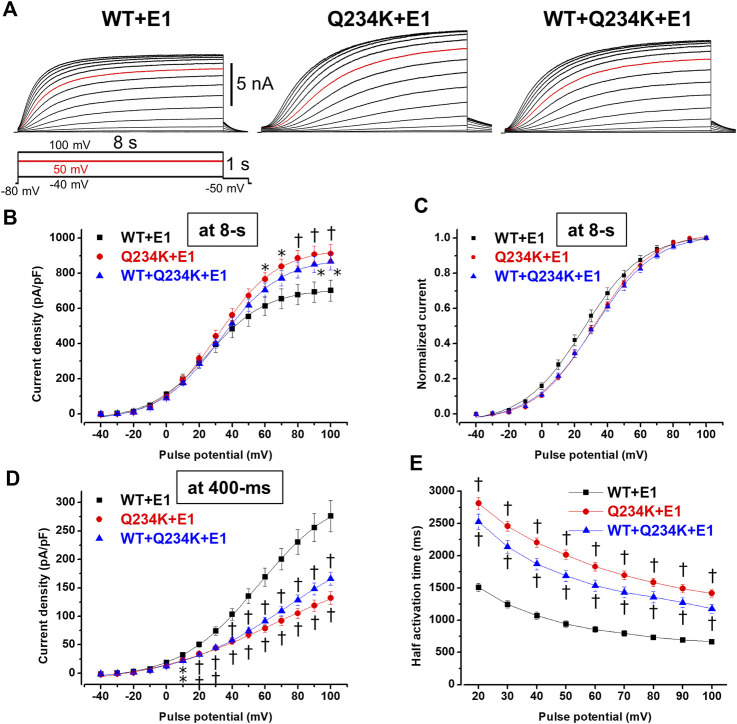
At 8-s depolarization, current density (CD) of the Q234K + E1-channels or WT + Q234K + E1-channels was significantly larger than the WT + E1-channels (WT + E1: 701 ± 59 pA/pF; Q234K + E1: 912 ± 50 pA/pF, < 0.01; WT + Q234K + E1: 867 ± 48 pA/pF, < 0.05). Voltage dependence of activation (VDA) of the Q234K + E1-channels or WT + Q234K + E1-channels was slightly but significantly shifted to depolarizing potentials in comparison to the WT + E1-channels ([V] WT + E1: 25.6 ± 2.6 mV; Q234K + E1: 31.8 ± 1.7 mV, < 0.05; WT + Q234K + E1: 32.3 ± 1.9 mV, < 0.05). Activation rate of the Q234K + E1-channels or WT + Q234K + E1-channels was significantly delayed in comparison to the WT + E1-channels ([half activation time] WT + E1: 664 ± 37 ms; Q234K + E1: 1,417 ± 60 ms, < 0.01; WT + Q234K + E1: 1,177 ± 71 ms, < 0.01). At 400-ms depolarization, CD of the Q234K + E1-channels or WT + Q234K + E1-channels was significantly decreased in comparison to the WT + E1-channels (WT + E1: 392 ± 42 pA/pF; Q234K + E1: 143 ± 12 pA/pF, < 0.01; WT + Q234K + E1: 209 ± 24 pA/pF, < 0.01) due to delayed activation rate and depolarizing shift of VDA.
The Q234K induced I gain-of-function during long (8-s)-depolarization, while loss of-function during short (400-ms)-depolarization, which indicates that the variant causes LQTS, and raises a possibility that the variant may also cause epilepsy. Our data provide novel insights into the functional consequences of charge addition on the Q3 in the S4 of KCNQ1.
KCNQ1和KCNE1形成缓慢激活的延迟整流钾电流(I)。I的功能丧失变体导致1型长QT综合征(LQTS)。此外,据报道一些变体可导致癫痫。电压门控钾通道的第4段(S4)有几个带正电荷的氨基酸呈周期性排列,充当电压传感器。有趣的是,KCNQ1在S4的第三个位置(Q3)有一个中性电荷的谷氨酰胺(KCNQ1中的Q234位置),这表明Q3(Q234)可能在I的门控特性中起重要作用。我们在患有LQTS且脑电图有癫痫样活动的患者(一名女孩及其母亲)中鉴定出一种新的Q234K变体(被带正电荷的赖氨酸取代)。母亲被诊断患有癫痫。因此,我们试图阐明Q234K对I门控特性的影响。
野生型(WT)-KCNQ1和/或Q234K-KCNQ1与KCNE1(E1)在tsA201细胞中瞬时共表达(WT + E1通道、Q234K + E1通道和WT + Q234K + E1通道),并使用全细胞膜片钳技术记录膜电流。
在8秒去极化时,Q234K + E1通道或WT + Q234K + E1通道的电流密度(CD)显著大于WT + E1通道(WT + E1:701±59 pA/pF;Q234K + E1:912±50 pA/pF,P<0.01;WT + Q234K + E1:867±48 pA/pF,P<0.05)。与WT + E1通道相比,Q234K + E1通道或WT + Q234K + E1通道的激活电压依赖性(VDA)略微但显著地向去极化电位偏移([V]WT + E1:25.6±2.6 mV;Q234K + E1:31.8±1.7 mV,P<0.05;WT + Q234K + E1:32.3±1.9 mV,P<0.05)。与WT + E1通道相比,Q234K + E1通道或WT + Q234K + E1通道的激活速率显著延迟([半激活时间]WT + E1:664±37 ms;Q234K + E1:1417±60 ms,P<0.01;WT + Q234K + E1:1177±71 ms,P<0.01)。在400毫秒去极化时,与WT + E1通道相比,Q234K + E1通道或WT + Q234K + E1通道的CD显著降低(WT + E1:392±42 pA/pF;Q234K + E1:143±12 pA/pF,P<0.01;WT + Q234K + E1:209±24 pA/pF,P<0.01),这是由于激活速率延迟和VDA的去极化偏移所致。
Q234K在长时间(8秒)去极化期间诱导I功能增强,而在短时间(400毫秒)去极化期间功能丧失,这表明该变体导致LQTS,并增加了该变体也可能导致癫痫的可能性。我们的数据为KCNQ1的S4中Q3电荷增加的功能后果提供了新的见解。