Wang Jiying, Kunikata Hiroshi, Yasuda Masayuki, Himori Noriko, Nitta Fumihiko, Nakazawa Toru
Department of Ophthalmology, Tohoku University Graduate School of Medicine, Sendai, Miyagi, Japan.
Department of Retinal Disease Control, Tohoku University Graduate School of Medicine, Sendai, Miyagi, Japan.
Ophthalmol Sci. 2024 May 7;4(6):100550. doi: 10.1016/j.xops.2024.100550. eCollection 2024 Nov-Dec.
To investigate the association of systemic oxidative stress level with myopic choroidal neovascularization (mCNV) and its clinical outcomes.
Retrospective case-control study.
This retrospective study included 52 eyes of 52 healthy participants (mean age: 62.5 years), 30 eyes of 30 patients (mean age: 59.6 years) with high myopia (HM) but without mCNV, and 23 eyes of 23 patients (mean age: 61.8 years) with HM and mCNV who received intravitreal anti-VEGF antibody injections (IVIs) using a pro re nata regimen during the 6-month follow-up after the first IVI.
Clinical findings, including oxidative stress parameters, such as diacron reactive oxygen metabolites (dROMs), biological antioxidant potential (BAP), and the BAP/dROM ratio (B/d ratio), were analyzed.
Clinical features and oxidative stress parameters.
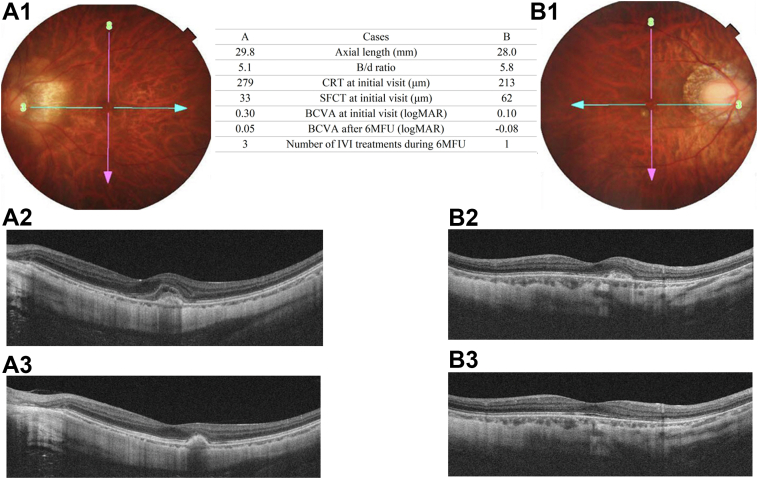
Both BAP and the B/d ratio were significantly lower in the HM/mCNV group than in the HM/no mCNV group ( = 0.002 and = 0.012, respectively) and than in the control group ( = 0.001 and = 0.026, respectively). In a multiple logistic regression analysis, axial length (odds ratio 1.878, = 0.042) and the B/d ratio (odds ratio 0.470, = 0.026) were significantly associated with mCNV. Dividing the patients into high and low B/d ratio groups (with a cutoff of 5.2) showed that subfoveal choroidal thickness (SFCT) was lower ( = 0.002) and the number of IVI treatments was higher ( = 0.029) in the low B/d ratio group than in the high B/d ratio group. In multiple regression analyses, only the B/d ratio was significantly associated with SFCT (β = 0.684, = 0.006).
The oxidative stress level in eyes with HM differed according to mCNV, SFCT, and the number of IVI treatments. Measuring oxidative stress parameters might be useful in eyes with HM both for assessing the risk of developing mCNV and determining disease activity.
Proprietary or commercial disclosure may be found in the Footnotes and Disclosures at the end of this article.
探讨全身氧化应激水平与近视性脉络膜新生血管(mCNV)及其临床结局的相关性。
回顾性病例对照研究。
这项回顾性研究纳入了52名健康参与者的52只眼(平均年龄:62.5岁)、30名高度近视(HM)但无mCNV患者的30只眼(平均年龄:59.6岁),以及23名HM合并mCNV患者的23只眼(平均年龄:61.8岁),这些患者在首次玻璃体内注射抗VEGF抗体(IVI)后的6个月随访期间采用按需给药方案接受IVI治疗。
分析临床检查结果,包括氧化应激参数,如戴克隆活性氧代谢产物(dROMs)、生物抗氧化能力(BAP)以及BAP/dROM比值(B/d比值)。
临床特征和氧化应激参数。
HM/mCNV组的BAP和B/d比值均显著低于HM/无mCNV组(分别为P = 0.002和P = 0.012)以及对照组(分别为P = 0.001和P = 0.026)。在多元逻辑回归分析中,眼轴长度(比值比1.878,P = 0.042)和B/d比值(比值比0.470,P = 0.026)与mCNV显著相关。将患者分为高B/d比值组和低B/d比值组(临界值为5.2)显示,低B/d比值组的黄斑中心凹下脉络膜厚度(SFCT)更低(P = 0.002),IVI治疗次数更多(P = 0.029)。在多元回归分析中,只有B/d比值与SFCT显著相关(β = 0.684,P = 0.006)。
HM患者眼中的氧化应激水平因mCNV、SFCT和IVI治疗次数而异。测量氧化应激参数可能有助于评估HM患者发生mCNV的风险并确定疾病活动度。
在本文末尾的脚注和披露中可能会找到专有或商业披露信息。