Chinese Academy of Medical Sciences & Peking Union Medical College, Beijing, China.
Department of Interventional Medicine, China-Japan Friendship Hospital, Beijing, China.
Korean J Radiol. 2024 Aug;25(8):756-766. doi: 10.3348/kjr.2023.1279.
To evaluate the efficacy and safety of thermal ablation in treating solitary low-risk T2N0M0 papillary thyroid cancer (PTC) and compare the outcomes of microwave ablation (MWA) and radiofrequency ablation (RFA).
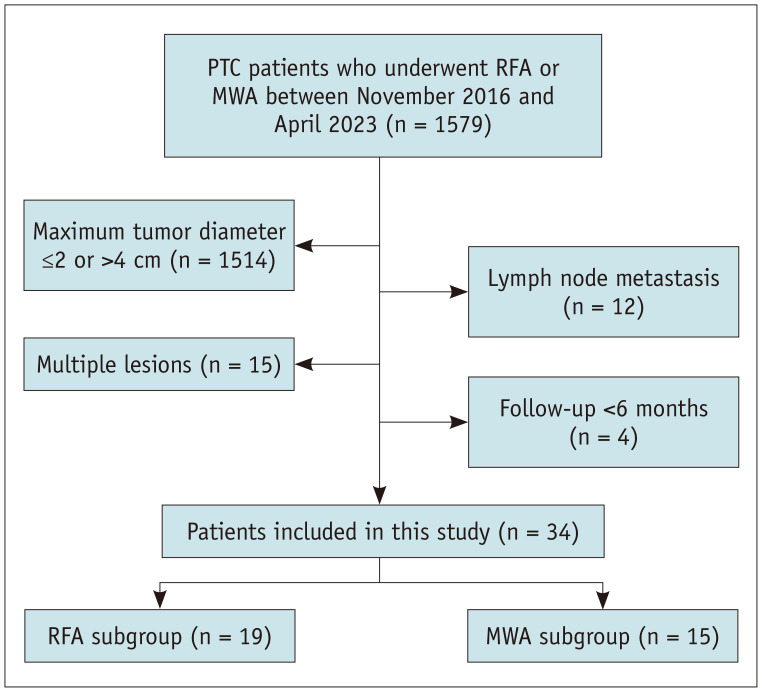
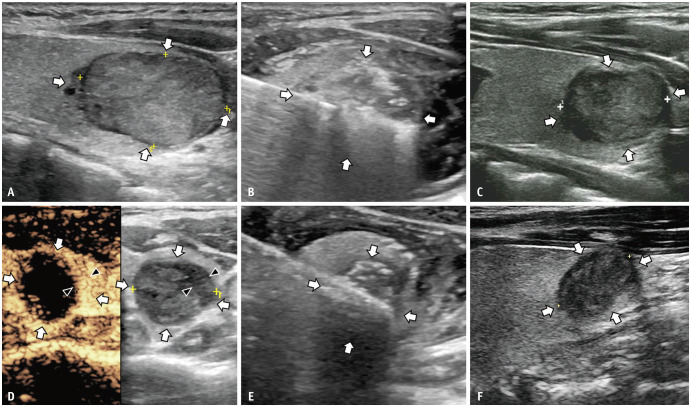
This retrospective, single center study involved 34 patients (age: 40.0 ± 13.9 years; 28 female) who had low-risk T2N0M0 PTC with a maximum diameter >2 cm and ≤4 cm and underwent MWA (n = 15) or RFA (n = 19) from November 2016 to April 2023. The primary outcomes were the cumulative rate of disease progression and delayed surgery rates. In contrast, the secondary outcomes included changes in tumor size, cumulative rate of complete tumor disappearance, and complication rates.
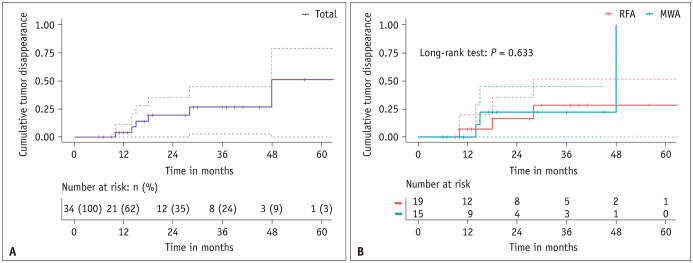
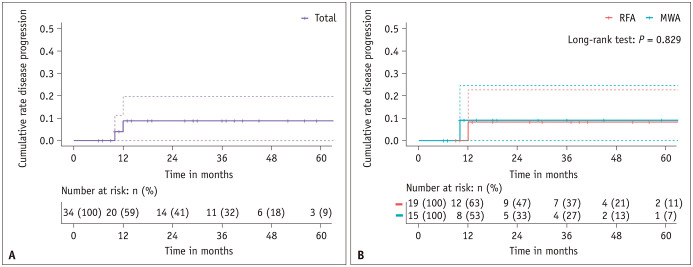
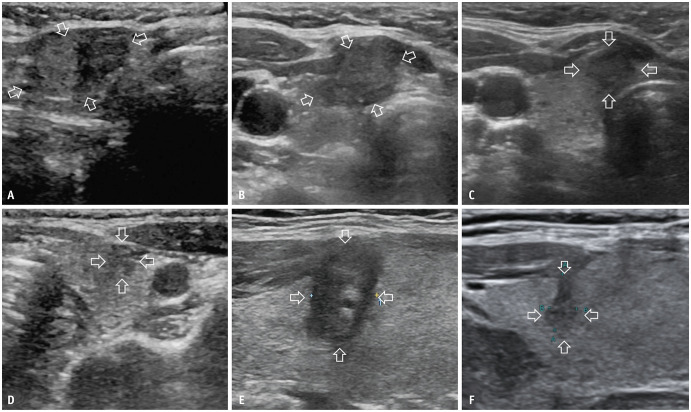
The median follow-up period was 18.0 months (interquartile range [IQR]: 9.0-40.0 months). At 12 months, the median volume reduction rate of the ablation zone was 74.2% (IQR: 53.7%-86.0%). Disease progression was noted in two patients within 1 year, including one patient with local tumor progression post-RFA and one with a new tumor post-MWA, resulting in a constant cumulative disease progression rate of 8.8% (95% confidence interval [CI]: 0%-19.8%) throughout the remaining follow-up period. Both patients were subsequently treated with additional ablation and did not require surgery. The cumulative rates of complete tumor disappearance at 1, 3, and 5 years were 4.0% (95% CI: 0%-11.4%), 26.8% (95% CI: 2.7%-44.9%), and 51.2% (95% CI: 0%-79.1%), respectively. No significant differences were observed in the disease progression ( = 0.829) or complete tumor disappearance ( = 0.633) rates between the MWA and RFA groups. Complications occurred in 14.7% (5/34) of patients presenting with transient hoarseness. RFA had a higher but not statistically significant complication rate than MWA did (21.1% [4/19] vs. 6.7% [1/15]; = 0.355).
Both MWA and RFA demonstrated promising short-term outcomes in terms of efficacy and safety in treating solitary low-risk T2N0M0 PTC, with no significant differences.
评估热消融治疗单发低危 T2N0M0 甲状腺乳头状癌(PTC)的疗效和安全性,并比较微波消融(MWA)和射频消融(RFA)的结果。
本回顾性单中心研究纳入了 34 名(年龄:40.0±13.9 岁;28 名女性)患有最大直径>2cm 且≤4cm 的低危 T2N0M0 PTC 的患者,他们于 2016 年 11 月至 2023 年 4 月期间接受了 MWA(n=15)或 RFA(n=19)治疗。主要结局是疾病进展累积率和延迟手术率。相比之下,次要结局包括肿瘤大小变化、完全肿瘤消失累积率和并发症发生率。
中位随访时间为 18.0 个月(四分位距 [IQR]:9.0-40.0 个月)。在 12 个月时,消融区体积减少率的中位数为 74.2%(IQR:53.7%-86.0%)。1 年内有 2 名患者出现疾病进展,包括 1 名 RFA 后局部肿瘤进展和 1 名 MWA 后新发肿瘤患者,导致疾病进展的累积率在整个剩余随访期间始终为 8.8%(95%CI:0%-19.8%)。这两名患者随后均接受了额外的消融治疗,无需手术。1、3 和 5 年的完全肿瘤消失累积率分别为 4.0%(95%CI:0%-11.4%)、26.8%(95%CI:2.7%-44.9%)和 51.2%(95%CI:0%-79.1%)。MWA 和 RFA 组之间的疾病进展率( = 0.829)或完全肿瘤消失率( = 0.633)无显著差异。14.7%(5/34)的患者出现短暂性声音嘶哑等并发症。RFA 的并发症发生率高于 MWA,但无统计学意义(21.1%[4/19]比 6.7%[1/15]; = 0.355)。
MWA 和 RFA 在治疗单发低危 T2N0M0 PTC 方面均显示出良好的短期疗效和安全性,且无显著差异。