Diego-Yagüe Itziar, Ramos-Martínez Antonio, Muñoz Patricia, Martínez-Sellés Manuel, Machado Marina, de Alarcón Arístides, Miró José M, Rodríguez-Gacía Raquel, Gutierrez-Díez José Francisco, Hidalgo-Tenorio Carmen, Loeches-Yagüe Belén, López-Azor Juan Carlos
Unidad de Enfermedades Infecciosas, Hospital Universitario Puerta de Hierro, IDIPHISA, Majadahonda, Madrid, Spain.
Universidad Autónoma de Madrid, Madrid, Spain.
Eur J Clin Microbiol Infect Dis. 2024 Oct;43(10):1989-2000. doi: 10.1007/s10096-024-04848-1. Epub 2024 Aug 7.
Staphylococcus aureus prosthetic valve endocarditis (SAPVE) is a serious infection with high mortality. The main objective of this study was to identify factors associated with in-hospital mortality.
From January 2008 to December 2021, consecutive patients from a Spanish cohort of infective endocarditis with a definitive diagnosis of SAPVE were analyzed.
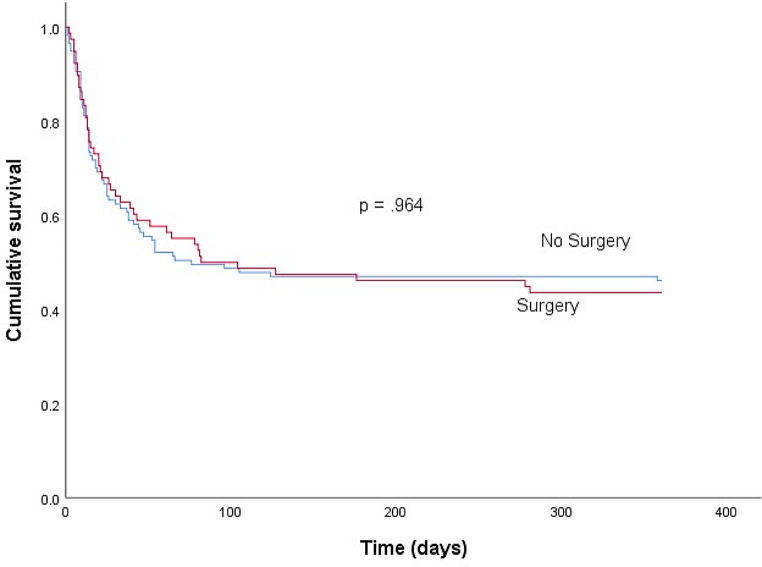
During the study period, 219 cases of definitive SAPVE were diagnosed, which accounted for 16.7% of a total of 1309 cases of definitive prosthetic valve endocarditis (PVE). Patients presented advanced age and marked comorbidity. There was a higher incidence of persistent bacteremia, septic shock, stroke, and acute kidney injury than in cases of PVE caused by other microorganisms. Methicillin resistance was not associated with differences in clinical presentation, echocardiographic findings, or mortality. Only 50.6% of the patients with surgical indications (88 patients) underwent surgery. Overall, in-hospital mortality was 47.9%. The variables associated with in-hospital mortality were age (OR:1.03, 95% CI: 1.00-1.05; p = 0.016), heart failure (OR:2.86, 95% CI: 1.53-5.32; p = 0.001), acute kidney injury (OR:2.42, 95%CI:1.28-4.58; p = 0.006), stroke (OR:3.53, 95%CI:1.79-6.96; p < 0.001) and surgery indicated but not performed (OR:2.01, 95%CI:1.06-3.8; p = 0.030). On the other hand, the performance of surgery per se in patients with SAPVE, regardless of whether there was a surgical indication according to the guidelines, was not associated with a reduction in in-hospital mortality.
SAPVE is characterized by high mortality, which is more marked in patients who present a surgical indication but do not undergo surgery.
金黄色葡萄球菌人工瓣膜心内膜炎(SAPVE)是一种严重感染,死亡率高。本研究的主要目的是确定与院内死亡率相关的因素。
对2008年1月至2021年12月期间来自西班牙感染性心内膜炎队列中确诊为SAPVE的连续患者进行分析。
在研究期间,共诊断出219例确诊的SAPVE病例,占1309例确诊人工瓣膜心内膜炎(PVE)病例总数的16.7%。患者年龄较大且合并症明显。与其他微生物引起的PVE病例相比,持续性菌血症、感染性休克、中风和急性肾损伤的发生率更高。耐甲氧西林与临床表现、超声心动图结果或死亡率的差异无关。只有50.6%有手术指征的患者(88例)接受了手术。总体而言,院内死亡率为47.9%。与院内死亡率相关的变量包括年龄(OR:1.03,95%CI:1.00-1.05;p = 0.016)、心力衰竭(OR:2.86,95%CI:1.53-5.32;p = 0.001)、急性肾损伤(OR:2.42,95%CI:1.28-4.58;p = 0.006)、中风(OR:3.53,95%CI:1.79-6.96;p < 0.001)以及有手术指征但未进行手术(OR:2.01,95%CI:1.06-3.8;p = 0.030)。另一方面,SAPVE患者本身进行手术,无论是否根据指南有手术指征,均与院内死亡率降低无关。
SAPVE的特点是死亡率高,在有手术指征但未接受手术的患者中更为明显。