Sørensen Jens Benn, Baas Paul, Szépligeti Szimonetta Komjáthiné, Pedersen Alma B, Johnsen Søren P, Carroll Robert, Schoemaker Minouk J, Rault Caroline, Daumont Melinda J, Ehrenstein Vera
Department of Oncology, Rigshospitalet, Copenhagen, Denmark.
Department of Thoracic Oncology, Netherlands Cancer Institute, Amsterdam, The Netherlands.
Acta Oncol. 2024 Aug 8;63:649-657. doi: 10.2340/1651-226X.2024.34802.
Malignant pleural mesothelioma (MPM) is a rare thoracic malignancy with poor prognosis and limited treatment options. Immunotherapy shows potential for improved outcomes; however, real-world evidence on its use will take time to accumulate. This study examined patient characteristics, treatment patterns, overall survival (OS), and predictors of mortality among patients diagnosed with MPM in Denmark prior to the introduction of newer treatments.
This historical cohort study based on routinely collected Danish National Registry data included adults newly diagnosed with MPM between 01 January 2011 and 31 May 2018. Summary statistics were used to describe patient characteristics and initial treatment. OS was estimated using Kaplan-Meier methods; Cox regression was used to compare patient mortality against the (age/sex-matched) general population and to investigate mortality predictors.
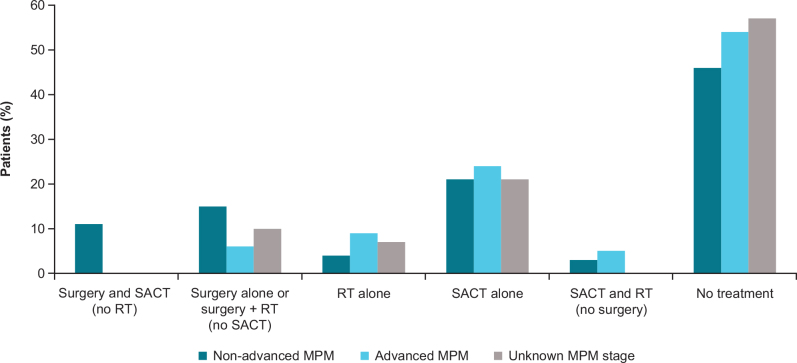
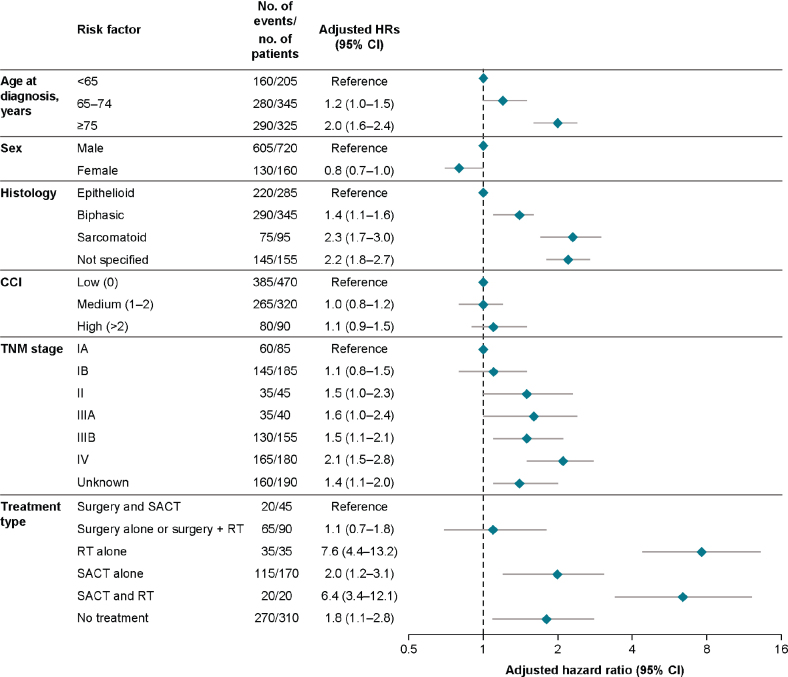
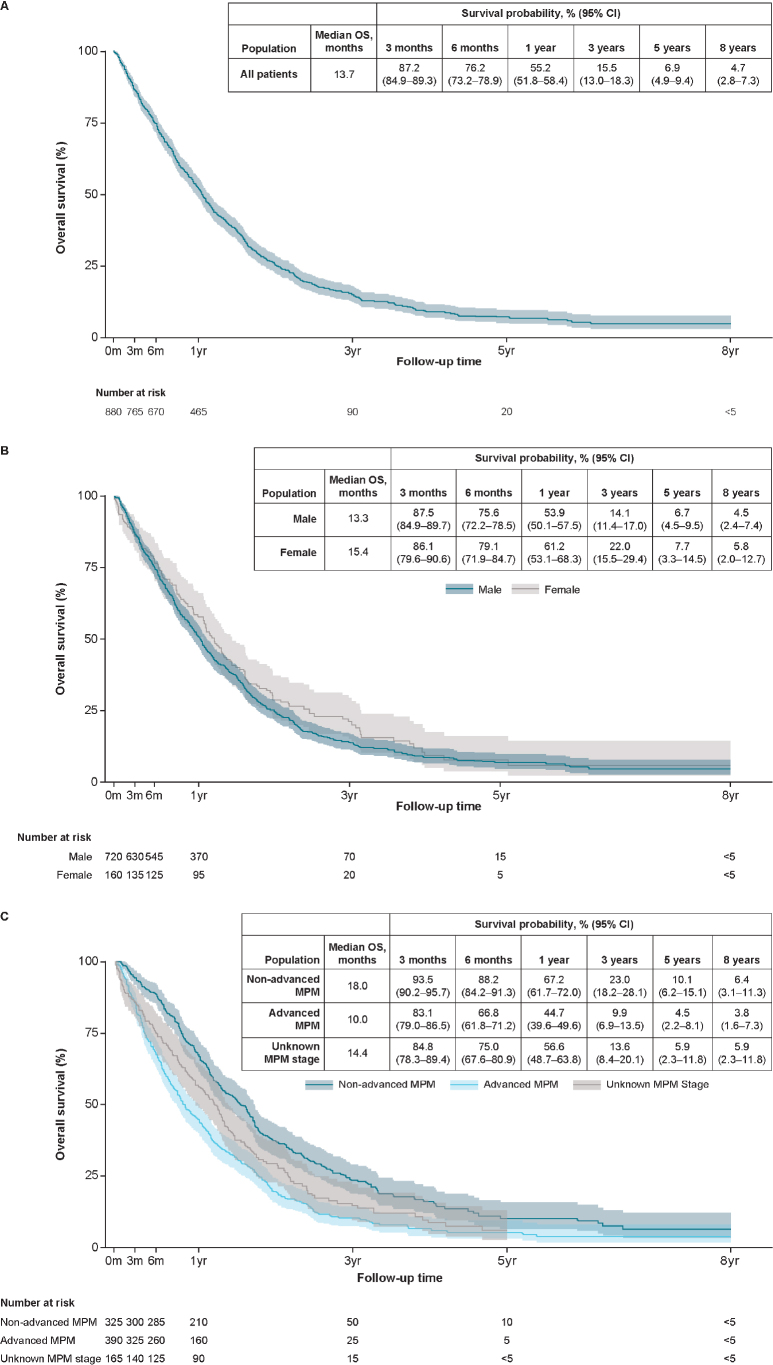
Overall, 880 patients were included; 44% had advanced MPM, 37% had non-advanced MPM, and 19% had unknown MPM stage. Median age at diagnosis was 71.9 years, and 82% of the patients were male. Within 180 days of diagnosis, no treatment was recorded for 215 patients (54%) with advanced MPM and 150 (46%) with non-advanced MPM. Median time-to-initial treatment (interquartile range) was 47 days (31-111) overall, 40 days (28-77) in patients with advanced MPM, and 53 days (35-121) with non-advanced MPM. Median OS was 13.7 months overall (non-advanced MPM: 18.0 months vs. advanced MPM: 10.0 months). Predictors of higher mortality were older age at diagnosis, histology, and advanced MPM stage.
These findings provide a baseline upon which to evaluate MPM epidemiology as newer treatments are adopted in routine practice.
恶性胸膜间皮瘤(MPM)是一种罕见的胸部恶性肿瘤,预后较差且治疗选择有限。免疫疗法显示出改善预后的潜力;然而,其实际应用的证据积累尚需时日。本研究调查了在丹麦引入新疗法之前被诊断为MPM的患者的特征、治疗模式、总生存期(OS)以及死亡预测因素。
这项基于丹麦国家常规收集登记数据的历史性队列研究纳入了2011年1月1日至2018年5月31日期间新诊断为MPM的成年人。使用汇总统计数据描述患者特征和初始治疗情况。采用Kaplan-Meier方法估计OS;使用Cox回归比较患者死亡率与(年龄/性别匹配的)普通人群,并调查死亡预测因素。
总体而言,纳入了880例患者;44%患有晚期MPM,37%患有非晚期MPM,19%的MPM分期未知。诊断时的中位年龄为71.9岁,82%的患者为男性。在诊断后的180天内,215例(54%)晚期MPM患者和150例(46%)非晚期MPM患者未记录任何治疗。总体初始治疗的中位时间(四分位间距)为47天(31 - 111天),晚期MPM患者为40天(28 - 77天),非晚期MPM患者为53天(35 - 121天)。总体中位OS为13.7个月(非晚期MPM:18.0个月 vs. 晚期MPM:10.0个月)。较高死亡率的预测因素为诊断时年龄较大、组织学类型和晚期MPM分期。
这些发现为在常规实践中采用新疗法时评估MPM流行病学提供了一个基线。