Department of Anesthesiology and Reanimation, Faculty of Medicine, Suleyman Demirel University, Isparta, Turkey.
BMC Surg. 2024 Aug 8;24(1):226. doi: 10.1186/s12893-024-02519-8.
The purpose of this study was to evaluate the predictability of utilizing the backward upward rightward pressure (BURP) maneuver and the efficacy of related tests in patients with a challenging airway and a Mallampati score of 2 or higher who underwent scheduled elective thyroid surgery.
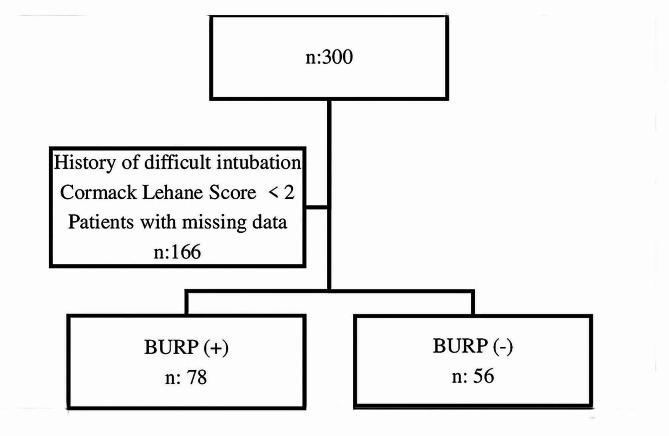
Patient files were scanned for 300 adult patients who had undergone thyroid surgery under general anesthesia. The information included their medical history of thyroid disease, previous thyroid surgery, and evaluation tests for difficult intubation such as Mallampati score, maximum mouth opening, ease of intubation, thyroid goitre grade, and whether the BURP maneuver was performed. Patients who had a history of difficult intubation or a Cormack Lehane score less than 2 were excluded. Additionally, the patients were divided into two groups: one group underwent the BURP maneuver (n = 78) and the other did not (n = 56).
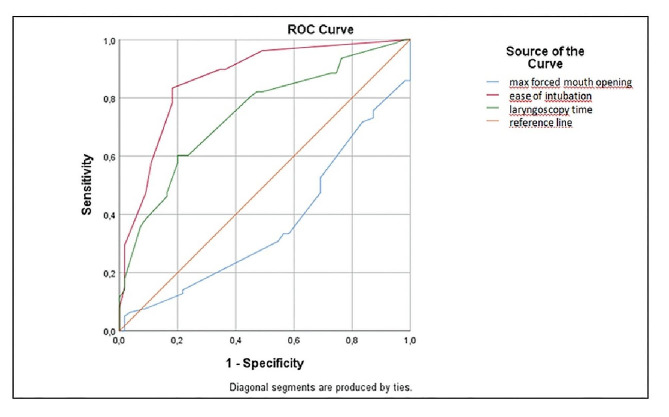
Statistically significant differences in the maximum mouth openings and thyroid goitre grade were observed between the groups according to the preoperative evaluation. Furthermore, significant differences were noted between the groups in terms of the ease of intubation, intubation time, Cormack-Lehane score, and number of intubation attempts.
There may be a correlation between the maximum mouth opening and thyroid goitre grade in predicting the use of the BURP maneuver. It is important to keep in mind, however, that difficult intubation may occur in some uncommon types of goiter, such as retrosternal goiter, even if the thyroid gland size is small. Therefore, it may be useful to consider performing the BURP maneuver.
本研究旨在评估在接受择期甲状腺手术的困难气道患者(Mallampati 评分为 2 或更高)中,使用向后向上向右推压(BURP)手法以及相关测试的预测性。
扫描了 300 名接受全身麻醉下甲状腺手术的成年患者的病历。信息包括他们的甲状腺疾病病史、既往甲状腺手术史以及困难插管评估测试,如 Mallampati 评分、最大张口度、插管难易程度、甲状腺肿等级以及是否进行 BURP 手法。排除有困难插管史或 Cormack Lehane 评分小于 2 的患者。此外,患者分为两组:一组进行 BURP 手法(n=78),另一组不进行(n=56)。
根据术前评估,两组间最大张口度和甲状腺肿等级存在统计学显著差异。此外,两组在插管容易度、插管时间、Cormack-Lehane 评分和插管尝试次数方面也存在显著差异。
最大张口度和甲状腺肿等级可能与 BURP 手法的使用相关。然而,需要注意的是,即使甲状腺体积较小,某些罕见类型的甲状腺肿(如胸骨后甲状腺肿)也可能发生困难插管。因此,考虑使用 BURP 手法可能是有用的。