Department of Pharmacy, Division of Pharmacology and Toxicology, Radboud University Medical Center, Nijmegen 6525GA, The Netherlands.
Department of Metabolic Health Research, Netherlands Organization for Applied Scientific Research (TNO), Leiden 2333BE, The Netherlands.
Mol Pharm. 2024 Sep 2;21(9):4347-4355. doi: 10.1021/acs.molpharmaceut.4c00302. Epub 2024 Aug 9.
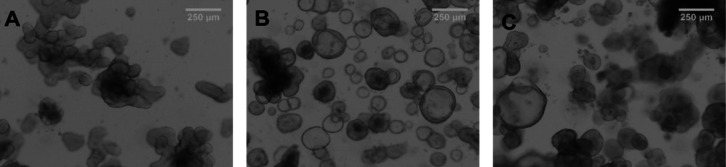
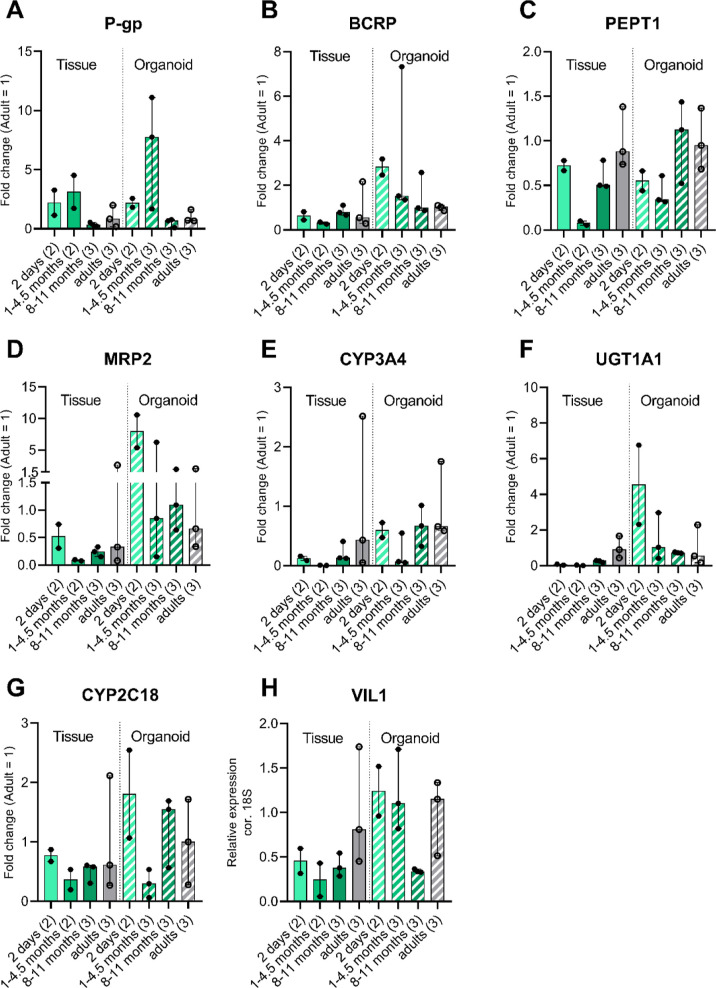
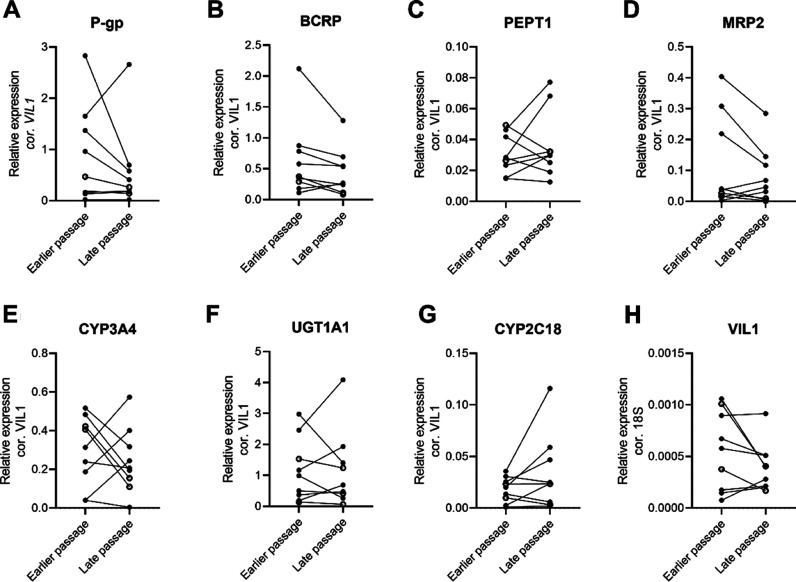
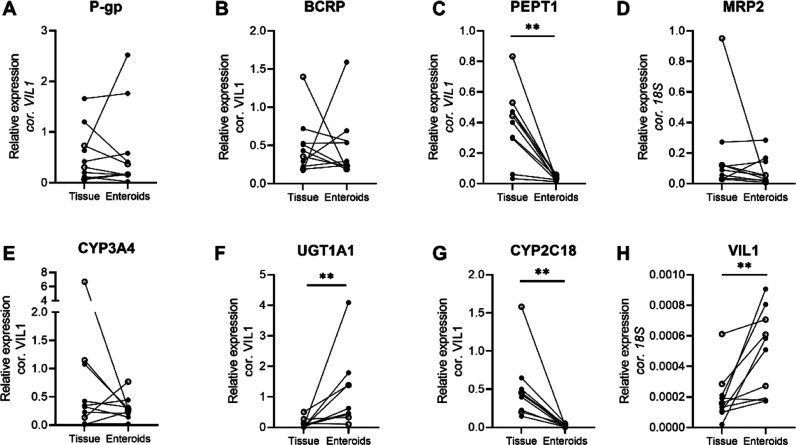
In childhood, developmental changes and environmental interactions highly affect orally dosed drug disposition across the age range. To optimize dosing regimens and ensure safe use of drugs in pediatric patients, understanding this age-dependent biology is necessary. In this proof-of-concept study, we aimed to culture age-specific enteroids from infant tissue which represent its original donor material, specifically for drug transport and metabolism. Enteroid lines from fresh infant tissues ( = 8, age range: 0.3-45 postnatal weeks) and adult tissues ( = 3) were established and expanded to 3D self-organizing enteroids. The gene expression of drug transporters P-gp (), BCRP (), MRP2 (), and PEPT1 () and drug metabolizing enzymes CYP3A4, CYP2C18, and UGT1A1 was determined with RT-qPCR in fresh tissue and its derivative differentiated enteroids. Expression levels of P-gp, BCRP, MRP2, and CYP3A4 were similar between tissues and enteroids. PEPT1 and CYP2C18 expression was lower in enteroids compared to that in the tissue. The expression of UGT1A1 in the tissue was lower than that in enteroids. The gene expression did not change with the enteroid passage number for all genes studied. Similar maturational patterns in tissues and enteroids were visually observed for P-gp, PEPT1, MRP2, CYP3A4, CYP2C18, and VIL1. In this explorative study, interpatient variability was high, likely due to the diverse patient characteristics of the sampled population (e.g., disease, age, and treatment). To summarize, maturational patterns of clinically relevant ADME genes in tissue were maintained in enteroids. These findings are an important step toward the potential use of pediatric enteroids in pediatric drug development, which in the future may lead to improved pediatric safety predictions during drug development. We reason that such an approach can contribute to a potential age-specific platform to study and predict drug exposure and intestinal safety in pediatrics.
在儿童期,发育变化和环境相互作用极大地影响了整个年龄段口服药物的处置。为了优化剂量方案并确保儿科患者安全使用药物,了解这种年龄依赖性生物学特性是必要的。在这项概念验证研究中,我们旨在从婴儿组织中培养代表其原始供体材料的特定年龄的肠类器官,用于药物转运和代谢。从新鲜婴儿组织(= 8,年龄范围:出生后 0.3-45 周)和成人组织(= 3)建立并扩增了肠类器官系,以形成 3D 自组织肠类器官。使用 RT-qPCR 测定了新鲜组织及其衍生的分化肠类器官中药物转运体 P-糖蛋白()、BCRP()、MRP2()和 PEPT1()和药物代谢酶 CYP3A4、CYP2C18 和 UGT1A1 的基因表达。在组织和肠类器官中,P-gp、BCRP、MRP2 和 CYP3A4 的表达水平相似。与组织相比,肠类器官中 PEPT1 和 CYP2C18 的表达水平较低。组织中 UGT1A1 的表达水平低于肠类器官。所有研究基因的表达水平都未随肠类器官的传代数而变化。在组织和肠类器官中,P-gp、PEPT1、MRP2、CYP3A4、CYP2C18 和 VIL1 的表达呈现相似的成熟模式。在这项探索性研究中,由于采样人群的患者特征(例如疾病、年龄和治疗)各不相同,因此患者间的变异性很高。总之,组织中与临床相关的 ADME 基因的成熟模式在肠类器官中得以维持。这些发现是将儿科肠类器官用于儿科药物开发的重要一步,这可能会在药物开发过程中提高儿科安全性预测。我们认为,这种方法可以为儿科研究和预测药物暴露和肠道安全性提供一个特定年龄的平台。