
用于共价共轭的硫代氨基脲功能化
Functionalizing Thiosemicarbazones for Covalent Conjugation.
作者信息
Hohnsen Johannes, Rryci Lukas, Obretenova Diana, Friedel Joshua, Jouchaghani Shahab, Klein Axel
机构信息
University of Cologne, Faculty of Mathematics and Natural Sciences, Department of Chemistry and Biochemistry, Institute for Inorganic and Materials Chemistry, Greinstraße 6, 50939 Koeln, Germany.
出版信息
Molecules. 2024 Aug 3;29(15):3680. doi: 10.3390/molecules29153680.
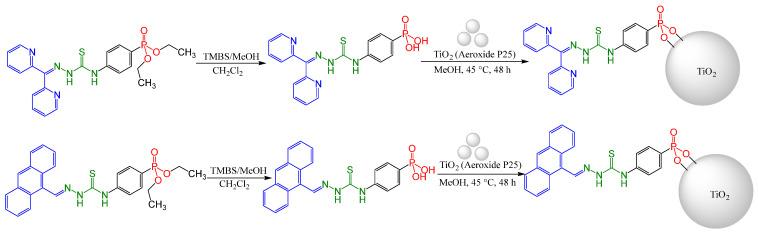
Thiosemicarbazones (TSCs) with their modular character (thiosemicarbazides + carbonyl compound) allow broad variation of up to four substituents on the main RRC=N(1)-NH-C(S)-N(4)RR core and are thus interesting tools for the formation of conjugates or the functionalization of nanoparticles (NPs). In this work, di-2-pyridyl ketone was introduced for the coordination of metals and 9-anthraldehyde for luminescence as R and R to TSCs. R and R substituents were varied for the formation of conjugates. Amino acids were introduced at the 4 position to produce [RRTSC-spacer-amino acid] conjugates. Further, functions such as phosphonic acid (R-P(O)(OH)), -glucose, -hydroquinone, OH, and thiol (SH) were introduced at the 4 position producing [RRTSC-spacer-anchor group] conjugates for direct NP anchoring. Phenyl, cyclohexyl, benzyl, ethyl and methyl were used as spacer units. Both phenyl phosphonic acid TSC derivatives were bound on TiO NPs as a first example of direct NP anchoring. [RRTSC-spacer-end group] conjugates including OH, S-Bn (Bn = benzyl), NH-Boc (Boc = -butyloxycarbonyl), COOBu, C≡CH, or N end groups were synthesized for potential covalent binding to functional molecules or functionalized NPs through amide, ester, or triazole functions. The synthesis of the thiosemicarbazides HNNH-C(S)-NRR starting from amines, including amino acids, SCCl or CS, and hydrazine and their condensation with dipyridyl ketone and anthraldehyde led to 34 new TSC derivatives. They were synthesized in up to six steps with overall yields ranging from 10 to 85% and were characterized by a combination of nuclear magnetic resonance spectroscopy and mass spectrometry. UV-vis absorption and photoluminescence spectroscopy allowed us to easily trace the dipyridyl imine and anthracene chromophores.
硫代氨基脲(TSCs)具有模块化特性(硫代氨基脲 + 羰基化合物),其主链RRC=N(1)-NH-C(S)-N(4)RR上最多可有四个取代基发生广泛变化,因此是形成共轭物或纳米颗粒(NPs)功能化的有趣工具。在本工作中,引入二 - 2 - 吡啶基酮用于金属配位,引入9 - 蒽醛用于发光,作为TSCs的R和R基团。改变R和R取代基以形成共轭物。在4位引入氨基酸以制备[RRTSC - 间隔基 - 氨基酸]共轭物。此外,在4位引入膦酸(R - P(O)(OH))、葡萄糖、对苯二酚、OH和硫醇(SH)等功能基团,制备用于直接锚定NP的[RRTSC - 间隔基 - 锚定基团]共轭物。使用苯基、环己基、苄基、乙基和甲基作为间隔单元。作为直接锚定NP的首个实例,两种苯基膦酸TSC衍生物均与TiO NPs结合。合成了包括OH、S - Bn(Bn = 苄基)、NH - Boc(Boc =叔丁氧羰基)、COOBu、C≡CH或N端基的[RRTSC - 间隔基 - 端基]共轭物,用于通过酰胺、酯或三唑功能与功能分子或功能化NP进行潜在的共价结合。从包括氨基酸的胺、SCCl或CS以及肼开始合成硫代氨基脲HNNH - C(S)-NRR,并使其与二吡啶基酮和蒽醛缩合,得到34种新的TSC衍生物。它们通过多达六个步骤合成,总产率为10%至85%,并通过核磁共振光谱和质谱联用进行表征。紫外 - 可见吸收光谱和光致发光光谱使我们能够轻松追踪二吡啶基亚胺和蒽发色团。


 Zotero 插件