Kubanek Milos, Binova Jana, Piherova Lenka, Krebsova Alice, Kotrc Martin, Hartmannova Hana, Hodanova Katerina, Musalkova Dita, Stranecky Viktor, Palecek Tomas, Chaloupka Anna, Grochova Ilga, Krejci Jan, Petrkova Jana, Melenovsky Vojtech, Kmoch Stanislav, Kautzner Josef
Department of Cardiology, Institute for Clinical and Experimental Medicine, Prague, Czech Republic.
European Reference Network for Rare, Low Prevalence and Complex Diseases of the Heart, ERN GUARD-Heart, IKEM, Prague, Czech Republic.
ESC Heart Fail. 2024 Dec;11(6):4127-4138. doi: 10.1002/ehf2.15009. Epub 2024 Aug 11.
Recent-onset dilated cardiomyopathy (RODCM) is characterized by heterogeneous aetiology and diverse clinical outcomes, with scarce data on genotype-phenotype correlates. Our aim was to correlate individual RODCM genotypes with left ventricular reverse remodelling (LVRR) and clinical outcomes.
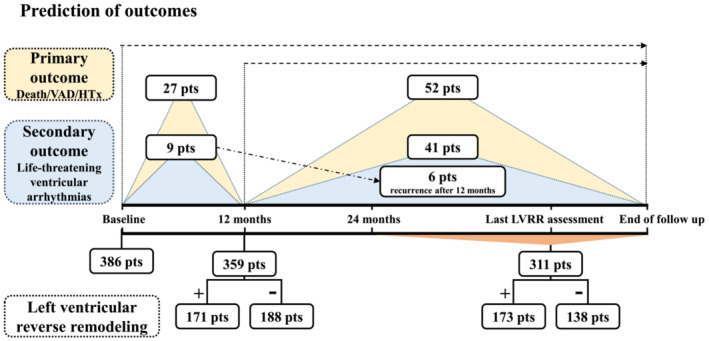
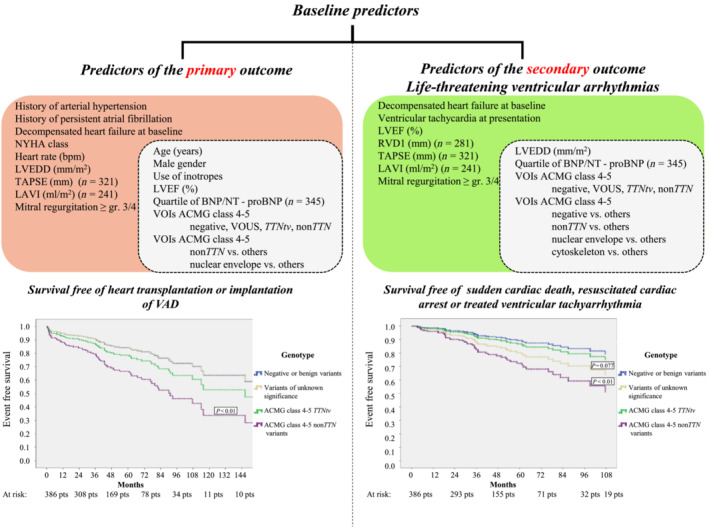
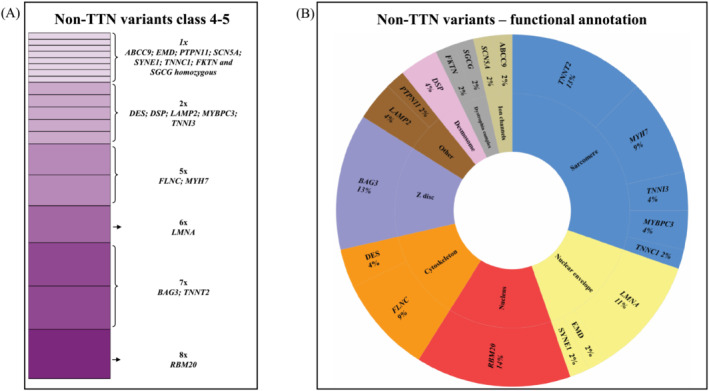
In this prospective study, a total of 386 Czech RODCM patients with symptom duration ≤6 months underwent genetic counselling and whole-exome sequencing (WES). The presence of pathogenic (class 5) or likely pathogenic (class 4) variants in a set of 72 cardiomyopathy-related genes was correlated with the occurrence of all-cause death, heart transplantation, or implantation of a ventricular assist device (primary outcome) and/or ventricular arrhythmia event (secondary outcome). LVRR was defined as an improvement of left ventricular ejection fraction to >50% or ≥10% absolute increase, with a left ventricular end-diastolic diameter ≤33 mm/m or ≥10% relative decrease. Median follow-up was 41 months. RODCM was familial in 98 (25%) individuals. Class 4-5 variants of interest (VOIs) were identified in 125 (32%) cases, with 69 (18%) having a single titin-truncating variant (TTNtv) and 56 (14%) having non-titin (non-TTN) VOIs. The presence of class 4-5 non-TTN VOIs, but not of TTNtv, heralded a lower probability of 12-month LVRR and proved to be an independent baseline predictor both of the primary and the secondary outcome. The negative result of genetic testing was a strong protective baseline variable against occurrence of life-threatening ventricular arrhythmias. Detection of class 4-5 VOIs in genes coding nuclear envelope proteins was another independent predictor of both study outcomes at baseline and also of life-threatening ventricular arrhythmias after 12 months. Class 4-5 VOIs of genes coding cytoskeleton were associated with an increased risk of life-threatening ventricular arrhythmias after baseline assessment. A positive family history of dilated cardiomyopathy alone only related to a lower probability of LVRR at 12 months and at the final follow-up.
RODCM patients harbouring class 4-5 non-TTN VOIs are at higher risk of progressive heart failure and life-threatening ventricular arrhythmias. Genotyping may improve their early risk stratification at baseline assessment.
近期发病的扩张型心肌病(RODCM)病因异质性强,临床结局多样,关于基因型与表型相关性的数据稀缺。我们的目的是将个体RODCM基因型与左心室逆向重构(LVRR)及临床结局相关联。
在这项前瞻性研究中,共有386例症状持续时间≤6个月的捷克RODCM患者接受了遗传咨询和全外显子测序(WES)。一组72个与心肌病相关基因中致病性(5类)或可能致病性(4类)变异的存在与全因死亡、心脏移植或心室辅助装置植入(主要结局)和/或室性心律失常事件(次要结局)的发生相关。LVRR定义为左心室射血分数提高至>50%或绝对增加≥10%,且左心室舒张末期直径≤33 mm/m或相对减小≥10%。中位随访时间为41个月。98例(25%)个体的RODCM为家族性。在125例(32%)病例中鉴定出4 - 5类感兴趣的变异(VOIs),其中69例(18%)有单个肌联蛋白截短变异(TTNtv),56例(14%)有非肌联蛋白(非TTN)VOIs。4 - 5类非TTN VOIs的存在而非TTNtv预示着12个月LVRR的可能性较低,并且被证明是主要结局和次要结局的独立基线预测因素。基因检测阴性是预防危及生命的室性心律失常发生的一个强有力的保护性基线变量。在编码核被膜蛋白的基因中检测到4 - 5类VOIs也是基线时两个研究结局以及12个月后危及生命的室性心律失常的另一个独立预测因素。编码细胞骨架的基因的4 - 5类VOIs与基线评估后危及生命的室性心律失常风险增加相关。仅扩张型心肌病的阳性家族史仅与12个月及最终随访时LVRR的可能性较低相关。
携带4 - 5类非TTN VOIs的RODCM患者发生进行性心力衰竭和危及生命的室性心律失常的风险更高。基因分型可能会改善他们在基线评估时的早期风险分层。