Department of Gastroenterology, The First People's Hospital of Wenling, 317500 Taizhou, Zhejiang, China.
Department of Gastroenterology, Linhai Second People's Hospital, 317016 Taizhou, Zhejiang, China.
Actas Esp Psiquiatr. 2024 Aug;52(4):571-582. doi: 10.62641/aep.v52i4.1559.
Inflammatory bowel disease (IBD) is a chronic, lifelong disease, so IBD patients are highly susceptible to negative emotions, such as anxiety and depression, resulting in a reduced quality of life. Mindfulness-based intervention (MBI) is widely used to reduce stress, anxiety and depression in people. Therefore, this study conducted a systematic review of mindfulness-based intervention training on anxiety, depression, and quality of life in patients with IBD through meta-analysis.
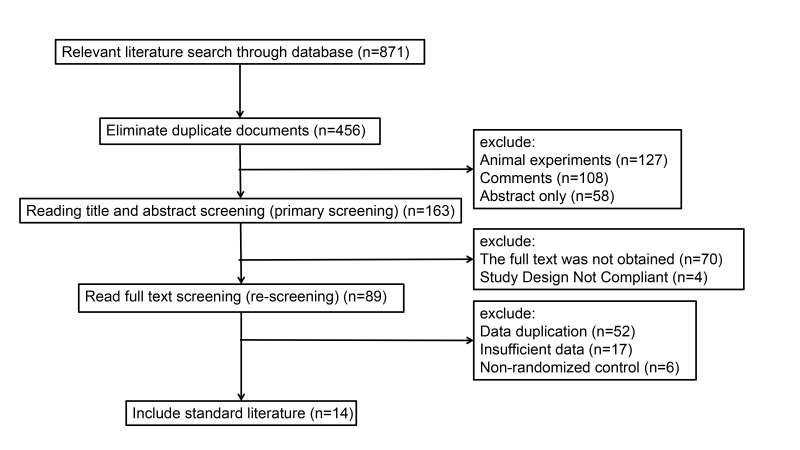
Search papers in PubMed, Web of Science, Cochrane Library, Google Scholar, CNKI, Wanfang, and Embase databases. The search time limit was from the establishment of the database to May 2023. Randomized controlled trial studies of the effect of mindfulness intervention training on patients with IBD were screened, the included results were integrated and analyzed, and ReviewManager 5.4 was used for meta-analysis.
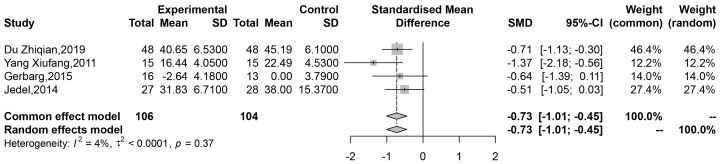
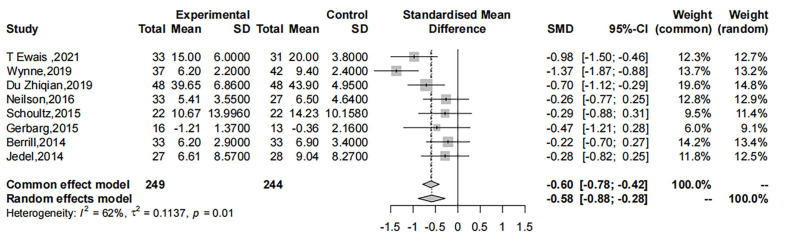
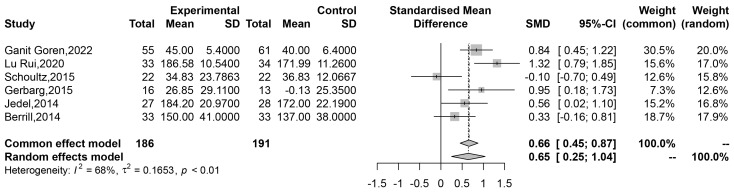
A total of 14 studies with a total of 1030 IBD patients were included. A total of 10 studies showed that the anxiety of patients in the mindfulness intervention group was significantly reduced by (standard mean difference (SMD) = -0.73, 95% confidence interval (CI): -1.01 to -0.45) compared to the control group. 8 studies showed that the intervention group significantly reduced patients' depression (SMD = -0.60, 95% CI: -0.78 to -0.42). 7 studies showed that the patient's quality of life improved after mindfulness intervention (SMD = 0.66, 95% CI: 0.45-0.87).
Mindfulness-based intervention training can improve anxiety, depression, and quality of life in patients with inflammatory bowel disease in the short term, but the long-term effects need to be confirmed by more randomized controlled trials.
炎症性肠病(IBD)是一种慢性、终身性疾病,因此 IBD 患者极易产生焦虑、抑郁等负性情绪,导致生活质量下降。正念干预(MBI)广泛应用于减轻人群压力、焦虑和抑郁。因此,本研究通过荟萃分析对 MBI 对 IBD 患者焦虑、抑郁和生活质量的影响进行了系统评价。
检索 PubMed、Web of Science、Cochrane 图书馆、Google Scholar、CNKI、万方、Embase 数据库中的文献。检索时间限定为数据库建立至 2023 年 5 月。筛选出正念干预训练对 IBD 患者影响的随机对照试验研究,对纳入结果进行整合分析,采用 ReviewManager 5.4 进行荟萃分析。
共纳入 14 项研究,共计 1030 例 IBD 患者。10 项研究表明,与对照组相比,正念干预组患者的焦虑明显降低(标准均数差(SMD)=-0.73,95%置信区间(CI):-1.01 至-0.45)。8 项研究表明,干预组患者的抑郁显著降低(SMD=-0.60,95%CI:-0.78 至-0.42)。7 项研究表明,正念干预后患者的生活质量得到改善(SMD=0.66,95%CI:0.45-0.87)。
正念干预训练短期内可改善炎症性肠病患者的焦虑、抑郁和生活质量,但长期效果需要更多的随机对照试验来证实。