Patel Kush P, Lansky Alexandra J, Kereiakes Dean J, Windecker Stephan, Cristea Ecaterina, Pietras Cody, Dressler Ovidiu, Issever M Ozgu, Curtis Michael, Bertolet Barry, Zidar James P, Smits Pieter C, Jiménez Díaz Victor Alfonso, McLaurin Brent, Brogno David A, Janssens Luc, Vrolix Mathias C, Gómez-Blázquez Iván, Sahul Zakir H, Kabour Ameer, Salido Luisa, Cleman Michael, Saito Shigeru, Leon Martin B, Baumbach Andreas
Institute of Cardiovascular Science, University College London, London, UK.
Barts Heart Centre, London, UK.
J Soc Cardiovasc Angiogr Interv. 2022 Jan 30;1(1):100004. doi: 10.1016/j.jscai.2021.100004. eCollection 2022 Jan-Feb.
The Supreme healing-targeted drug-eluting stent (DES) is designed to promote endothelial healing to reduce stent-related adverse events. This may be particularly relevant among complex lesions that have a higher rate of adverse events. We sought to compare 1-year outcomes of percutaneous coronary intervention in complex lesions between the Supreme DES and contemporary durable-polymer, everolimus-eluting stents (DP-EES).
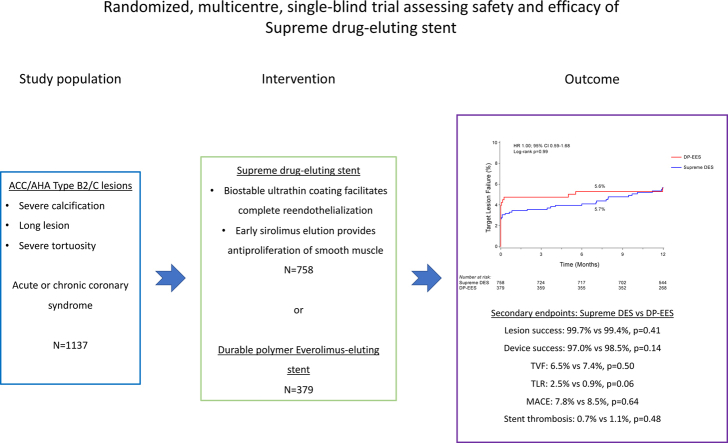
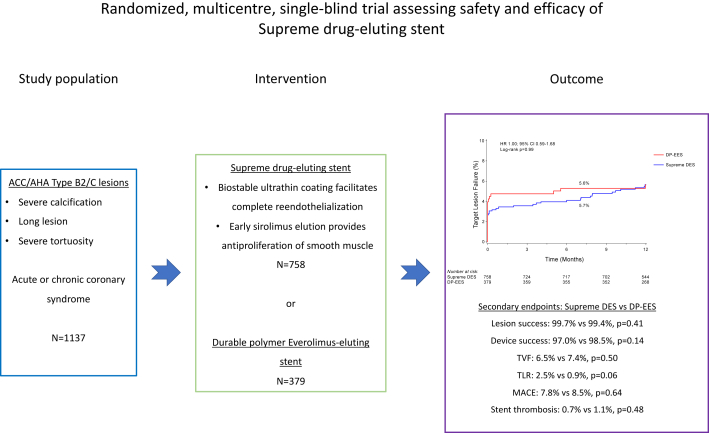
PIONEER III was a multicenter, prospective, single-blind clinical trial, randomizing 1629 patients with either an acute or chronic coronary syndrome in a 2:1 ratio to the Supreme DES or DP-EES. Complex lesions (American College of Cardiology/American Heart Association type B2/C) were found in 1137 patients. Outcomes were also compared for specific parameters of lesion complexity: severe calcification, long length (>20 mm), and severe tortuosity. The primary end point was target lesion failure at 1 year.
At 1 year, there was no difference in target lesion failure between the Supreme DES and DP-EES: (5.7% vs 5.6%; hazard ratio 1.00, 95% confidence interval 0.59-1.68, = .99). Similarly, there were no differences in the secondary end points of lesion success (99.7% vs 99.4%, = .41), device success (97.0% vs 98.5%, = .14), target vessel failure (6.5% vs 7.4%, = .50), major adverse cardiac events (7.8% vs 8.5%, = .64), or stent thrombosis (0.7% vs 1.1%, = .48). A trend was observed toward a higher rate of target lesion revascularization with the Supreme DES (2.5% vs 0.9%, = .06).
This study suggests that the Supreme DES is as effective and safe at 1 year compared with the standard DP-EES across a broad spectrum of lesion complexity.
最高愈合靶向药物洗脱支架(DES)旨在促进内皮愈合,以减少支架相关不良事件。这在不良事件发生率较高的复杂病变中可能尤为重要。我们试图比较最高DES与当代耐用聚合物依维莫司洗脱支架(DP-EES)在复杂病变中经皮冠状动脉介入治疗的1年结局。
先锋III是一项多中心、前瞻性、单盲临床试验,将1629例急性或慢性冠状动脉综合征患者按2:1的比例随机分为最高DES组或DP-EES组。1137例患者存在复杂病变(美国心脏病学会/美国心脏协会B2/C型)。还比较了病变复杂性的特定参数的结局:严重钙化、长病变(>20毫米)和严重迂曲。主要终点是1年时的靶病变失败。
1年时,最高DES与DP-EES的靶病变失败无差异:(5.7%对5.6%;风险比1.00,95%置信区间0.59-1.68,P = 0.99)。同样,在病变成功(99.7%对99.4%,P = 0.41)、器械成功(97.0%对98.5%,P = 0.14)、靶血管失败(6.5%对7.4%,P = 0.50)、主要不良心脏事件(7.8%对8.5%,P = 0.64)或支架血栓形成(0.7%对1.1%,P = 0.48)这些次要终点方面也无差异。观察到最高DES的靶病变血运重建率有升高趋势(2.5%对0.9%,P = 0.06)。
本研究表明,在广泛的病变复杂性范围内,最高DES与标准DP-EES相比,1年时同样有效且安全。