Mendez-Ruiz Alan, Lossos Izidore S, Cohen Mauricio G
Department of Medicine, University of Miami Miller School of Medicine, Miami, Florida.
Division of Hematology, Department of Medicine and Sylvester Comprehensive Cancer Center, University of Miami, Miami, Florida.
J Soc Cardiovasc Angiogr Interv. 2023 Mar 6;2(3):100608. doi: 10.1016/j.jscai.2023.100608. eCollection 2023 May-Jun.
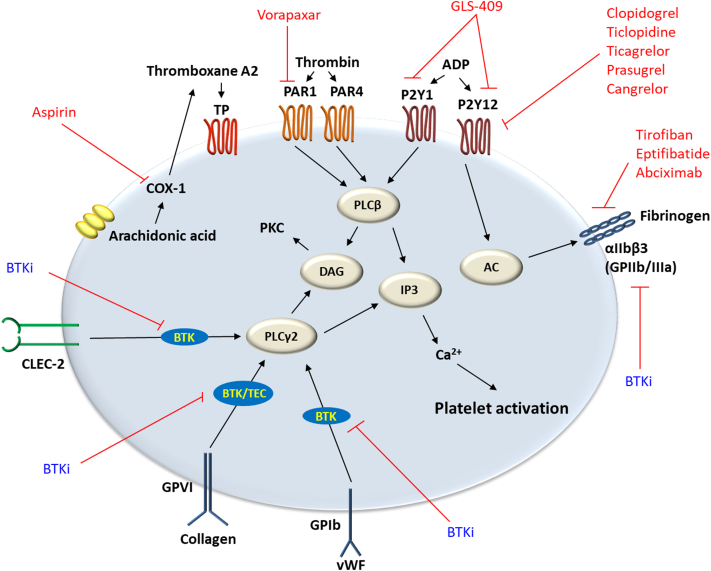
Bruton's tyrosine kinase inhibitors (BTKi), known for their off-target antiplatelet effects and increased bleeding risk, have become more frequently used in patients with cancer with lymphoid malignancies. When encountering patients on BTKi who also require antiplatelet therapies, particularly dual-antiplatelet therapy that is a well-established treatment after percutaneous coronary intervention (PCI), the potential increase in bleeding risk raises concern. The development of new-generation BTKi with a higher selectivity, such as acalabrutinib and zanubrutinib, could be an answer to this conundrum, but bleeding still occurs. It is important that the interventional cardiologist becomes familiar with agents that could affect the management of antiplatelet therapy in patients treated with PCI.
布鲁顿酪氨酸激酶抑制剂(BTKi)因其脱靶抗血小板作用和出血风险增加而闻名,在患有淋巴系统恶性肿瘤的癌症患者中使用得越来越频繁。当遇到正在使用BTKi且同时需要抗血小板治疗的患者时,尤其是在经皮冠状动脉介入治疗(PCI)后作为既定治疗方案的双联抗血小板治疗时,出血风险的潜在增加引发了人们的担忧。新一代具有更高选择性的BTKi,如阿卡拉布替尼和泽布替尼的研发,可能是解决这一难题的办法,但出血情况仍会发生。介入心脏病专家熟悉那些可能影响接受PCI治疗患者抗血小板治疗管理的药物非常重要。