Khan Danish, Vinayak Ananya A, Sitron Cole S, Brandman Onn
Department of Biochemistry, Stanford University School of Medicine, Stanford, CA 94305, USA.
Department of Cellular Biochemistry, Max Planck Institute of Biochemistry, Am Klopferspitz 18, 82152 Martinsried, Germany.
bioRxiv. 2024 Oct 14:2024.08.02.606406. doi: 10.1101/2024.08.02.606406.
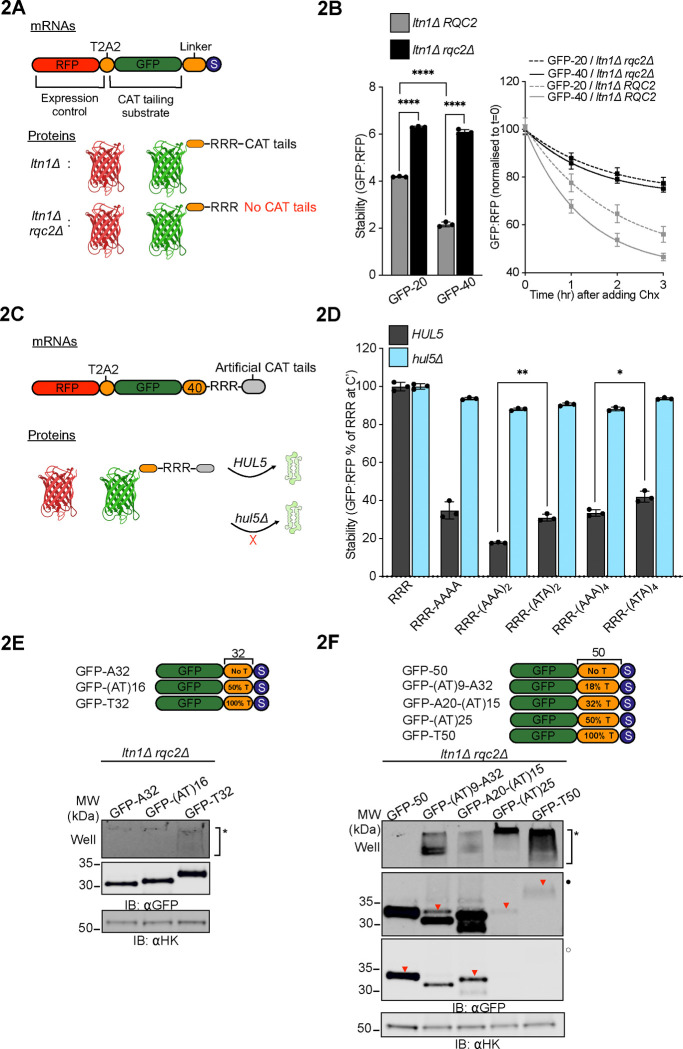
The ribosome-associated quality control (RQC) pathway resolves stalled ribosomes. As part of RQC, stalled nascent polypeptide chains (NCs) are appended with CArboxy-Terminal amino acids (CAT tails) in an mRNA-free, non-canonical elongation process. CAT tail composition includes Ala, Thr, and potentially other residues. The relationship between CAT tail composition and function has remained unknown. Using biochemical approaches in yeast, we discovered that mechanochemical forces on the NC regulate CAT tailing. We propose CAT tailing initially operates in an "extrusion mode" that increases NC lysine accessibility for on-ribosome ubiquitination. Thr in CAT tails enhances NC extrusion by preventing formation of polyalanine, which can form α-helices that lower extrusion efficiency and disrupt termination of CAT tailing. After NC ubiquitylation, pulling forces on the NC switch CAT tailing to an Ala-only "release mode" which facilitates nascent chain release from large ribosomal subunits and NC degradation. Failure to switch from extrusion to release mode leads to accumulation of NCs on large ribosomal subunits and proteotoxic aggregation of Thr-rich CAT tails.
核糖体相关质量控制(RQC)途径可解决停滞的核糖体问题。作为RQC的一部分,停滞的新生多肽链(NCs)在无mRNA的非经典延伸过程中会被添加羧基末端氨基酸(CAT尾)。CAT尾的组成包括丙氨酸、苏氨酸以及可能的其他残基。CAT尾组成与功能之间的关系一直未知。通过在酵母中使用生化方法,我们发现NC上的机械化学力调节CAT尾化。我们提出,CAT尾化最初以“挤出模式”运行,该模式增加了NC赖氨酸可及性,以进行核糖体上的泛素化。CAT尾中的苏氨酸通过防止聚丙氨酸的形成来增强NC挤出,聚丙氨酸可形成α-螺旋,从而降低挤出效率并破坏CAT尾化的终止。在NC泛素化后,NC上的拉力将CAT尾化切换为仅含丙氨酸的“释放模式”,这有利于新生链从大核糖体亚基释放以及NC降解。无法从挤出模式切换到释放模式会导致NC在大核糖体亚基上积累以及富含苏氨酸的CAT尾的蛋白毒性聚集。