
基于电子密度的质子阻止本领比和平均激发能的估计及其通过机器学习方法的应用
Estimation of Proton Stopping Power Ratio and Mean Excitation Energy Using Electron Density and Its Applications via Machine Learning Approach.
作者信息
Chika Charles Ekene
机构信息
Department of Mathematics, University of Nigeria, Nsukka, Enugu, Nigeria.
出版信息
J Med Phys. 2024 Apr-Jun;49(2):155-166. doi: 10.4103/jmp.jmp_157_23. Epub 2024 Jun 25.
PURPOSE
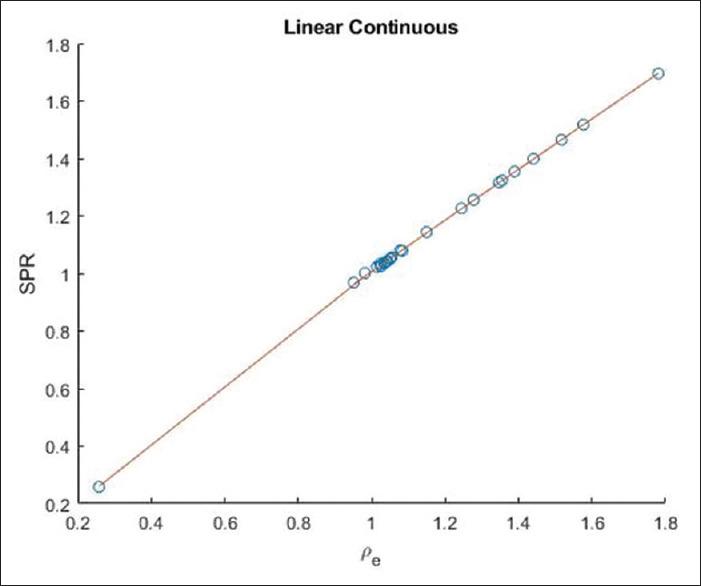
The purpose of this study was to develop a simple flexible method for accurate estimation of stopping power ratio (SPR) and mean excitation energy () using relative electron density ( ).
MATERIALS AND METHODS
The model was formulated using empirical relationships between SPR, mean excitation energy , and relative electron density. Some examples were implemented, and a comparison was carried out using other existing methods. The needed coefficients in the model were estimated using optimization tools. Basis vector method (BVM) and Hunemohr and Saito (H-S) method were applied to estimate the used in the application section. 80 kVp and 150 kVpSn were used as low and high energy, respectively, for the implementation of dual-energy methods.
RESULTS
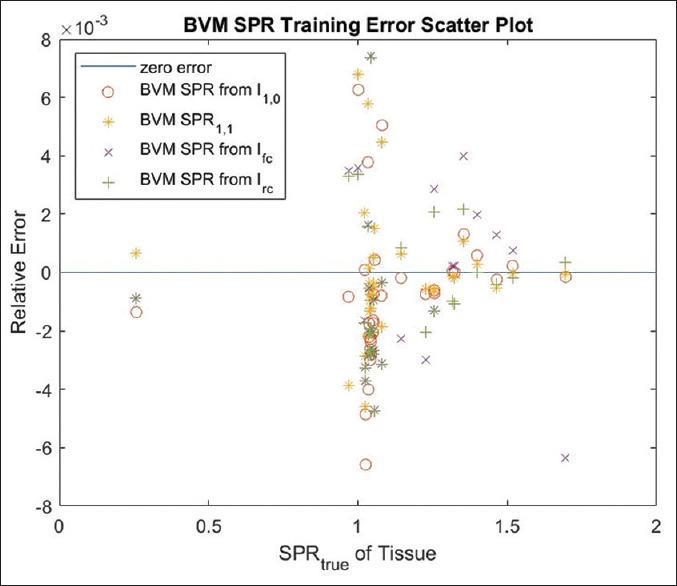
All the examples of the proposed method considered have modeling error that is ≤0.32% and testing root mean square error (RMSE) ≤0.92% for SPR with a mean error close to 0.00%. The method was able to achieve modeling RMSE of 2.12% for mean excitation energy with room for improvement. Similar or better results were achieved in application to BVM.
CONCLUSION
The method showed robustness in application by achieving lower testing error than other presented methods in most cases. It achieved accurate estimation which can be improved using the machine learning algorithm since it is flexible to implement in terms of the function (model) degree and tissue classification.
目的
本研究的目的是开发一种简单灵活的方法,用于使用相对电子密度( )准确估计阻止本领比(SPR)和平均激发能( )。
材料与方法
该模型是利用SPR、平均激发能 和相对电子密度之间的经验关系建立的。给出了一些示例,并与其他现有方法进行了比较。模型中所需的系数使用优化工具进行估计。应用基向量法(BVM)和胡内莫尔与斋藤(H-S)法来估计应用部分中使用的 。分别使用80 kVp和150 kVpSn作为低能和高能来实施双能方法。
结果
所提出方法的所有示例对于SPR的建模误差均≤0.32%,测试均方根误差(RMSE)≤0.92%,平均误差接近0.00%。该方法对于平均激发能能够实现2.12%的建模RMSE,仍有改进空间。在应用于BVM时取得了相似或更好的结果。
结论
该方法在应用中表现出稳健性,在大多数情况下比其他提出的方法具有更低的测试误差。它实现了准确估计,由于在函数(模型)程度和组织分类方面易于实现,因此可以使用机器学习算法进行改进。






 Zotero 插件