Sidik Novalia, McEntegart Margaret, Joshi Francis, Owens Colum, Shaukat Aadil, Gallagher Sean, Strange Julian, Tang Kare, Elghamaz Ahmed, Mozid Abdul, Ladwiniec Andrew, Oldroyd Keith, Schuette Diana, Copt Samuel, Spratt James C
Golden Jubilee National Hospital, Glasgow, United Kingdom.
Royal Victoria Hospital, Belfast, United Kingdom.
J Soc Cardiovasc Angiogr Interv. 2024 May 18;3(7):102017. doi: 10.1016/j.jscai.2024.102017. eCollection 2024 Jul.
Chronic total occlusion (CTO) remains the most complex anatomical subset of lesions in percutaneous coronary intervention (PCI), often requiring advanced techniques and technologies, including the use of microcatheters.
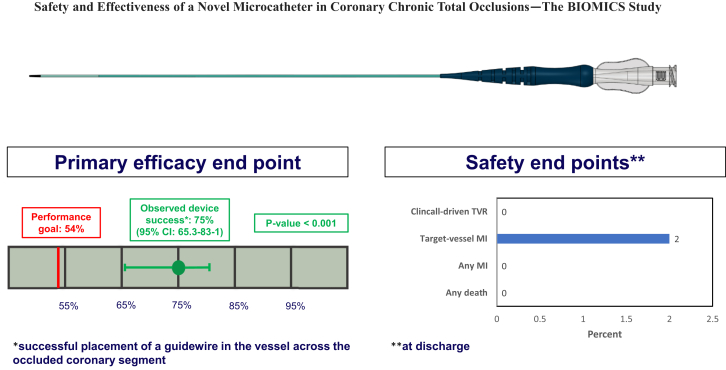
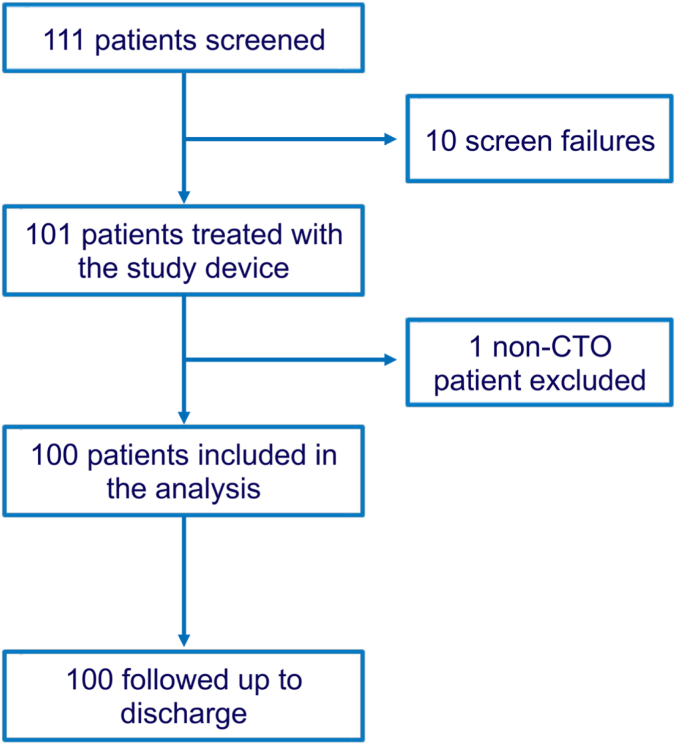
The BIOMICS study is a premarket first-in-human prospective, multicenter, open-label, single-arm trial investigating the safety and efficacy of a novel coronary microcatheter (BioMC, Biosensors International) in 100 patients with symptoms of ischemia undergoing elective CTO-PCI. The primary efficacy end point of the study was device success defined according to the CTO-ARC (Chronic Total Occlusion Academic Research Consortium) criteria namely the ability of the microcatheter to successfully facilitate placement of a guide wire beyond the occluded coronary segment. The primary safety end point was the incidence of in-hospital cardiac death or myocardial infarction at hospital discharge.
Hundred patients were recruited between March 2022 and January 2023. The primary efficacy end point was achieved in 75% of patients (95% CI, 65.3%-83.1%; < .0001 for superiority compared to the prespecified performance goal of 54%). The primary safety end point of in-hospital cardiac death or myocardial infarction was observed in 2% of the patients. There were no study device-related coronary perforations or device failures.
The use of a novel coronary microcatheter during CTO-PCI was associated with a high device success and an excellent safety profile.
慢性完全闭塞病变(CTO)仍是经皮冠状动脉介入治疗(PCI)中最复杂的病变解剖类型,通常需要先进的技术,包括使用微导管。
BIOMICS研究是一项上市前的首次人体前瞻性、多中心、开放标签、单臂试验,旨在研究一种新型冠状动脉微导管(BioMC,百生科技)在100例有缺血症状且接受择期CTO-PCI治疗的患者中的安全性和有效性。该研究的主要疗效终点是根据CTO-ARC(慢性完全闭塞学术研究联盟)标准定义的器械成功,即微导管成功促进导丝穿过闭塞冠状动脉节段的能力。主要安全终点是出院时院内心脏死亡或心肌梗死的发生率。
2022年3月至2023年1月招募了100例患者。75%的患者达到了主要疗效终点(95%CI,65.3%-83.1%;与预先设定的54%的性能目标相比,优越性P<0.0001)。2%的患者出现了主要安全终点,即院内心脏死亡或心肌梗死。没有与研究器械相关的冠状动脉穿孔或器械故障。
在CTO-PCI期间使用新型冠状动脉微导管具有较高的器械成功率和出色的安全性。