
乳糜泻患儿临床实践中麸质摄入量与麸质免疫原性肽之间的关联
Association in Clinical Practice Between Gluten Intake and Gluten Immunogenic Peptides in Celiac Children.
作者信息
Meijer Caroline R, Bakker Jaap, Boers Anneloes, Jansen Sophie, Mengi Zeliha, Mearin Maria Luisa
机构信息
Department of Pediatric Gastroenterology, Leiden University Medical Center, Willem Alexander Children's Hospital, Leiden, The Netherlands.
Department of Clinical Chemistry and Laboratory Medicine, Leiden University Medical Center, Leiden, The Netherlands.
出版信息
Gastro Hep Adv. 2022 Apr 28;1(4):652-658. doi: 10.1016/j.gastha.2022.04.015. eCollection 2022.
BACKGROUND AND AIMS
The dietary compliance and its assessment in celiac disease (CD) patients on a strict gluten-free diet (GFD) remain a challenge. Two relatively new, validated methods have been proposed to detect occasional gluten ingestion: standardized dietary questionnaire and determination of urinary gluten immunogenic peptides (GIPs). Our aim was to prospectively assess dietary compliance via these methods and compare their results with those of tissue transglutaminase antibodies (tTGA).
METHODS
This was a prospective single-center study. Consecutive CD patients (aged 1-18 years) on a GFD scheduled for regular consultation between March and August 2019 were invited. In addition to standard care, a completed dietary questionnaire and urine sample for GIP were collected. Pearson's chi-square test, Fisher's exact test, and Mann-Whitney U test were performed.
RESULTS
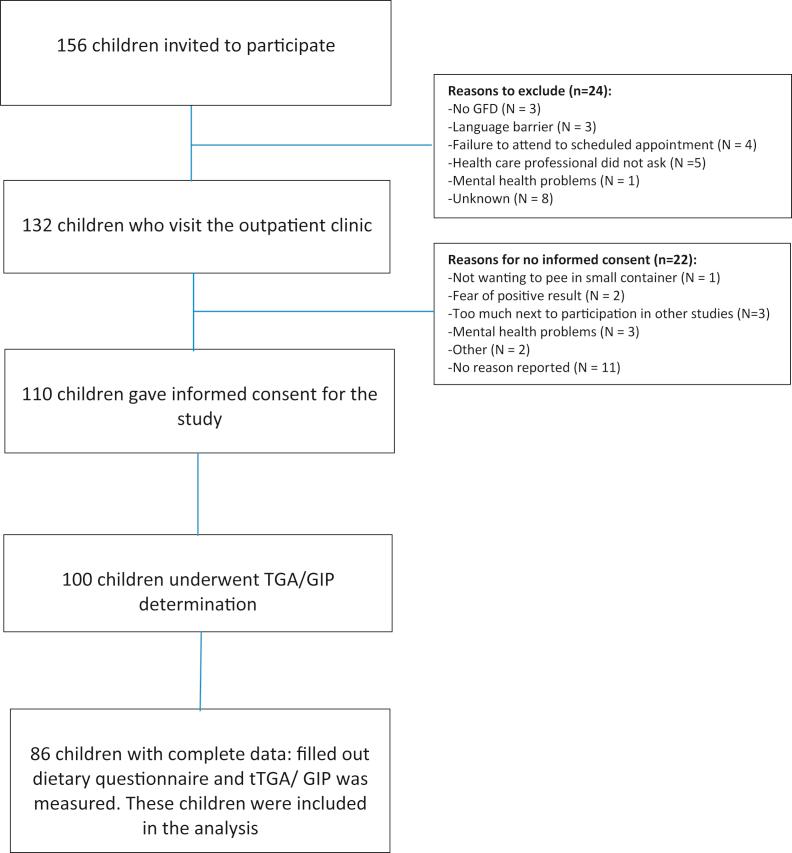
Of the 156 eligible children, 110 provided informed consent. Completed dietary questionnaire, GIP, and tTGA results were available from 86 children (median age 12.8 years, median GFD duration 30 months, 65% female). Adherence to the GFD evaluated by GIP, dietary questionnaire, and anti-tTGA was 94.2%, 75.6% and 94.2%, respectively. No association was found between the tTGA results and the detection of GIP, as well as between the tTGA results and the dietary questionnaires scores ( = .5 and .312, respectively). The participants perceived both the questionnaire and the measurement of GIP as reassuring with regard to correct implementation of the GFD.
CONCLUSION
All the 3 methods have limitations to monitor dietary compliance. The comparison of their performance shows that the best single method is the use of the validated dietary questionnaire, which should therefore be implemented in the regular care for children with CD. The most effective combination of dietary questionnaire and urinary GIP determination should be used in specific clinical situations.
背景与目的
对于严格遵循无麸质饮食(GFD)的乳糜泻(CD)患者,饮食依从性及其评估仍然是一项挑战。已经提出了两种相对较新的、经过验证的方法来检测偶尔摄入的麸质:标准化饮食问卷和尿麸质免疫原性肽(GIP)测定。我们的目的是通过这些方法前瞻性地评估饮食依从性,并将其结果与组织转谷氨酰胺酶抗体(tTGA)的结果进行比较。
方法
这是一项前瞻性单中心研究。邀请了2019年3月至8月期间计划定期复诊的连续CD患者(年龄1 - 18岁),这些患者正在遵循GFD饮食。除了标准护理外,还收集了一份完整的饮食问卷和用于GIP检测的尿液样本。进行了Pearson卡方检验、Fisher精确检验和Mann - Whitney U检验。
结果
在156名符合条件的儿童中,110名提供了知情同意书。86名儿童(中位年龄12.8岁,中位GFD持续时间3个月,65%为女性)有完整的饮食问卷、GIP和tTGA结果。通过GIP、饮食问卷和抗tTGA评估的GFD依从性分别为94.2%、75.6%和94.2%。未发现tTGA结果与GIP检测之间以及tTGA结果与饮食问卷得分之间存在关联(分别为P = 0.5和0.312)。参与者认为问卷和GIP测量对于正确实施GFD都令人放心。
结论
所有这三种方法在监测饮食依从性方面都有局限性。它们性能的比较表明,最佳的单一方法是使用经过验证的饮食问卷,因此应在CD儿童的常规护理中实施。饮食问卷和尿GIP测定的最有效组合应在特定临床情况下使用。
 Zotero 插件