Alonso Manuel Díez, Moreno Fernando Mendoza, Mansilla Cristina Vera, Matías Belén, Jimenez Rubén, Allaoua Youssef, Moraza Ignacio Busteros, Vilar Alberto, Barrena Silvestra, Díaz-Pedrero Raúl, Ortega Miguel A, de Mon Melchor Alvarez, Gutierrez Alberto
Department of General and Digestive Surgery, University Hospital Príncipe de Asturias, 28805 Madrid, Spain.
Department of Surgery, Medical and Social Sciences. Faculty of Medicine and Health Sciences, University of Alcalá, 28801 Alcalá de Henares, Spain.
J Cancer. 2024 Jul 9;15(15):4789-4800. doi: 10.7150/jca.96655. eCollection 2024.
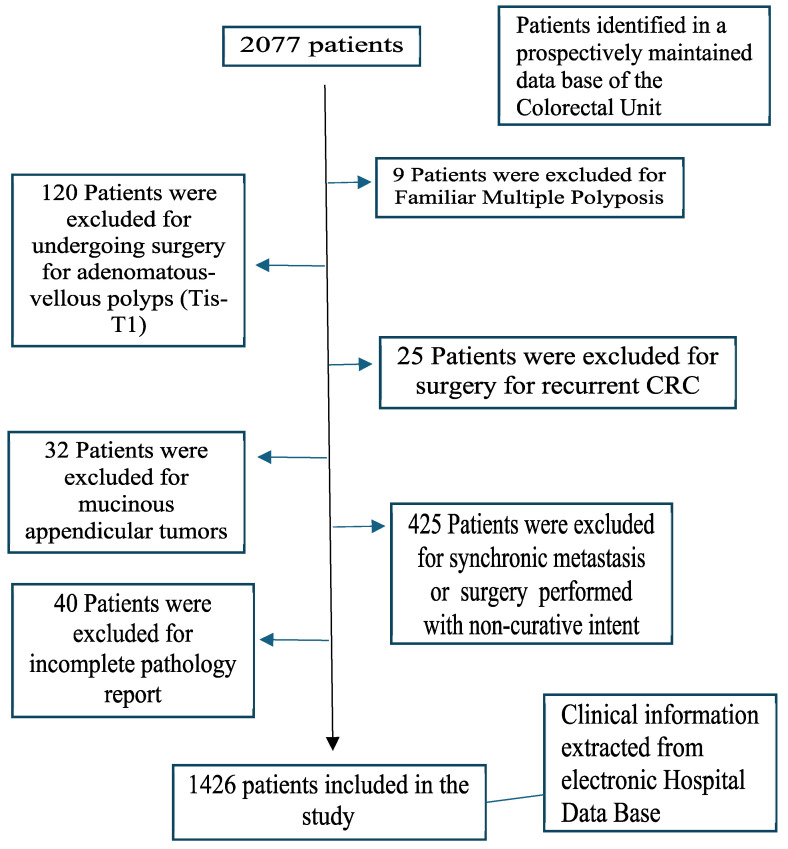
Tumor nodules or tumor deposits (TDs) are a histopathological prognostic factor that are associated with a negative evolutionary course in patients with colorectal cancer (CRC). There are still controversial aspects of TDs, including how they should be integrated into the TNM classification system. The objective of this study was to analyze the predictive value of TDs for cancer-related survival (CRS) and time-to-recurrence survival (TTR) and to evaluate the prognostic value of TDs in patients whose tumors also presented lymph node metastasis (LNM). In this retrospective observational study, all patients treated for CRC between January 2010 and December 2020 at the same hospital were included. CRS and TTR were classified by tumor stage. The results were compared between patients whose tumors had TDs and patients whose tumors did not. A total of 1426 patients met the criteria for inclusion in the analysis. TDs were detected in 178 patients (12.5%): 60 had tumors without LNM, and 118 had LNM. Patients with TD tumors had a lower CRS at 60 months after diagnosis (42% vs. 82%; p < 0.001) and a shorter TTR (34% vs. 79%; p < 0.001). Cox multiple regression analysis revealed that the presence of TD was associated with an increased risk of death from CRC (HR: 1.820; 95% CI: 1.327-2.496) and an increased risk of recurrence (HR: 2.315; 95% CI: 1.743-3.073). In each N stage category, the CRS was significantly lower in the subgroup with TD: in patients with N1a tumors, the CRS was 44% when TD vs. 70% when TD (p = 0.019); in the N1b group it was 36% vs. 66% (p < 0.001); in the N2a group it was 34% vs. 58% (p = 0.012); and in N2b tumors it was 23% vs. 53% (p = 0.031). The present study shows that the information on the presence of TDs is complementary to that provided by LNM and allows the identification of subgroups of patients in each N stage determined by two metrics, CRS and TTR. TDs should be included in the definition of TNM system categories in patients who simultaneously present with LNM.
肿瘤结节或肿瘤沉积物(TDs)是一种组织病理学预后因素,与结直肠癌(CRC)患者的不良病程相关。TDs仍存在一些争议性方面,包括应如何将其纳入TNM分类系统。本研究的目的是分析TDs对癌症相关生存(CRS)和复发时间生存(TTR)的预测价值,并评估TDs在肿瘤同时伴有淋巴结转移(LNM)患者中的预后价值。在这项回顾性观察研究中,纳入了2010年1月至2020年12月在同一家医院接受CRC治疗的所有患者。CRS和TTR按肿瘤分期分类。比较了肿瘤有TDs的患者和肿瘤无TDs的患者的结果。共有1426例患者符合纳入分析的标准。178例患者(12.5%)检测到TDs:60例患者肿瘤无LNM,118例患者有LNM。TD肿瘤患者在诊断后60个月时的CRS较低(42%对82%;p<0.001),TTR较短(34%对79%;p<0.001)。Cox多因素回归分析显示,TD的存在与CRC死亡风险增加(HR:1.820;95%CI:1.327 - 2.496)和复发风险增加(HR:2.315;95%CI:1.743 - 3.073)相关。在每个N分期类别中,有TD的亚组的CRS显著较低:在N1a肿瘤患者中,有TD时CRS为44%,无TD时为70%(p = 0.019);在N1b组中分别为36%对66%(p<0.001);在N2a组中为34%对58%(p = 0.012);在N2b肿瘤中为23%对53%(p = 0.031)。本研究表明,TDs存在的信息与LNM提供的信息互补,并允许通过CRS和TTR这两个指标确定每个N分期中的患者亚组。对于同时伴有LNM的患者,TDs应纳入TNM系统类别的定义中。