Jiang Hongying, Zheng Qi, Cheng Yun-Ju, Buzoianu Manuela, Neubrander Rachel, Zusterzeel Robbert, Farb Andrew, Moscucci Mauro
Center for Devices and Radiological Health, US Food and Drug Administration, Silver Spring, Maryland.
Center for Drug Evaluation and Research, US Food and Drug Administration, Silver Spring, Maryland.
J Soc Cardiovasc Angiogr Interv. 2023 Jan 2;2(1):100541. doi: 10.1016/j.jscai.2022.100541. eCollection 2023 Jan-Feb.
A recent analysis of a large registry showed differences in periprocedural outcomes of the Watchman left atrial appendage closure device in males compared with females. The objective of our study was to investigate the 5-year event rate in males and females enrolled in the Watchman device premarket clinical studies submitted for US Food and Drug Administration review.
We conducted a patient-level meta-analysis of 2256 patients from 4 studies: the PROTECT AF (Embolic Protection in Patients with Atrial Fibrillation) and PREVAIL (Prospective Randomized Evaluation of the Watchman Left Atrial Appendage Closure Device in Patients with Atrial Fibrillation vs Long-Term Warfarin Therapy) randomized controlled trials and their continued-access registries-CAP1 (Continued Access to PROTECT AF) and CAP2 (Continued Access to PREVAIL). The outcomes evaluated were ischemic stroke (IS), IS/systemic embolism, hemorrhagic stroke (HS), and all-cause mortality. Mixed-effects Cox regression models and statistical testing for treatment-by-sex interaction were used to compare left atrial appendage closure vs warfarin in males and females. Hazard ratios adjusted (aHRs) for CHADS scores were generated using the same model with CHADS score as a covariate. Time-to-event end points were evaluated using the Kaplan-Meier method and log-rank test.
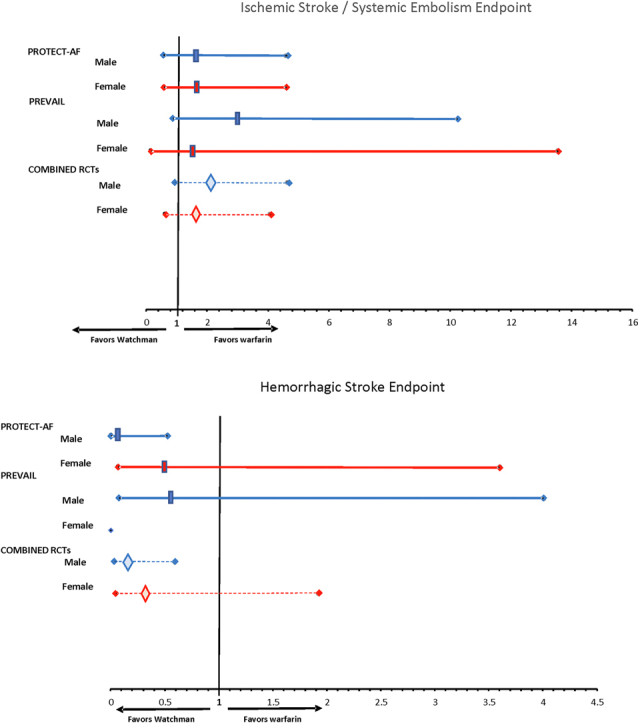
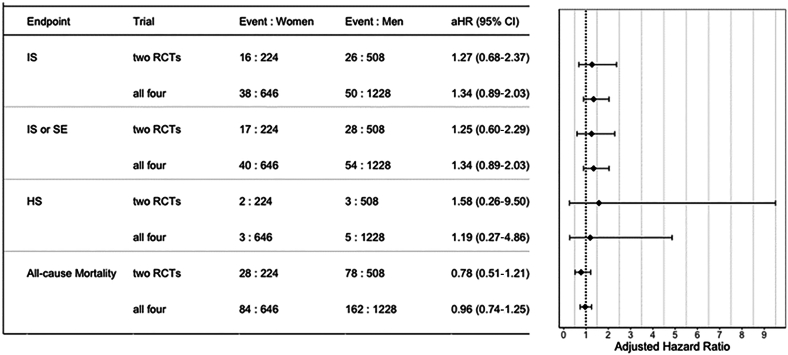
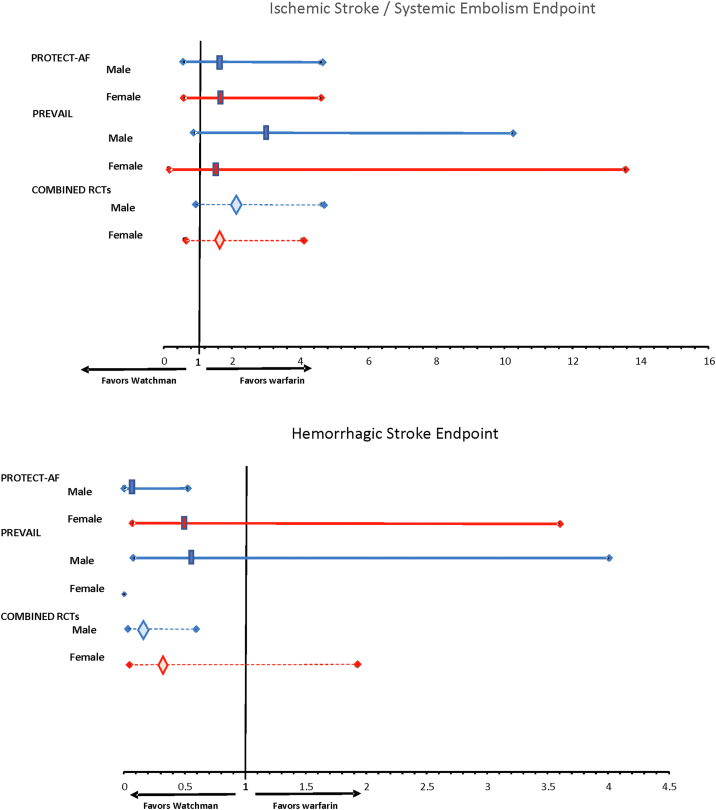
For Watchman vs warfarin in the 2 randomized controlled trials, there was no significant interaction between sex and treatment for IS, IS/systemic embolism, HS, and all-cause mortality ( > .05); both males and females in the Watchman group had a lower aHR for HS than that in the warfarin group, which was statistically significant for males (aHR, 0.163; 95% CI, 0.045-0.593). In addition, there were no differences in outcomes between females and males treated with the Watchman device when pooling all studies.
These data suggest that sex does not significantly affect the long-term safety and effectiveness of the Watchman device in patients with nonvalvular atrial fibrillation; however, further studies are needed.
最近一项对大型注册研究的分析显示,与女性相比,男性使用Watchman左心耳封堵装置的围手术期结果存在差异。我们研究的目的是调查参与提交给美国食品药品监督管理局审查的Watchman装置上市前临床研究的男性和女性的5年事件发生率。
我们对来自4项研究的2256例患者进行了患者水平的荟萃分析:PROTECT AF(心房颤动患者的栓塞保护)和PREVAIL(Watchman左心耳封堵装置与长期华法林治疗在心房颤动患者中的前瞻性随机评估)随机对照试验及其继续入组注册研究——CAP1(继续入组PROTECT AF)和CAP2(继续入组PREVAIL)。评估的结局包括缺血性卒中(IS)、IS/系统性栓塞、出血性卒中(HS)和全因死亡率。使用混合效应Cox回归模型和性别交互作用的统计检验来比较男性和女性左心耳封堵与华法林治疗的效果。使用相同模型并将CHADS评分作为协变量生成CHADS评分调整后的风险比(aHRs)。使用Kaplan-Meier方法和对数秩检验评估事件发生时间终点。
在2项随机对照试验中,对于Watchman与华法林治疗,IS、IS/系统性栓塞、HS和全因死亡率在性别与治疗之间无显著交互作用(P>0.05);Watchman组的男性和女性HS的aHR均低于华法林组,其中男性具有统计学意义(aHR,0.163;95%CI,0.045-0.593)。此外,汇总所有研究时,接受Watchman装置治疗的女性和男性在结局方面无差异。
这些数据表明,性别对非瓣膜性心房颤动患者使用Watchman装置的长期安全性和有效性无显著影响;然而,仍需要进一步研究。