Akhter Most Jesmin, Al-Amin Md, Hossain Md Akram, Kamal Md Murtuza
Department of Food Processing and Preservation Faculty of Engineering Hajee Mohammad Danesh Science and Technology University, Dinajpur 5200, Bangladesh.
Int J Food Sci. 2024 Aug 2;2024:2662967. doi: 10.1155/2024/2662967. eCollection 2024.
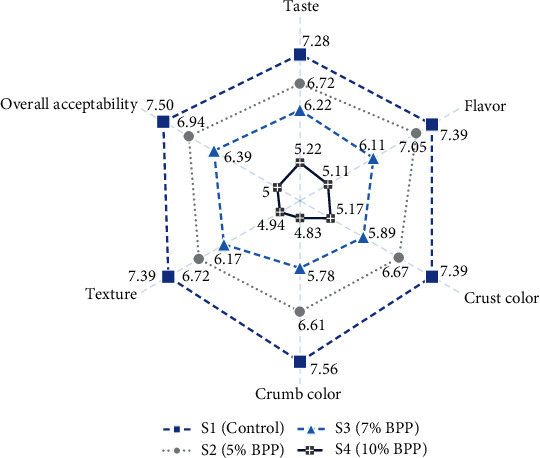
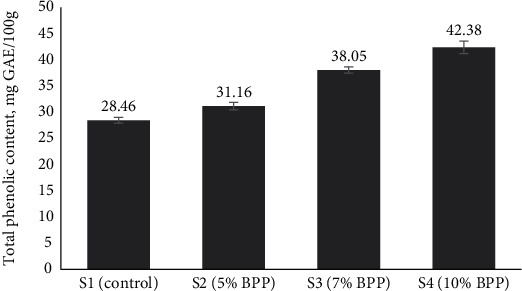
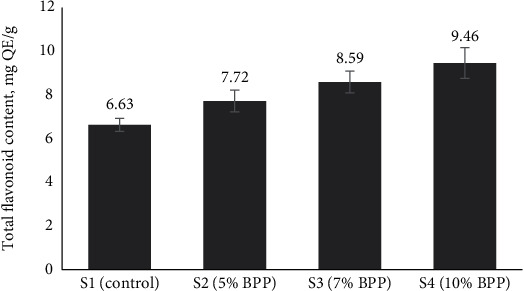
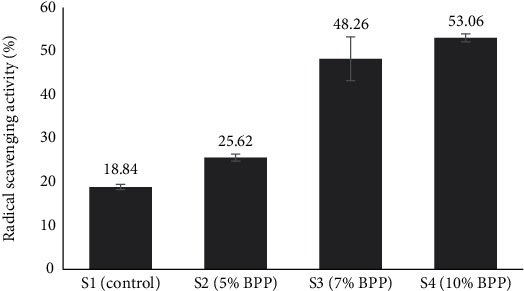
This research investigated the impact of enriching bread with banana peel powder (BPP) on nutritional attributes, bioactive components, antioxidant activity, and sensory characteristics. Four bread samples were prepared and evaluated: S1 (control), S2 (5% BPP), S3 (7% BPP), and S4 (10% BPP). The addition of BPP resulted in a reduction in moisture content and an increase in ash, fat, protein, and fibre levels, while reducing overall carbohydrate content. Furthermore, BPP-enriched bread exhibited an increase in total phenolic content (TPC) (ranging from 28.46 to 42.38 mg GAE/100 g) and total flavonoid content (TFC) (ranging from 6.63 to 9.46 QE mg/g), indicating enhanced antioxidant properties. The DPPH assay demonstrated the antioxidant potential of BPP-incorporated bread, with the radical scavenging activity (RSA) increasing from 18.84% to 53.03% with increasing BPP enrichment. Color assessment revealed changes in both crust and crumb, with a decrease from 78.46 to 40.53 in the lightness (∗) value of the crust and from 61.21 to 41.10 in the lightness (∗) value of the crumb. Additionally, changes in ∗ and ∗ values were observed. The ∗ values varied between 17.59 and 12.42 for the crust and between 6.96 and 5.89 for the crumb. The ∗ values varied between 31.61 and 23.65 for the crust and between 19.63 and 16.58 for the crumb. Sensory evaluation suggested that up to 5% BPP inclusion in bread mirrored the texture, taste, appearance, and overall acceptability of control bread, but enrichment beyond 5% resulted in lower sensory scores. In summary, the incorporation of BPP significantly influenced various aspects of bread, highlighting its potential for applications in the food and industry sectors.
本研究调查了用香蕉皮粉(BPP)强化面包对其营养特性、生物活性成分、抗氧化活性和感官特性的影响。制备并评估了四个面包样品:S1(对照)、S2(5%BPP)、S3(7%BPP)和S4(10%BPP)。添加BPP导致水分含量降低,灰分、脂肪、蛋白质和纤维含量增加,同时降低了总碳水化合物含量。此外,富含BPP的面包总酚含量(TPC)增加(范围为28.46至42.38mg GAE/100g),总黄酮含量(TFC)增加(范围为6.63至9.46 QE mg/g),表明抗氧化性能增强。DPPH测定表明,加入BPP的面包具有抗氧化潜力,随着BPP添加量的增加,自由基清除活性(RSA)从18.84%增加到53.03%。颜色评估显示,面包皮和面包心均有变化,面包皮的明度()值从78.46降至40.53,面包心的明度()值从61.21降至41.10。此外,还观察到和值的变化。面包皮的值在17.59至12.42之间,面包心的值在6.96至5.89之间。面包皮的值在31.61至23.65之间,面包心的值在19.63至16.58之间。感官评价表明,面包中加入高达5%BPP时,其质地、味道、外观和总体可接受性与对照面包相似,但超过5%的添加量会导致感官评分降低。总之,BPP的加入显著影响了面包的各个方面,突出了其在食品和工业领域的应用潜力。