Hamilton Ashleigh C, Bannon Finian J, Dunne Philip D, James Jacqueline, McQuaid Stephen, Gray Ronan T, Salto-Tellez Manuel, Cardwell Chris R, Loughrey Maurice B, Coleman Helen G
Centre for Public Health, Queen's University Belfast, Northern Ireland, UK.
Patrick G. Johnston Centre for Cancer Research, Queen's University Belfast, Northern Ireland, UK.
Gastro Hep Adv. 2022 Nov 8;2(3):347-359. doi: 10.1016/j.gastha.2022.11.005. eCollection 2023.
The observed increase in the incidence of early-onset colorectal cancer (EOCRC) is being driven by sporadic cases, but the molecular characteristics of these tumors are not fully understood. Our objective was to investigate the prevalence of microsatellite instability (MSI) and selected mutations in sporadic EOCRC, and their association with survival.
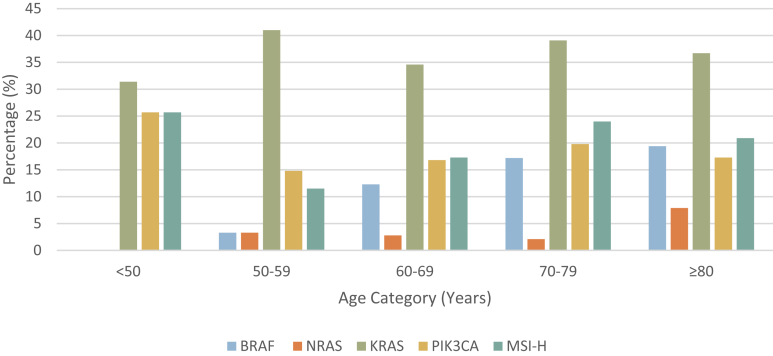
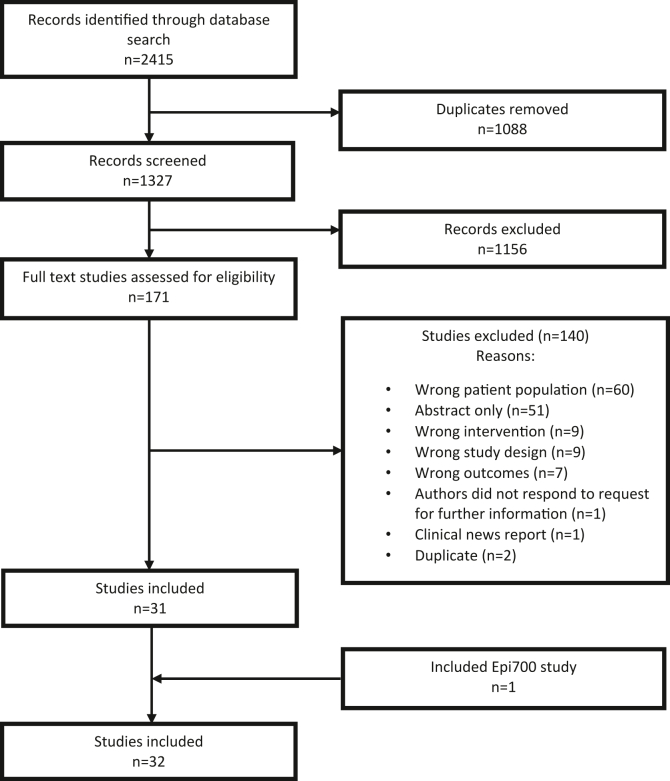
Firstly, we compared the prevalence of molecular characteristics and survival within a population-based cohort study of 652 stage II and III colon cancer patients in Northern Ireland, comparing sporadic early-onset (<50 years, n = 35) with older (60-69 years, n = 179) patients. Secondly, a systematic review for studies reporting the prevalence of MSI, mismatch repair deficiency (dMMR), or , , , , and mutations in sporadic EOCRC was conducted. A meta-analysis was performed to calculate pooled estimates of the prevalence of molecular features in sporadic EOCRC.
Firstly, within the cohort study, EOCRC patients did not have a significantly increased risk of colorectal cancer-specific death (adjusted hazard ratio 1.20; 95% confidence interval [CI] 0.61-2.39) compared with 60- to 69-year-olds. Second, 32 studies were included in the systematic review. The pooled analysis estimated a prevalence of 10% (95% CI 7%-14%) for MSI high/dMMR in sporadic EOCRC. and mutations had a prevalence of 1% (95% CI 0%-3%) and 32% (95% CI 23%-40%), respectively.
The molecular characteristics of sporadic EOCRC differ from those of cancers in older adults, particularly regarding reduced prevalence of mutations. Ten percent of sporadic EOCRC display MSI high/dMMR. Further studies are needed to address survival in sporadic EOCRC cases and whether molecular profiles influence EOCRC outcomes in this patient group.
早发性结直肠癌(EOCRC)发病率的上升是由散发病例推动的,但这些肿瘤的分子特征尚未完全明确。我们的目的是研究散发性EOCRC中微卫星不稳定性(MSI)和特定突变的发生率,以及它们与生存率的关系。
首先,在北爱尔兰一项基于人群的队列研究中,我们比较了652例II期和III期结肠癌患者的分子特征发生率和生存率,将散发性早发性(<50岁,n = 35)患者与老年(60 - 69岁,n = 179)患者进行对比。其次,对报告散发性EOCRC中MSI、错配修复缺陷(dMMR)或 、 、 、 、 和 突变发生率的研究进行了系统综述。进行荟萃分析以计算散发性EOCRC中分子特征发生率的合并估计值。
首先,在队列研究中,与60至69岁的患者相比,EOCRC患者的结直肠癌特异性死亡风险没有显著增加(调整后的风险比为1.20;95%置信区间[CI]为0.61 - 2.39)。其次,系统综述纳入了32项研究。汇总分析估计,散发性EOCRC中MSI高/dMMR的发生率为10%(95%CI为7% - 14%)。 和 突变的发生率分别为1%(95%CI为0% - 3%)和32%(95%CI为23% - 40%)。
散发性EOCRC的分子特征与老年患者的癌症不同,特别是 突变的发生率较低。10%的散发性EOCRC表现为MSI高/dMMR。需要进一步研究来探讨散发性EOCRC病例的生存率,以及分子特征是否会影响该患者群体的EOCRC预后。