Department of Forensic Science, University of Toronto, Mississauga, Canada.
Department of Occupational Science and Occupational Therapy, University of Toronto, Toronto, Canada.
PLoS Med. 2024 Aug 12;21(8):e1004418. doi: 10.1371/journal.pmed.1004418. eCollection 2024 Aug.
Traumatic brain injury (TBI) is disproportionately prevalent among individuals who intersect or are involved with the criminal justice system (CJS). In the absence of appropriate care, TBI-related impairments, intersecting social determinants of health, and the lack of TBI awareness in CJS settings can lead to lengthened sentences, serious disciplinary charges, and recidivism. However, evidence suggests that most clinical practice guidelines (CPGs) overlook equity and consequently, the needs of disadvantaged groups. As such, this review addressed the research question "To what extent are (1) intersections with the CJS considered in CPGs for TBI, (2) TBI considered in CPGs for CJS, and (3) equity considered in CPGs for CJS?".
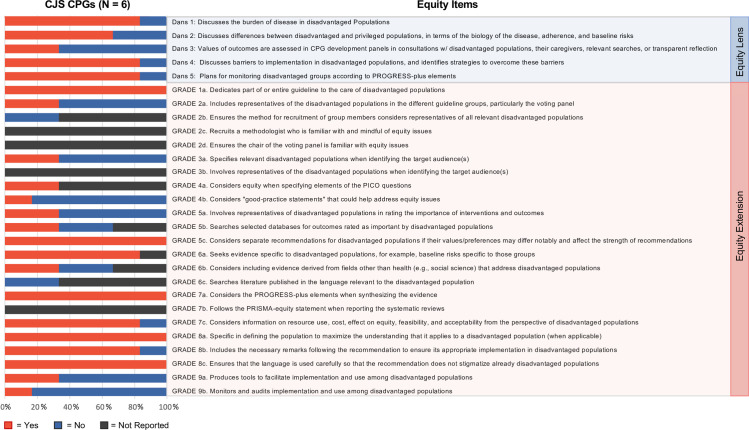
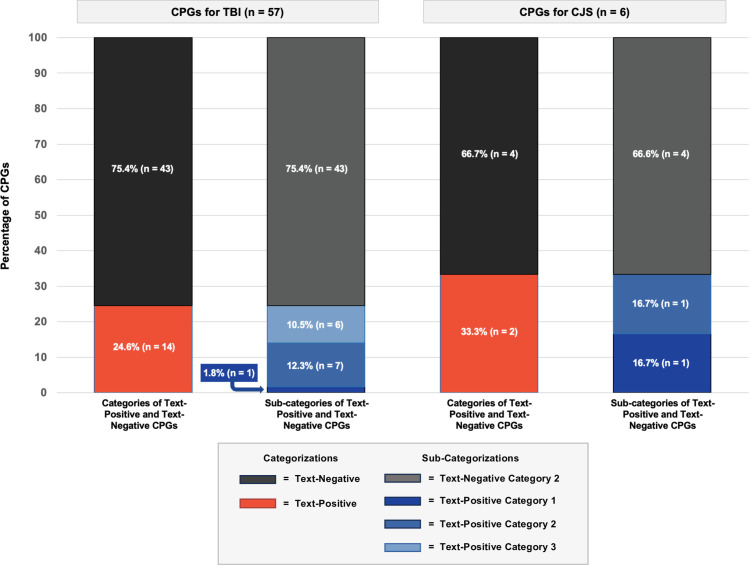
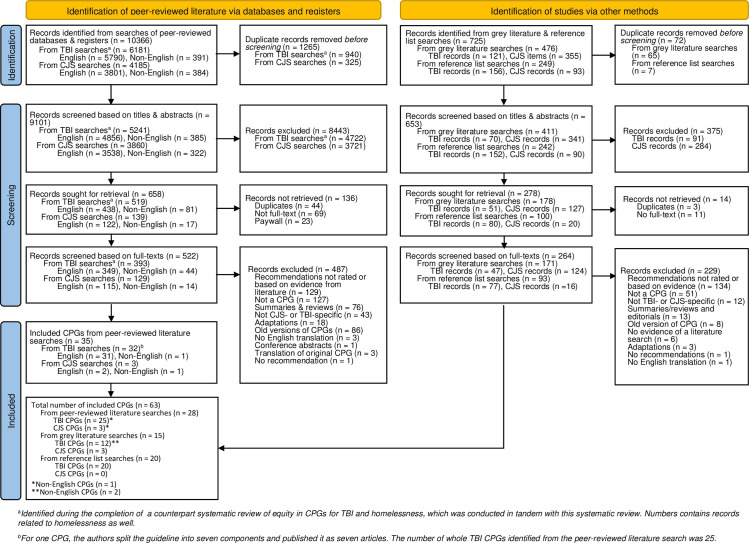
CPGs were identified from electronic databases (MEDLINE, Embase, CINAHL, PsycINFO), targeted websites, Google Search, and reference lists of identified CPGs on November 2021 and March 2023 (CPGs for TBI) and May 2022 and March 2023 (CPGs for CJS). Only CPGs for TBI or CPGs for CJS were included. We calculated the proportion of CPGs that included TBI- or CJS-specific content, conducted a qualitative content analysis to understand how evidence regarding TBI and the CJS was integrated in the CPGs, and utilised equity assessment tools to understand if and how equity was considered. Fifty-seven CPGs for TBI and 6 CPGs for CJS were included in this review. Fourteen CPGs for TBI included information relevant to the CJS, but only 1 made a concrete recommendation to consider legal implications during vocational evaluation in the forensic context. Two CPGs for CJS acknowledged the prevalence of TBI among individuals in prison and one specifically recommended considering TBI during health assessments. Both CPGs for TBI and CPGs for CJS provided evidence specific to a single facet of the CJS, predominantly in policing and corrections. The use of equity best practices and the involvement of disadvantaged groups in the development process were lacking among CPGs for CJS. We acknowledge limitations of the review, including that our searches were conducted in English language and thus, we may have missed other non-English language CPGs in this review. We further recognise that we are unable to comment on evidence that is not integrated in the CPGs, as we did not systematically search for research on individuals with TBI who intersect with the CJS, outside of CPGs.
Findings from this review provide the foundation to consider CJS involvement in CPGs for TBI and to advance equity in CPGs for CJS. Conducting research, including investigating the process of screening for TBI with individuals who intersect with all facets of the CJS, and utilizing equity assessment tools in guideline development are critical steps to enhance equity in healthcare for this disadvantaged group.
颅脑创伤 (TBI) 在与刑事司法系统 (CJS) 交叉或涉及的人群中比例过高。如果没有适当的护理,TBI 相关损伤、交叉的健康决定因素以及 CJS 环境中对 TBI 的认识不足,可能会导致刑期延长、严重的纪律处分和累犯。然而,有证据表明,大多数临床实践指南 (CPG) 忽略了公平性,因此忽略了弱势群体的需求。因此,本研究旨在回答以下研究问题:“(1)CPG 中是否考虑了与 CJS 的交叉,(2)CPG 中是否考虑了 TBI,以及(3)CPG 中是否考虑了公平性?”。
我们于 2021 年 11 月和 2023 年 3 月(TBI 的 CPG)以及 2022 年 5 月和 2023 年 3 月(CJS 的 CPG)从电子数据库(MEDLINE、Embase、CINAHL、PsycINFO)、目标网站、Google 搜索和确定的 CPG 的参考文献列表中确定了 CPG。仅包括 TBI 或 CJS 的 CPG。我们计算了包含 TBI 或 CJS 特定内容的 CPG 的比例,进行了定性内容分析以了解 TBI 和 CJS 的证据如何整合到 CPG 中,并利用公平性评估工具了解公平性是否以及如何被考虑。本研究共纳入 57 项 TBI 的 CPG 和 6 项 CJS 的 CPG。14 项 TBI 的 CPG 包含与 CJS 相关的信息,但只有 1 项在法医环境中的职业评估中具体建议考虑法律影响。2 项 CJS 的 CPG 承认在监狱中的个体中 TBI 的普遍存在,并特别建议在健康评估中考虑 TBI。TBI 和 CJS 的 CPG 均提供了与 CJS 的单一方面相关的证据,主要集中在警务和惩戒方面。CJS 的 CPG 在使用公平性最佳实践和让弱势群体参与制定过程方面存在不足。我们承认本研究存在局限性,包括我们的搜索仅在英语环境中进行,因此我们可能会错过本综述中其他非英语语言的 CPG。我们还认识到,由于我们没有系统地搜索与 CJS 交叉的 TBI 个体的研究,因此我们无法对 CPG 中未整合的证据发表评论。
本研究结果为在 TBI 的 CPG 中考虑 CJS 的参与以及在 CJS 的 CPG 中推进公平性提供了基础。开展研究,包括调查与 CJS 的各个方面交叉的个体的 TBI 筛查过程,并在指南制定中利用公平性评估工具,是增强这一弱势群体医疗保健公平性的关键步骤。