• 文献检索
  • 文档翻译
  • 深度研究
  • 学术资讯
  • Suppr Zotero 插件Zotero 插件
  • 邀请有礼
  • 套餐&价格
  • 历史记录
应用&插件
Suppr Zotero 插件Zotero 插件浏览器插件Mac 客户端Windows 客户端微信小程序
定价
高级版会员购买积分包购买API积分包
服务
文献检索文档翻译深度研究API 文档MCP 服务
关于我们
关于 Suppr公司介绍联系我们用户协议隐私条款
关注我们

Suppr 超能文献

核心技术专利:CN118964589B侵权必究
粤ICP备2023148730 号-1Suppr @ 2026

文献检索

告别复杂PubMed语法,用中文像聊天一样搜索,搜遍4000万医学文献。AI智能推荐,让科研检索更轻松。

立即免费搜索

文件翻译

保留排版,准确专业,支持PDF/Word/PPT等文件格式,支持 12+语言互译。

免费翻译文档

深度研究

AI帮你快速写综述,25分钟生成高质量综述,智能提取关键信息,辅助科研写作。

立即免费体验

基于公平理念的社交媒体 COVID-19 风险传播策略:范围综述。

Equity-informed social media COVID-19 risk communication strategies: a scoping review.

机构信息

Faculty of Education, Western University, London, Ontario, Canada.

College of Nursing, University of South Carolina, Columbia, South Carolina, USA.

出版信息

BMJ Open. 2024 Aug 12;14(8):e085630. doi: 10.1136/bmjopen-2024-085630.

DOI:10.1136/bmjopen-2024-085630
PMID:39134442
原文链接:https://pmc.ncbi.nlm.nih.gov/articles/PMC11331911/
Abstract

OBJECTIVES

The COVID-19 pandemic has had devastating worldwide impact but most prominent was its effect on marginalised, underserved and equity-deserving populations. Social media arose as an important platform from which health organisations could rapidly disseminate information to equity-deserving populations about COVID-19 risks and events, provide instructions on how to mitigate those risks, motivate compliance with health directives, address false information, provide the opportunity for engagement and immediate feedback. The objective of this scoping review was to synthesise the academic and grey literature on equity-informed social media risk communication strategies developed during the pandemic.

DESIGN

The review followed the Arksey and O'Malley framework and focused on the research question: What are the promising principles, processes, and practices for producing equity-informed social media risk communications?

DATA SOURCES

CINAHL Complete, MEDLINE (OVID), Business Source Complete, EMBASE database OVID, Scopus and PubMed's curated COVID-19 literature hub: LitCovid, PsycINFO OVID were searched using terms related to access to health services, social media, risk communication, misinformation, community engagement, infectious disease, pandemics and marginalisation, supplemented by grey literature from relevant health organisations.

ELIGIBILITY CRITERIA FOR SELECTING STUDIES

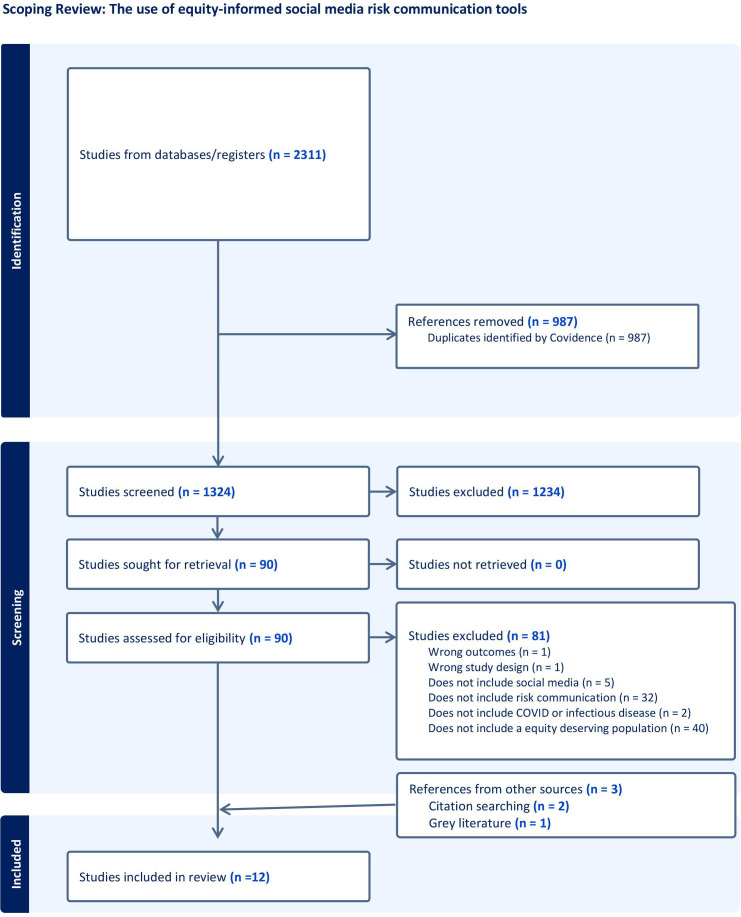
Studies were eligible if the population of interest was an equity-deserving population, the concept discussed was COVID-19 risk communication and the article was published in English between January 2019 and December 2022.

DATA EXTRACTION AND SYNTHESIS

COVIDENCE facilitated screening and extraction. Charted data were thematically analysed following Braun and Clarke's phased process. Preliminary findings were collaboratively discussed with representatives from health agencies and community organisations focused on serving equity-deserving groups.

RESULTS

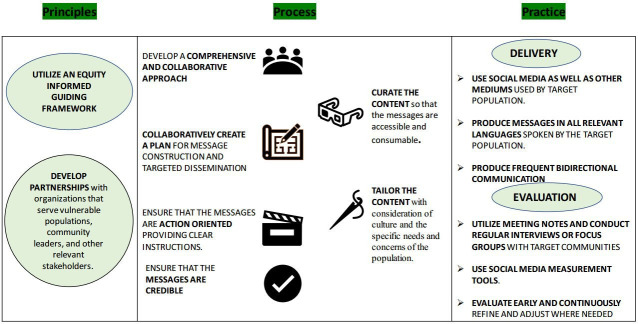
12 studies were included. In terms of principles and process, studies emphasised the need to collaboratively create plans for message construction and targeted dissemination using a risk communication framework, capitalise on access to community resources and pre-established communication mediums and be considerate of population-specific needs and concerns. Practice entails careful consideration of communication mediums, language usage, communication frequency and evaluation.

CONCLUSION

This scoping review provides valuable insights for health agencies and community organisations in developing principles, processes and practices to equitably communicate risk information through social media. Engagement with stakeholders further refined and confirmed the findings, offering insights for future crisis communication strategies.
https://cdn.ncbi.nlm.nih.gov/pmc/blobs/b99b/11331911/3c8f1aecb5ac/bmjopen-14-8-g002.jpg
https://cdn.ncbi.nlm.nih.gov/pmc/blobs/b99b/11331911/75510d77769c/bmjopen-14-8-g001.jpg
https://cdn.ncbi.nlm.nih.gov/pmc/blobs/b99b/11331911/3c8f1aecb5ac/bmjopen-14-8-g002.jpg
https://cdn.ncbi.nlm.nih.gov/pmc/blobs/b99b/11331911/75510d77769c/bmjopen-14-8-g001.jpg
https://cdn.ncbi.nlm.nih.gov/pmc/blobs/b99b/11331911/3c8f1aecb5ac/bmjopen-14-8-g002.jpg
摘要

目的

COVID-19 大流行在全球范围内造成了毁灭性的影响,但最突出的是它对边缘化、服务不足和公平权益人群的影响。社交媒体成为卫生组织向公平权益人群快速传播有关 COVID-19 风险和事件信息的重要平台,提供如何减轻这些风险的指导,激励遵守卫生指令,解决虚假信息,提供参与和即时反馈的机会。本范围综述的目的是综合大流行期间制定的以公平为导向的社交媒体风险沟通策略的学术和灰色文献。

设计

该综述遵循 Arksey 和 O'Malley 框架,重点研究以下研究问题:产生以公平为导向的社交媒体风险沟通的有前途的原则、过程和实践是什么?

数据来源

CINAHL Complete、MEDLINE(OVID)、Business Source Complete、EMBASE 数据库 OVID、Scopus 和 PubMed 的 COVID-19 文献中心:LitCovid、PsycINFO OVID 使用与获得卫生服务、社交媒体、风险沟通、错误信息、社区参与、传染病、大流行和边缘化相关的术语进行搜索,辅之以来自相关卫生组织的灰色文献。

入选研究的资格标准

如果目标人群是公平权益人群,讨论的概念是 COVID-19 风险沟通,并且文章在 2019 年 1 月至 2022 年 12 月期间以英文发表,则研究符合条件。

数据提取和综合

COVIDENCE 促进了筛选和提取。根据 Braun 和 Clarke 的分阶段过程对图表数据进行了主题分析。初步发现与专注于服务公平权益群体的卫生机构和社区组织的代表进行了协作讨论。

结果

共纳入 12 项研究。在原则和过程方面,研究强调需要协作制定使用风险沟通框架构建信息和有针对性传播的计划,利用社区资源和预先建立的沟通媒介的优势,并考虑特定人群的需求和关注点。实践需要仔细考虑沟通媒介、语言使用、沟通频率和评估。

结论

本范围综述为卫生机构和社区组织通过社交媒体公平沟通风险信息提供了有价值的见解。与利益相关者的互动进一步完善和证实了研究结果,为未来的危机沟通策略提供了见解。

相似文献

1
Equity-informed social media COVID-19 risk communication strategies: a scoping review.基于公平理念的社交媒体 COVID-19 风险传播策略:范围综述。
BMJ Open. 2024 Aug 12;14(8):e085630. doi: 10.1136/bmjopen-2024-085630.
2
Use of equity-informed social media COVID-19 risk communication tools: a scoping review protocol.使用基于公平的社交媒体 COVID-19 风险沟通工具:范围综述方案。
BMJ Open. 2022 Oct 28;12(10):e061851. doi: 10.1136/bmjopen-2022-061851.
3
A Comprehensive Analysis of COVID-19 Misinformation, Public Health Impacts, and Communication Strategies: Scoping Review.全面分析新冠病毒错误信息、公共卫生影响和传播策略:范围综述。
J Med Internet Res. 2024 Aug 21;26:e56931. doi: 10.2196/56931.
4
Prevalence of Health Misinformation on Social Media-Challenges and Mitigation Before, During, and Beyond the COVID-19 Pandemic: Scoping Literature Review.社交媒体上健康类错误信息的流行情况-在新冠疫情之前、期间和之后的挑战和缓解措施:范围文献综述。
J Med Internet Res. 2024 Aug 19;26:e38786. doi: 10.2196/38786.
5
Beyond the black stump: rapid reviews of health research issues affecting regional, rural and remote Australia.超越黑木树:影响澳大利亚地区、农村和偏远地区的健康研究问题的快速综述。
Med J Aust. 2020 Dec;213 Suppl 11:S3-S32.e1. doi: 10.5694/mja2.50881.
6
Communication to promote and support physical distancing for COVID-19 prevention and control.促进和支持预防和控制 COVID-19 的物理隔离的沟通。
Cochrane Database Syst Rev. 2023 Oct 9;10(10):CD015144. doi: 10.1002/14651858.CD015144.
7
Experiences of Governments and Public Health Agencies Regarding Crisis Communication During the COVID-19 Pandemic in the Digital Age: Protocol for a Systematic Review of Qualitative Studies.数字时代 COVID-19 大流行期间政府和公共卫生机构危机沟通经验:定性研究系统评价方案。
JMIR Res Protoc. 2024 Jun 27;13:e58040. doi: 10.2196/58040.
8
Influence of social media and the digital environment on international migration of health workforce from low- and middle-income countries post COVID-19 pandemic: a scoping review protocol.社交媒体和数字环境对 COVID-19 大流行后低中等收入国家卫生人力国际迁移的影响:范围综述方案。
BMJ Open. 2024 Oct 17;14(10):e087213. doi: 10.1136/bmjopen-2024-087213.
9
Unintended consequences of measures implemented in the school setting to contain the COVID-19 pandemic: a scoping review.学校为遏制新冠疫情而采取的措施所产生的意外后果:一项范围综述。
Cochrane Database Syst Rev. 2024 Dec 12;12(12):CD015397. doi: 10.1002/14651858.CD015397.pub2.
10
Communication and engagement of community members from ethnic minorities during COVID-19: a scoping review.少数民族社区成员在 COVID-19 期间的沟通和参与:一项范围综述。
BMJ Open. 2023 Jun 21;13(6):e069552. doi: 10.1136/bmjopen-2022-069552.

引用本文的文献

1
Experiences of risk communication among managers of home-visit nursing agencies during the COVID-19 pandemic: a qualitative descriptive study.新冠疫情期间家访护理机构管理者的风险沟通经验:一项质性描述性研究
BMC Nurs. 2025 Aug 5;24(1):1024. doi: 10.1186/s12912-025-03669-7.

本文引用的文献

1
Communication inequalities and health disparities among vulnerable groups during the COVID-19 pandemic - a scoping review of qualitative and quantitative evidence.在 COVID-19 大流行期间弱势群体之间的沟通不平等和健康差距-定性和定量证据的范围综述。
BMC Public Health. 2023 Mar 6;23(1):428. doi: 10.1186/s12889-023-15295-6.
2
Scientific Misinformation and Mistrust of COVID-19 Preventive Measures among the UK Population: A Pilot Study.英国民众中关于新冠病毒预防措施的科学错误信息与不信任:一项试点研究
Vaccines (Basel). 2023 Jan 30;11(2):301. doi: 10.3390/vaccines11020301.
3
Use of equity-informed social media COVID-19 risk communication tools: a scoping review protocol.
使用基于公平的社交媒体 COVID-19 风险沟通工具:范围综述方案。
BMJ Open. 2022 Oct 28;12(10):e061851. doi: 10.1136/bmjopen-2022-061851.
4
Engaging Underserved Communities in COVID-19 Health Equity Implementation Research: An Analysis of Community Engagement Resource Needs and Costs.让服务不足社区参与新冠疫情健康公平实施研究:社区参与资源需求与成本分析
Front Health Serv. 2022;2. doi: 10.3389/frhs.2022.850427. Epub 2022 Mar 17.
5
Community-Engaged Bidirectional Crisis and Emergency Risk Communication With Immigrant and Refugee Populations During the COVID-19 Pandemic.社区参与式双向危机和紧急风险沟通在 COVID-19 大流行期间与移民和难民群体。
Public Health Rep. 2022 Mar-Apr;137(2):352-361. doi: 10.1177/00333549211065514. Epub 2022 Jan 13.
6
Better Together: Launching and Nurturing a Community Stakeholder Committee to Enhance Care and Research for Asthma and COPD.携手共进:成立和培育社区利益相关者委员会,以加强哮喘和 COPD 的护理和研究。
Chest. 2022 Feb;161(2):382-388. doi: 10.1016/j.chest.2021.10.028. Epub 2021 Nov 2.
7
Predicting COVID-19 Vaccination Intention: The Roles of Institutional Trust, Perceived Vaccine Safety, and Interdependent Self-Construal.预测新冠疫苗接种意愿:制度信任、感知疫苗安全性和相互依存自我建构的作用
Health Commun. 2023 May;38(6):1189-1200. doi: 10.1080/10410236.2021.1996685. Epub 2021 Nov 3.
8
Illinois Unidos: A Community Demands Equity, Justice, and Inclusion.伊利诺伊团结组织:一个呼吁公平、正义和包容的社区。
Am J Public Health. 2021 Oct;111(S3):S204-S207. doi: 10.2105/AJPH.2021.306407.
9
Use of Community-Based Participatory Research Partnerships to Reduce COVID-19 Disparities Among Marshallese Pacific Islander and Latino Communities - Benton and Washington Counties, Arkansas, April-December 2020.利用社区参与式研究伙伴关系减少阿肯色州本顿县和华盛顿县马绍尔群岛太平洋岛民和拉丁裔社区的 COVID-19 差异-2020 年 4 月至 12 月。
Prev Chronic Dis. 2021 Oct 7;18:E91. doi: 10.5888/pcd18.210124.
10
Examining Social Media Crisis Communication during Early COVID-19 from Public Health and News Media for Quality, Content, and Corresponding Public Sentiment.审视 COVID-19 早期公共卫生和新闻媒体的社交媒体危机沟通:质量、内容和相应的公众情绪。
Int J Environ Res Public Health. 2021 Jul 28;18(15):7986. doi: 10.3390/ijerph18157986.