Department of Orthopaedic Surgery, Philadelphia College of Osteopathic Medicine, 4190 City Avenue, Philadelphia, PA, 19131, USA.
Department of Orthopaedics, UT Health San Antonio, San Antonio, TX, USA.
Eur J Orthop Surg Traumatol. 2024 Aug;34(6):3265-3273. doi: 10.1007/s00590-024-04062-x. Epub 2024 Aug 13.
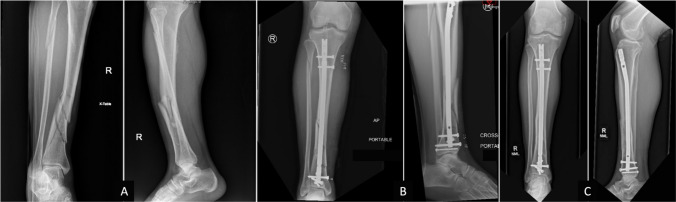
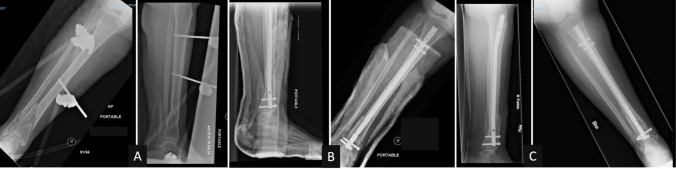
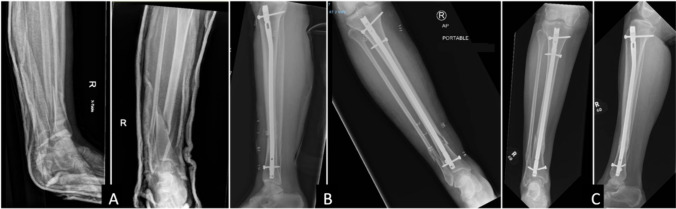
Malalignment of distal tibia fractures can lead to malunion/nonunion or alter the limb mechanical axis which may cause arthritis. Proposed methods to decrease malalignment include fibular fixation or multiplanar interlocking screws, however these remain controversial. This study aimed to identify factors associated with malalignment in distal tibial fractures with associated fibular shaft fractures.
A retrospective review was performed of distal tibia fractures with associated fibular shaft fractures treated with intramedullary nailing at two level one trauma centers between 2015 and 2019. Cases involving malalignment (> 5° of deviation from anatomic axis on either coronal/sagittal axis) on final follow-up (minimum three months postoperatively) were compared to those without malalignment with regard to demographics, fracture characteristics, intraoperative characteristics, and complications.
The rate of malalignment was 13%. On multivariate analysis, multiplanar distal interlocking screw fixation (odds ratio [OR], 0.18; 95% confidence interval [CI] 0.03-0.92) was associated with a decreased rate of final malalignment, while nail diameter > 10 mm was associated with a higher rate (OR, 4.05; 95% CI 1.25-13.11). Fibular fixation was not associated with malalignment.
Multiplanar distal interlocking screws may protect against malalignment. Fibula fixation does not appear associated with a decreased rate of malalignment in distal tibia fractures treated with intramedullary nails.
III.
胫骨远端骨折对线不良可导致愈合不良/不愈合或改变肢体力学轴线,从而导致关节炎。减少对线不良的方法包括腓骨固定或多平面锁定螺钉,但这些方法仍存在争议。本研究旨在确定与伴有腓骨干骨折的胫骨远端骨折对线不良相关的因素。
对 2015 年至 2019 年间在两个一级创伤中心接受髓内钉治疗的伴有腓骨干骨折的胫骨远端骨折进行回顾性研究。将最终随访(术后至少 3 个月)时存在对线不良(冠状面/矢状面任何一侧偏离解剖轴>5°)的病例与无对线不良的病例进行比较,比较内容包括人口统计学、骨折特征、术中特征和并发症。
对线不良的发生率为 13%。多变量分析显示,多平面远端锁定螺钉固定(比值比 [OR],0.18;95%置信区间 [CI],0.03-0.92)与最终对线不良发生率降低相关,而钉直径>10mm 与更高的发生率相关(OR,4.05;95%CI,1.25-13.11)。腓骨固定与对线不良无关。
多平面远端锁定螺钉可能可预防对线不良。在接受髓内钉治疗的胫骨远端骨折中,腓骨固定似乎与对线不良发生率降低无关。
III 级。