Langhorst Amy, Zhang Dandan, Berman Jonah, Biraku Xhulja, Rieland Julie, Yu Mengjie, Love Brian, Banu Mihaela, Taub Alan
Materials Science and Engineering, The University of Michigan, Ann Arbor, MI, USA.
Mechanical Engineering, The University of Michigan, Ann Arbor, MI, USA.
Sci Rep. 2024 Aug 13;14(1):18819. doi: 10.1038/s41598-024-69105-z.
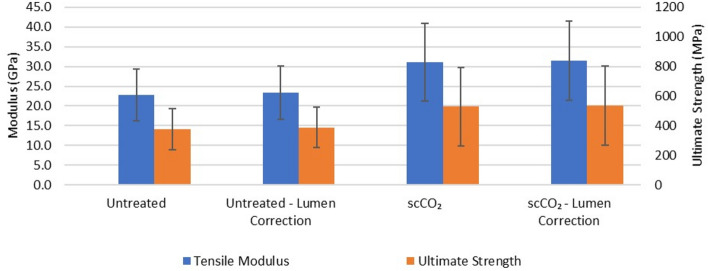
The desire for lightweight, carbon-negative materials has been increasing in recent years, particularly as the transportation sector reduces its global carbon footprint. Natural fibers, such as flax fiber and their composites, offer a compelling combination of properties including low density, high specific strength, and carbon negativity. However, because of the low modulus and high variability in performance, natural fibers can't compete with glass fibers as structural reinforcements in polymer composites. In this study, flax technical fibers were treated in supercritical CO (scCO), and the effects of this treatment on the morphology and properties of flax fibers are reported. Treatment in scCO successfully resulted in higher fiber modulus and strength by 33% and 40%, respectively. Fiber porosity was reduced by 50% and morphological changes to the fibers were observed. Specifically, fiber lumen collapsed during treatment and micro/mesoporosity was reduced by 27%. Treated flax fibers were used to create 30 vol% unidirectional flax-epoxy composites. ScCO treatment raised composite modulus and strength by 33% and 25%, respectively. Because of the dependence between technical fiber size and mechanical properties, the relationship between fiber modulus and fiber size were created and applied to the rule-of-mixtures. This relationship were found to be viable representations of the fiber performance within each composite. Overall, the treatment developed in this study has the potential to significantly improve natural fiber properties, enabling their consideration for use in lightweight, semi-structural composites.
近年来,对轻质、负碳材料的需求一直在增加,尤其是在交通运输部门减少其全球碳足迹的情况下。天然纤维,如亚麻纤维及其复合材料,具有低密度、高比强度和负碳性等令人瞩目的综合性能。然而,由于天然纤维模量低且性能变化大,在聚合物复合材料中作为结构增强材料无法与玻璃纤维竞争。在本研究中,对亚麻工业纤维进行了超临界CO(scCO)处理,并报道了该处理对亚麻纤维形态和性能的影响。scCO处理成功使纤维模量和强度分别提高了33%和40%。纤维孔隙率降低了50%,并观察到纤维的形态变化。具体而言,处理过程中纤维腔塌陷,微孔/介孔率降低了27%。用处理过的亚麻纤维制备了30体积%的单向亚麻-环氧复合材料。scCO处理使复合材料的模量和强度分别提高了33%和25%。由于工业纤维尺寸与力学性能之间的相关性,建立了纤维模量与纤维尺寸之间的关系并应用于混合法则。发现这种关系能够切实反映每种复合材料中的纤维性能。总体而言,本研究中开发的处理方法有可能显著改善天然纤维性能,使其能够用于轻质半结构复合材料。