FRIGE Institute of Human Genetics, FRIGE House, Ahmedabad, India.
Postgraduate Institute of Medical Education and Research, PGIMER, Chandigarh, India.
Orphanet J Rare Dis. 2024 Aug 13;19(1):295. doi: 10.1186/s13023-024-03300-z.
Rare disorders comprise of ~ 7500 different conditions affecting multiple systems. Diagnosis of rare diseases is complex due to dearth of specialized medical professionals, testing labs and limited therapeutic options. There is scarcity of data on the prevalence of rare diseases in different populations. India being home to a large population comprising of 4600 population groups, of which several thousand are endogamous, is likely to have a high burden of rare diseases. The present study provides a retrospective overview of a cohort of patients with rare genetic diseases identified at a tertiary genetic test centre in India.
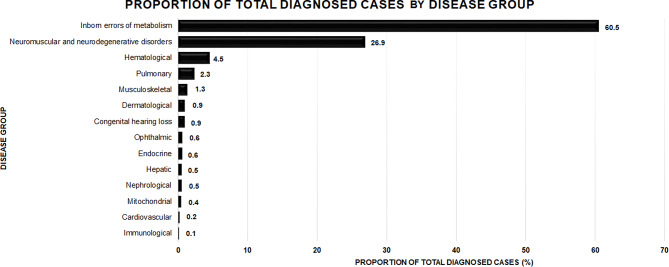
Overall, 3294 patients with 305 rare diseases were identified in the present study cohort. These were categorized into 14 disease groups based on the major organ/ organ system affected. Highest number of rare diseases (D = 149/305, 48.9%) were identified in the neuromuscular and neurodevelopmental (NMND) group followed by inborn errors of metabolism (IEM) (D = 47/305; 15.4%). Majority patients in the present cohort (N = 1992, 61%) were diagnosed under IEM group, of which Gaucher disease constituted maximum cases (N = 224, 11.2%). Under the NMND group, Duchenne muscular dystrophy (N = 291/885, 32.9%), trinucleotide repeat expansion disorders (N = 242/885; 27.3%) and spinal muscular atrophy (N = 141/885, 15.9%) were the most common. Majority cases of β-thalassemia (N = 120/149, 80.5%) and cystic fibrosis (N = 74/75, 98.7%) under the haematological and pulmonary groups were observed, respectively. Founder variants were identified for Tay-Sachs disease and mucopolysaccharidosis IVA diseases. Recurrent variants for Gaucher disease (GBA:c.1448T > C), β-thalassemia (HBB:c.92.+5G > C), non-syndromic hearing loss (GJB2:c.71G > A), albinism (TYR:c.832 C > T), congenital adrenal hyperplasia (CYP21A2:c.29-13 C > G) and progressive pseudo rheumatoid dysplasia (CCN6:c.298T > A) were observed in the present study.
The present retrospective study of rare disease patients diagnosed at a tertiary genetic test centre provides first insight into the distribution of rare genetic diseases across the country. This information will likely aid in drafting future health policies, including newborn screening programs, development of target specific panel for affordable diagnosis of rare diseases and eventually build a platform for devising novel treatment strategies for rare diseases.
罕见疾病包括影响多个系统的约 7500 种不同病症。由于缺乏专业医疗人员、检测实验室和有限的治疗选择,罕见疾病的诊断较为复杂。不同人群中罕见疾病的患病率数据稀缺。印度是一个拥有 4600 个族群的人口大国,其中几千个族群是同宗的,因此可能有很高的罕见疾病负担。本研究提供了印度一家三级遗传检测中心所识别的罕见遗传疾病患者队列的回顾性概述。
本研究队列共发现 3294 名患有 305 种罕见疾病的患者。根据主要受累器官/系统,将这些疾病分为 14 个疾病组。神经肌肉和神经发育(NMND)组中罕见疾病数量最多(D=149/305,48.9%),其次是先天性代谢缺陷(IEM)(D=47/305;15.4%)。本队列中大多数患者(N=1992,61%)在 IEM 组中被诊断出患有疾病,其中戈谢病构成最大的病例数(N=224,11.2%)。在 NMND 组中,杜氏肌营养不良症(N=291/885,32.9%)、三核苷酸重复扩展疾病(N=242/885;27.3%)和脊髓性肌萎缩症(N=141/885,15.9%)是最常见的疾病。血液和肺部组中β-地中海贫血(N=120/149,80.5%)和囊性纤维化(N=74/75,98.7%)的大多数病例都是β-地中海贫血和囊性纤维化。在本研究中,发现了 Tay-Sachs 病和黏多糖贮积症 IVA 疾病的创始变体。戈谢病(GBA:c.1448T>C)、β-地中海贫血(HBB:c.92.+5G>C)、非综合征性听力损失(GJB2:c.71G>A)、白化病(TYR:c.832 C>T)、先天性肾上腺增生(CYP21A2:c.29-13 C>G)和进行性假性类风湿发育不良(CCN6:c.298T>A)的常见变异体在本研究中被发现。
本研究对三级遗传检测中心诊断的罕见疾病患者进行的回顾性研究首次提供了全国范围内罕见遗传疾病分布的信息。这些信息可能有助于制定未来的卫生政策,包括新生儿筛查计划、针对负担得起的罕见疾病诊断的目标特定面板的开发,最终为制定罕见疾病的新治疗策略构建一个平台。