Guide Andrew, Garbett Shawn, Feng Xiaoke, Mapes Brandy M, Cook Justin, Sulieman Lina, Cronin Robert M, Chen Qingxia
Department of Biostatistics, Vanderbilt University Medical Center, Nashville, TN 37203-2158, United States.
Vanderbilt Institute for Clinical and Translational Research, Vanderbilt University Medical Center, Nashville, TN 37203-2158, United States.
J Am Med Inform Assoc. 2024 Dec 1;31(12):2869-2879. doi: 10.1093/jamia/ocae217.
Scales often arise from multi-item questionnaires, yet commonly face item non-response. Traditional solutions use weighted mean (WMean) from available responses, but potentially overlook missing data intricacies. Advanced methods like multiple imputation (MI) address broader missing data, but demand increased computational resources. Researchers frequently use survey data in the All of Us Research Program (All of Us), and it is imperative to determine if the increased computational burden of employing MI to handle non-response is justifiable.
Using the 5-item Physical Activity Neighborhood Environment Scale (PANES) in All of Us, this study assessed the tradeoff between efficacy and computational demands of WMean, MI, and inverse probability weighting (IPW) when dealing with item non-response.
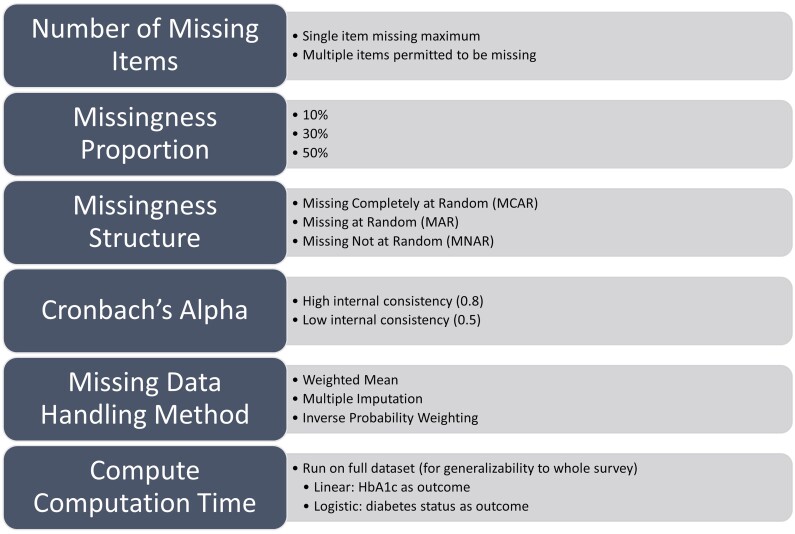
Synthetic missingness, allowing 1 or more item non-response, was introduced into PANES across 3 missing mechanisms and various missing percentages (10%-50%). Each scenario compared WMean of complete questions, MI, and IPW on bias, variability, coverage probability, and computation time.
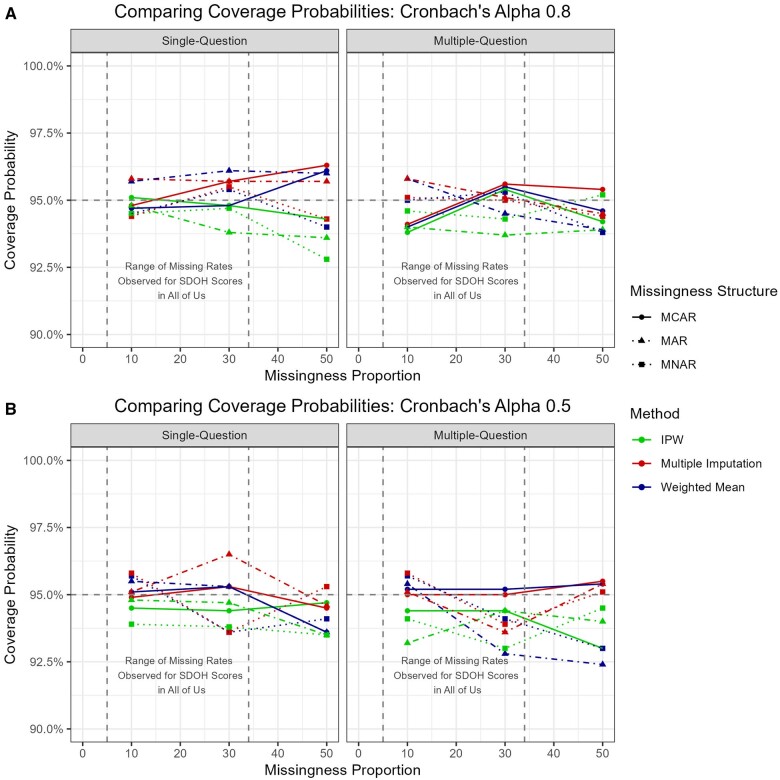
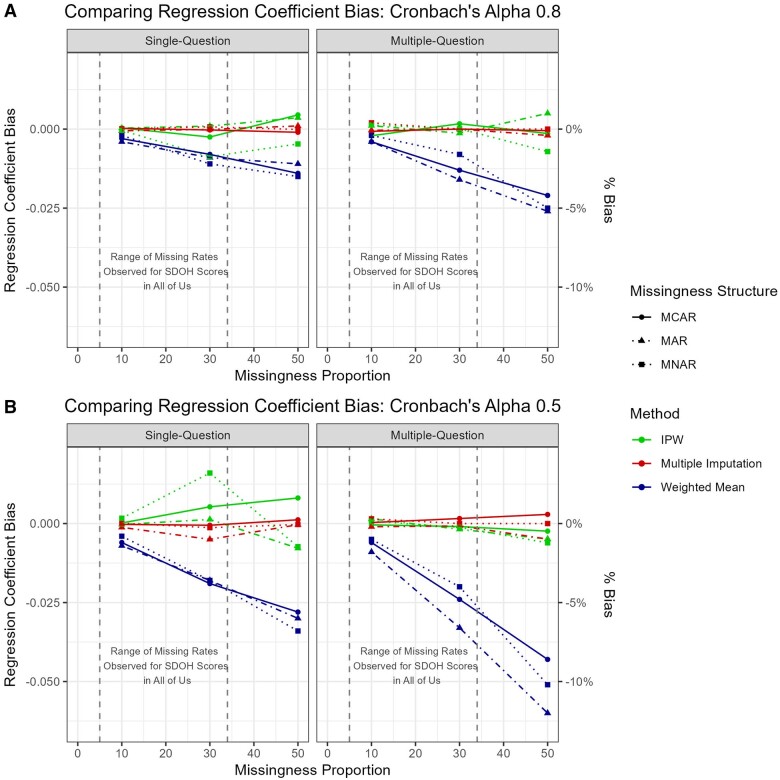
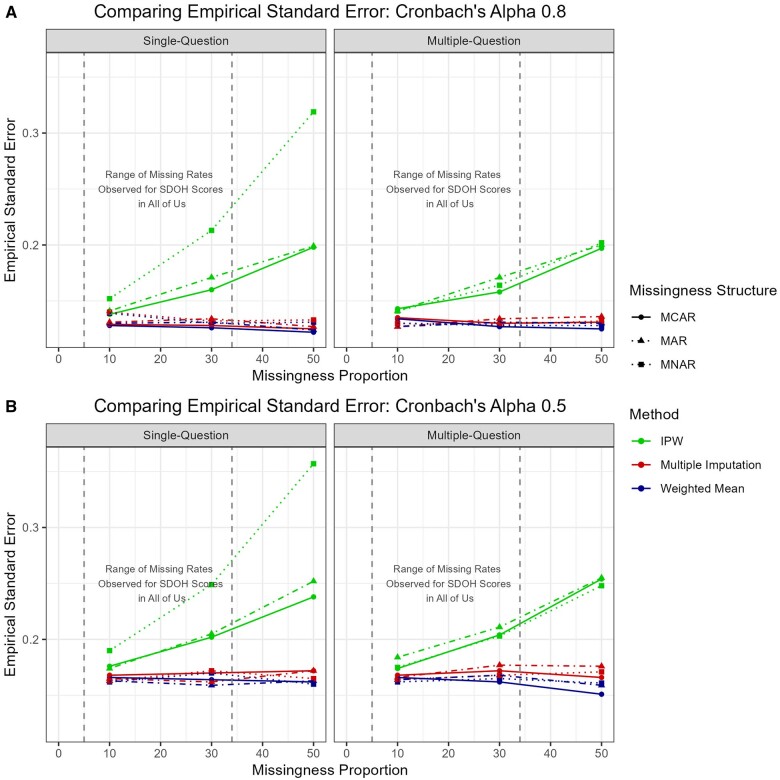
All methods showed minimal biases (all <5.5%) for good internal consistency, with WMean suffered most with poor consistency. IPW showed considerable variability with increasing missing percentage. MI required significantly more computational resources, taking >8000 and >100 times longer than WMean and IPW in full data analysis, respectively.
The marginal performance advantages of MI for item non-response in highly reliable scales do not warrant its escalated cloud computational burden in All of Us, particularly when coupled with computationally demanding post-imputation analyses. Researchers using survey scales with low missingness could utilize WMean to reduce computing burden.
量表通常源自多项目问卷,但常常面临项目无应答的情况。传统方法使用可用应答的加权均值(WMean),但可能忽略了缺失数据的复杂性。诸如多重填补(MI)等先进方法可处理更广泛的缺失数据,但需要更多的计算资源。研究人员经常在“我们所有人”研究计划(All of Us)中使用调查数据,因此必须确定采用MI来处理无应答所增加的计算负担是否合理。
本研究使用“我们所有人”研究计划中的5项身体活动邻里环境量表(PANES),评估了在处理项目无应答时,WMean、MI和逆概率加权(IPW)在功效和计算需求之间的权衡。
通过3种缺失机制和不同的缺失百分比(10%-50%),将允许1个或多个项目无应答的合成缺失引入到PANES中。每个场景都比较了完整问题的WMean、MI和IPW在偏差、变异性、覆盖概率和计算时间方面的表现。
在内部一致性良好的情况下,所有方法的偏差均最小(均<5.5%),其中WMean在一致性较差时受影响最大。随着缺失百分比的增加,IPW显示出相当大的变异性。MI需要显著更多的计算资源,在完整数据分析中分别比WMean和IPW长8000多倍和100多倍。
对于高度可靠量表中的项目无应答,MI的边际性能优势并不能证明其在“我们所有人”研究计划中增加的云计算负担是合理的,特别是当与计算要求高的插补后分析相结合时。使用缺失率低的调查量表的研究人员可以使用WMean来减轻计算负担。