Department of Medical Oncology, National Cancer Center Hospital, 5-1-1 Tsukiji, Chuo-ku, Tokyo, 104-0045, Japan.
Department of Diagnostic Pathology, National Cancer Center Hospital, Tokyo, Japan.
Breast Cancer. 2024 Nov;31(6):1037-1045. doi: 10.1007/s12282-024-01617-y. Epub 2024 Aug 14.
HER2-low populations constitute a heterogeneous group, and the cytotoxic anticancer agent efficacy based on HER2 status remains unclear. This study evaluated the clinicopathological features and outcomes of patients with advanced breast cancer showing HER2-low expression treated with eribulin or capecitabine, two treatment options after anthracycline and taxane treatment.
We retrospectively evaluated patients who were treated with eribulin or capecitabine between 2011 and 2015. HER2 status was evaluated according to the ASCO/CAP guidelines.
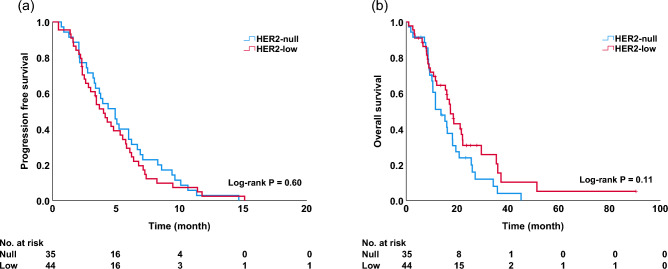
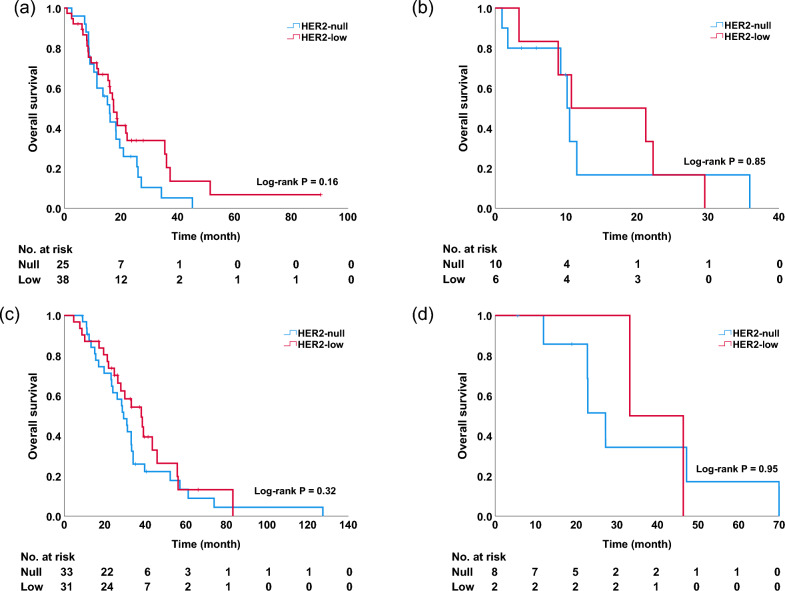
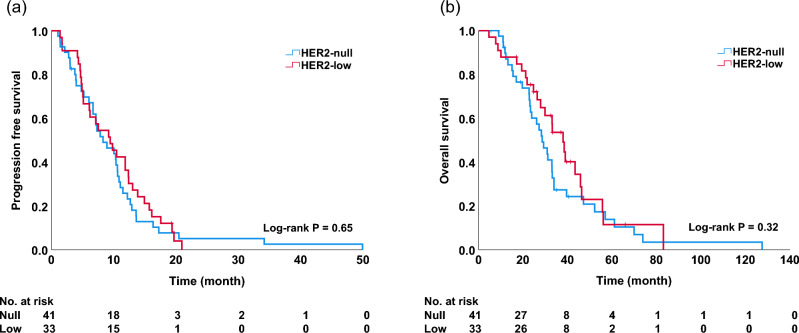
No significant difference was observed in overall survival (OS; eribulin: hazard ratio [HR], 0.66; 95% CI 0.40-1.10; capecitabine: HR, 0.76; 95% CI 0.45-1.30) or progression-free survival (PFS; eribulin: HR, 1.13; 95% CI 0.72-1.78; capecitabine: HR, 0.90; 95% CI 0.56-1.44) between patients receiving eribulin (HER2-null: 35, HER2-low: 44) and those receiving capecitabine (HER2-null: 41, HER2-low: 33). Subgroup analysis revealed no significant differences in OS between the two groups in the hormone-positive and -negative populations for eribulin and capecitabine. HER2-null and HER2-low patients showed objective response rates (ORRs) of 22.5% and 9.1% (p = 0.09) overall, and 32.0% and 10.5% (p = 0.03), respectively, in hormone-positive cases among eribulin-treated patients. No response was observed in hormone-negative patients. Capecitabine treatment in HER2-null and HER2-low patients had overall ORRs of 26.8% and 15.2% (p = 0.23), respectively, with 27.3% and 16.1% (p = 0.28) for hormone-positive cases; and 25.0% and 0% (p = 1.0), respectively, for hormone-negative cases.
Eribulin and capecitabine sensitivity may vary based on HER2 expression in patients with HER2-low and HER2-null breast cancer. Prognosis was similar between the HER2-low and the HER2-null groups.
HER2-低人群构成一个异质群体,基于 HER2 状态的细胞毒性抗癌药物疗效仍不清楚。本研究评估了接受曲妥珠单抗和紫杉烷治疗后接受艾瑞布林或卡培他滨治疗的晚期乳腺癌 HER2-低表达患者的临床病理特征和结局,这两种治疗选择。
我们回顾性评估了 2011 年至 2015 年间接受艾瑞布林或卡培他滨治疗的患者。根据 ASCO/CAP 指南评估 HER2 状态。
在总生存期(OS;艾瑞布林:风险比 [HR],0.66;95%CI,0.40-1.10;卡培他滨:HR,0.76;95%CI,0.45-1.30)或无进展生存期(PFS;艾瑞布林:HR,1.13;95%CI,0.72-1.78;卡培他滨:HR,0.90;95%CI,0.56-1.44)方面,接受艾瑞布林治疗的患者(HER2-阴性:35 例,HER2-低表达:44 例)与接受卡培他滨治疗的患者(HER2-阴性:41 例,HER2-低表达:33 例)之间无显著差异。亚组分析显示,在艾瑞布林和卡培他滨治疗的激素阳性和阴性人群中,两组之间 OS 无显著差异。HER2-阴性和 HER2-低表达患者的客观缓解率(ORR)分别为 22.5%和 9.1%(p=0.09),在激素阳性患者中分别为 32.0%和 10.5%(p=0.03)。在激素阴性患者中未观察到缓解。在 HER2-阴性和 HER2-低表达患者中,卡培他滨治疗的总体 ORR 分别为 26.8%和 15.2%(p=0.23),在激素阳性患者中分别为 27.3%和 16.1%(p=0.28);而在激素阴性患者中分别为 25.0%和 0%(p=1.0)。
在 HER2-低和 HER2-阴性乳腺癌患者中,艾瑞布林和卡培他滨的敏感性可能因 HER2 表达而异。HER2-低组和 HER2-阴性组的预后相似。