Department of Pediatrics, Lady Davis Carmel Medical Center, Haifa, Israel.
Rappaport Faculty of Medicine, Technion-Israel Institute of Technology, Haifa, Israel.
Eur J Pediatr. 2024 Oct;183(10):4499-4506. doi: 10.1007/s00431-024-05690-5. Epub 2024 Aug 15.
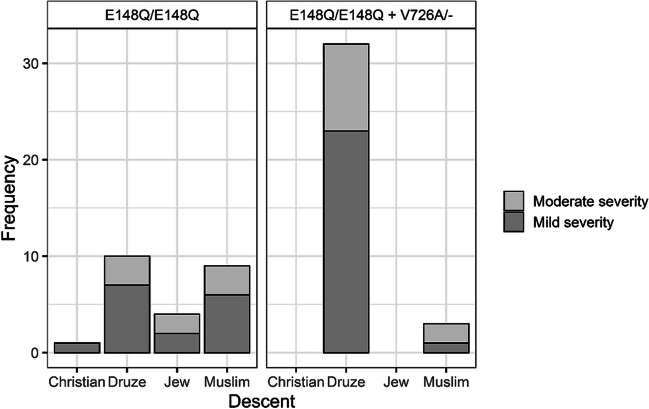
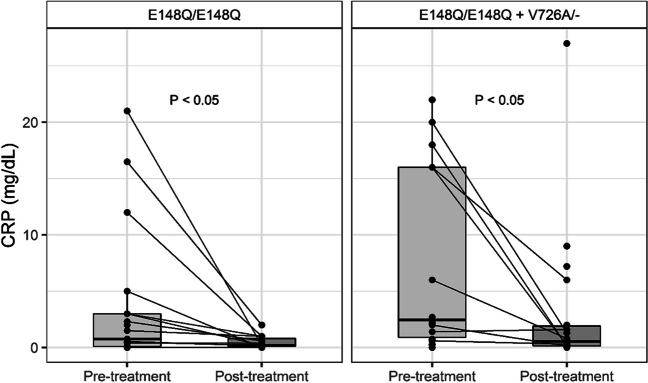
Familial Mediterranean fever (FMF) is an autosomal recessive autoinflammatory disease, linked to mutations in the MEFV gene. The p.E148Q variant, found on exon 2, has an uncertain role in FMF, with debates on whether it is a benign polymorphism or a pathogenic mutation. This study aimed to assess the clinical characteristics and severity of FMF in patients homozygous for the p.E148Q variant and to evaluate the impact of the p.V726A variant in these patients. This retrospective cohort study analyzed data from electronic medical records at Carmel Medical Center, Israel. Patients who underwent genetic testing for FMF from November 2004 to December 2019 and had p.E148Q/p.E148Q or p.E148Q/p.E148Q + p.V726A variants were included. Disease severity was assessed using the Tel Hashomer Key to Severity Score. Statistical analyses compared clinical characteristics and severity between genotype groups. The study included 61 FMF patients, with 24 (39%) having p.E148Q/p.E148Q and 37 (61%) having p.E148Q/p.E148Q + p.V726A variants. The majority (72%) were Druze. Most patients (65.5%) exhibited mild disease, while 31.1% had moderate disease, with no cases of severe disease. Colchicine treatment significantly reduced CRP levels in all patients.
These findings suggest that the p.E148Q variant, whether alone or with p.V726A, generally results in mild to moderate FMF severity, supporting its pathogenic role in particular ethnicity. These results contribute to understanding the clinical significance of the p.E148Q variant and considering the patient's need for Colchicine treatment.
• The role of the p.E148Q variant in FMF is debated, with questions about whether it is a benign polymorphism or a pathogenic mutation. • The prevalence of MEFV variants can vary significantly among different ethnic groups.
• The p.E148Q variant has clinical significance in particular ethnicities, as supported by a significant reduction in CRP levels following colchicine treatment. • The p.E148Q variant, whether alone or with p.V726A, generally results in mild to moderate FMF severity.
评估纯合 p.E148Q 变异患者的家族性地中海热(FMF)临床特征和严重程度,并评估 p.V726A 变异在这些患者中的影响。
这是一项回顾性队列研究,分析了 2004 年 11 月至 2019 年 12 月期间在以色列 Carmel 医疗中心接受 FMF 基因检测的电子病历数据。纳入同时携带 p.E148Q/p.E148Q 或 p.E148Q/p.E148Q+p.V726A 变异的患者。使用 Tel Hashomer 严重程度评分评估疾病严重程度。统计学分析比较了基因型组之间的临床特征和严重程度。
研究纳入 61 例 FMF 患者,其中 24 例(39%)为纯合 p.E148Q/p.E148Q,37 例(61%)为 p.E148Q/p.E148Q+p.V726A 变异。大多数患者(72%)为德鲁兹人。大多数患者(65.5%)为轻症,31.1%为中症,无重症病例。所有患者经秋水仙碱治疗后 CRP 水平均显著降低。
这些结果表明,p.E148Q 变异无论单独存在还是与 p.V726A 共同存在,通常导致 FMF 轻至中度严重程度,支持其在特定族群中具有致病性。这些结果有助于理解 p.E148Q 变异的临床意义,并考虑患者对秋水仙碱治疗的需求。