Obaid Sami, Guberman Guido I, St-Onge Etienne, Campbell Emma, Edde Manon, Lamsam Layton, Bouthillier Alain, Weil Alexander G, Daducci Alessandro, Rheault François, Nguyen Dang K, Descoteaux Maxime
Department of Neurosciences, University of Montreal, Montreal, QC, Canada.
University of Montreal Hospital Research Center (CRCHUM), Montreal, QC, Canada.
Front Neurol. 2024 Jul 31;15:1400601. doi: 10.3389/fneur.2024.1400601. eCollection 2024.
Operculo-insular epilepsy (OIE) is a rare condition amenable to surgery in well-selected cases. Despite the high rate of neurological complications associated with OIE surgery, most postoperative deficits recover fully and rapidly. We provide insights into this peculiar pattern of functional recovery by investigating the longitudinal reorganization of structural networks after surgery for OIE in 10 patients.
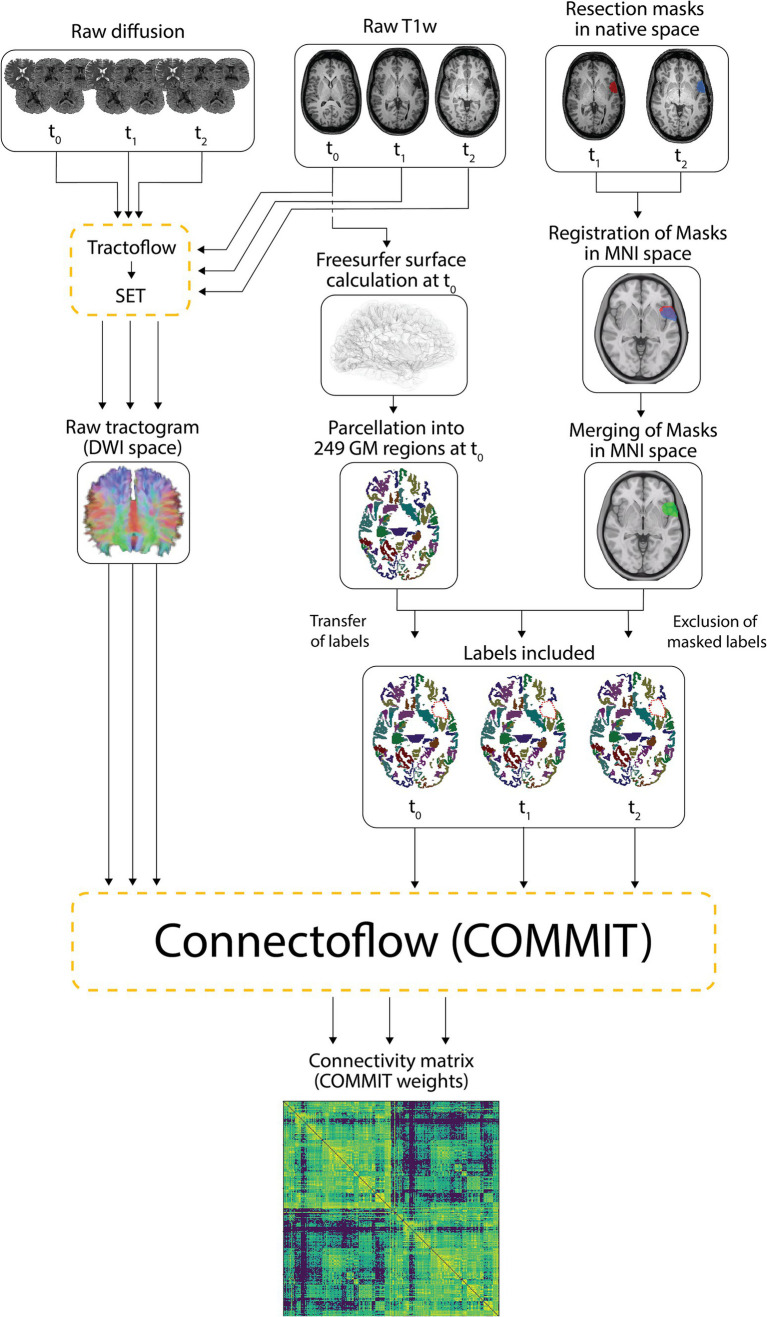
Structural T1 and diffusion-weighted MRIs were performed before surgery (t) and at 6 months (t) and 12 months (t) postoperatively. These images were processed with an original, comprehensive structural connectivity pipeline. Using our method, we performed comparisons between the t and t timepoints and between the t and t timepoints to characterize the progressive structural remodeling.
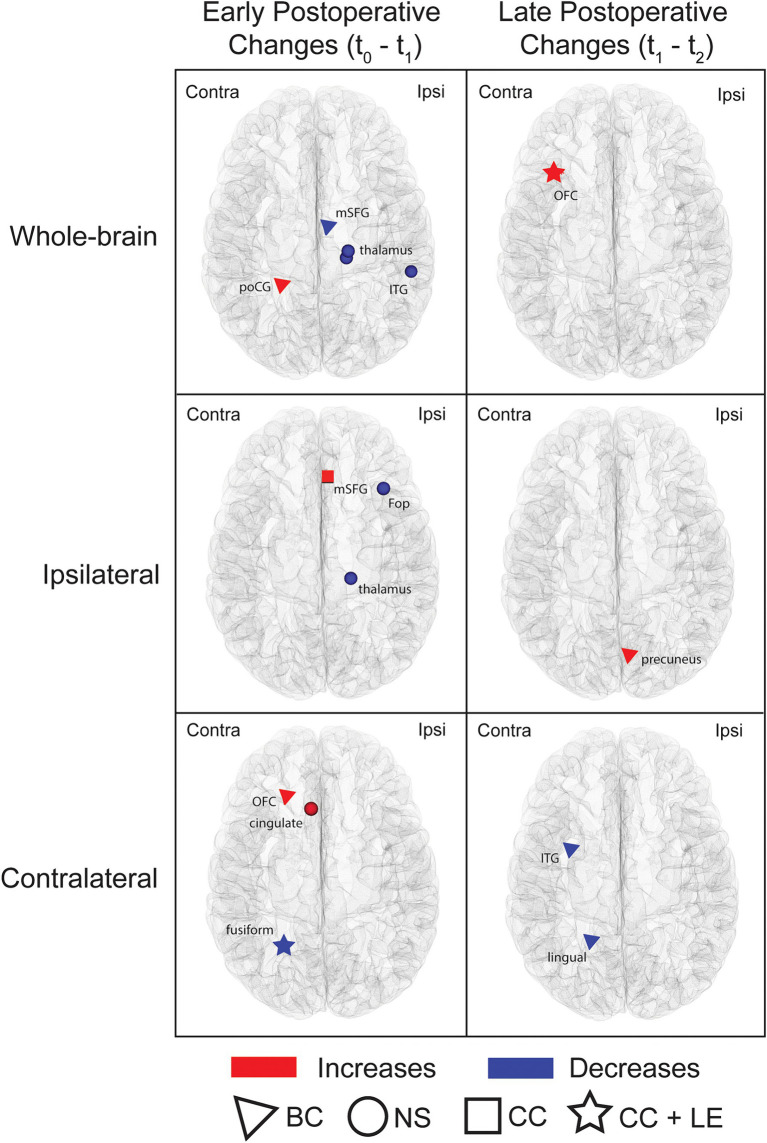
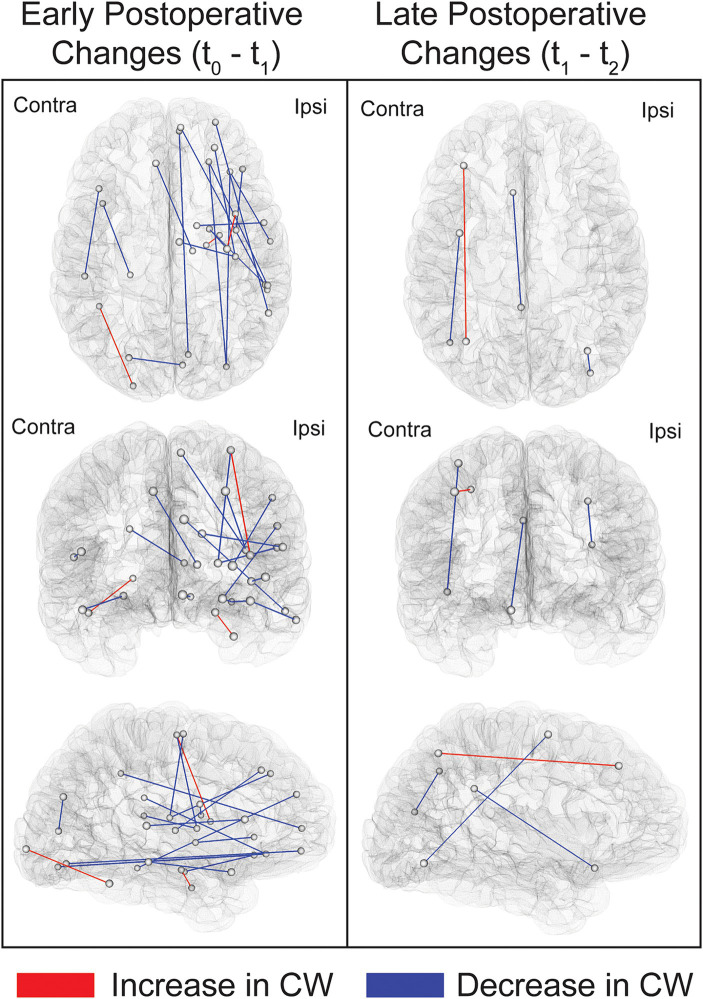
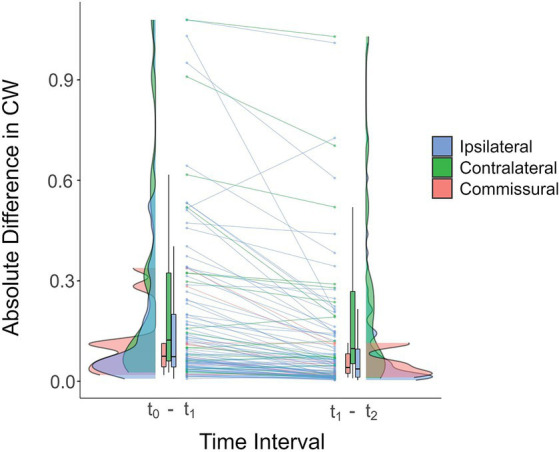
We found a widespread pattern of postoperative changes primarily in the surgical hemisphere, most of which consisted of reductions in connectivity strength (CS) and regional graph theoretic measures (rGTM) that reflect local connectivity. We also observed increases in CS and rGTMs predominantly in regions located near the resection cavity and in the contralateral healthy hemisphere. Finally, most structural changes arose in the first six months following surgery (i.e., between t and t).
To our knowledge, this study provides the first description of postoperative structural connectivity changes following surgery for OIE. The ipsilateral reductions in connectivity unveiled by our analysis may result from the reversal of seizure-related structural alterations following postoperative seizure control. Moreover, the strengthening of connections in peri-resection areas and in the contralateral hemisphere may be compatible with compensatory structural plasticity, a process that could contribute to the recovery of functions seen following operculo-insular resections for focal epilepsy.
岛盖-岛叶癫痫(OIE)是一种罕见疾病,在精心挑选的病例中适合进行手术治疗。尽管OIE手术相关的神经并发症发生率很高,但大多数术后缺损能完全且迅速恢复。我们通过研究10例OIE手术患者术后结构网络的纵向重组,深入了解这种特殊的功能恢复模式。
在手术前(t0)、术后6个月(t1)和12个月(t2)进行结构T1加权和扩散加权磁共振成像。这些图像采用一种新颖的、全面的结构连接性处理流程进行处理。使用我们的方法,我们在t0和t1时间点之间以及t0和t2时间点之间进行比较,以表征渐进性的结构重塑。
我们发现术后变化广泛存在,主要发生在手术侧半球,其中大部分表现为连接强度(CS)和反映局部连接性的区域图论测量值(rGTM)降低。我们还观察到CS和rGTM增加,主要发生在切除腔附近区域和对侧健康半球。最后,大多数结构变化发生在术后的前六个月(即t0和t1之间)。
据我们所知,本研究首次描述了OIE手术后的结构连接性变化。我们分析揭示的同侧连接性降低可能是术后癫痫发作得到控制后,与癫痫发作相关的结构改变逆转所致。此外,切除区域周围和对侧半球连接的增强可能与代偿性结构可塑性相符,这一过程可能有助于局灶性癫痫岛盖-岛叶切除术后功能的恢复。