Institute for Molecular Cardiovascular Research (IMCAR), RWTH Aachen University, Aachen 52074, Germany; Aachen-Maastricht Institute for CardioRenal Disease (AMICARE), RWTH Aachen University, Aachen 52074, Germany.
Klinik für Innere Medizin III, Universität des Saarlandes, Homburg, Germany.
EBioMedicine. 2024 Sep;107:105293. doi: 10.1016/j.ebiom.2024.105293. Epub 2024 Aug 14.
Female mice are more resistant to obesogenic effects of a high-fat diet (HFD), compared to male mice. Although the underlying mechanisms are poorly understood, sex hormones seem to play an important role. Interestingly, the activity of the oestrogen receptor-α (ERα) is affected by the calcium-sensing-receptor (CaSR). Therefore, we investigated sex-differences upon diet-induced obesity and the role of adipocyte-specific CaSR herein.
Adipocyte-specific Casr deficient mice (AdipoqCreCasr) and control mice (Casr) were injected with AAV8-PCSK9 to make them prone to develop atherosclerosis and fed an obesity-inducing diet for 12 weeks.
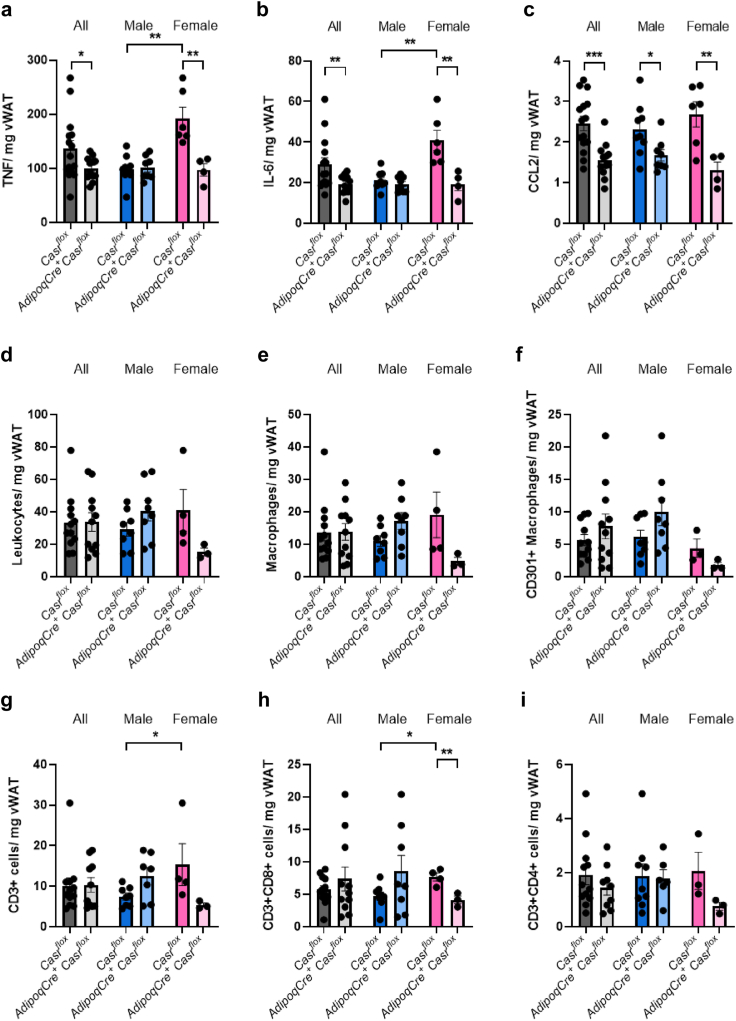
Female mice have lower visceral white adipose tissue (vWAT) mass compared to male mice, while this sex-difference is abolished upon adipocyte-specific Casr deficiency. Furthermore, while females showed elevated levels of inflammatory cytokines and CD3CD8 T cell accumulation in vWAT, compared to males, adipocyte-specific Casr deficiency abrogated this sex-phenotype and demonstrated an inhibition of inflammatory signalling pathways. The expression of Erα, as well as associated genes involved in adipocyte differentiation, was increased in female mice in a mostly adipocyte-specific Casr dependent manner. Interestingly, circulating lipid levels were reduced in female compared to male mice, which correlated with decreased atherosclerotic plaque formation. These systemic effects were abrogated upon adipocyte-specific Casr deficiency.
Our findings indicate that female mice show a more pronounced vWAT dysfunction compared to males upon obesity. This sex effect is abolished upon adipocyte-specific Casr deficiency. In contrast, females show diminished atherosclerotic plaque formation compared to males, an effect that was abrogated by adipocyte-specific Casr deficiency.
This work was supported by a grant from the Interdisciplinary Center for Clinical Research within the faculty of Medicine at the RWTH Aachen University, by the Corona Foundation, by the Deutsche Forschungsgemeinschaft (DFG), the BMBF and Free State of Bavaria and the DZHK.
与雄性小鼠相比,雌性小鼠对高脂肪饮食(HFD)的致肥胖作用更具抵抗力。尽管其潜在机制尚不清楚,但性激素似乎起着重要作用。有趣的是,雌激素受体-α(ERα)的活性受钙敏感受体(CaSR)的影响。因此,我们研究了饮食诱导肥胖时的性别差异以及在此处脂肪细胞特异性 CaSR 的作用。
脂肪细胞特异性 Casr 缺失小鼠(AdipoqCreCasr)和对照小鼠(Casr)接受 AAV8-PCSK9 注射以使它们易患动脉粥样硬化,并接受致肥胖饮食 12 周。
与雄性小鼠相比,雌性小鼠的内脏白色脂肪组织(vWAT)质量较低,而脂肪细胞特异性 Casr 缺失则消除了这种性别差异。此外,尽管与雄性相比,雌性小鼠的 vWAT 中炎症细胞因子水平升高且 CD3CD8 T 细胞积聚,但脂肪细胞特异性 Casr 缺失消除了这种性别表型并抑制了炎症信号通路。雌性小鼠 ERα 的表达以及与脂肪细胞分化相关的相关基因的表达均以脂肪细胞特异性 Casr 依赖性的方式增加。有趣的是,与雄性相比,雌性的循环脂质水平降低,这与动脉粥样硬化斑块形成减少有关。这些系统性影响在脂肪细胞特异性 Casr 缺失后被消除。
我们的发现表明,与雄性相比,肥胖的雌性小鼠的 vWAT 功能更明显。这种性别作用在脂肪细胞特异性 Casr 缺失后被消除。相比之下,与雄性相比,雌性的动脉粥样硬化斑块形成减少,而脂肪细胞特异性 Casr 缺失则消除了这种作用。
这项工作得到了 RWTH 亚琛大学医学系临床研究跨学科中心、科罗娜基金会、德国研究基金会(DFG)、BMBF 和巴伐利亚自由州以及 DZHK 的资助。