Wang Yixuan, Xu Zhe, Xu Xue, Yang Shuwen, Li Yuanyuan, Zhang Hanwen, Zhang Yufeng, Wang Fu-Sheng, Wang Ying, Bi Jingfeng
School of Pharmaceutical Sciences, Shandong University of Traditional Chinese Medicine, Jinan, China.
Phase I Clinical Trial Ward, The Fifth Medical Center of Chinese the PLA General Hospital, Beijing, China.
Front Pharmacol. 2024 Aug 1;15:1421516. doi: 10.3389/fphar.2024.1421516. eCollection 2024.
This study investigates the association between convalescent plasma therapy and the negative conversion rate in patients with persistent COVID-19 test positivity.
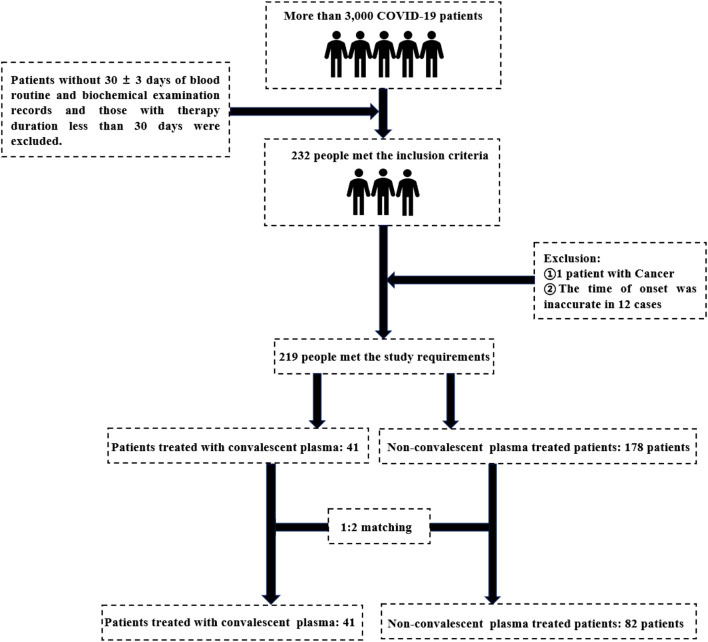
A retrospective analysis was conducted on patients with severe or mild to moderate COVID-19 whose viral nucleic acid tests remained positive for over 30 days. Patients were categorized into two groups: those who administered convalescent plasma therapy and those who were not. Data collected included information on therapy strategies used (convalescent plasma, corticosteroids, interferons, etc.), patients' demographic characteristics, comorbidities, therapeutic medications, and nucleic acid testing results. Patients in the convalescent plasma therapy group were matched 1:2 ratio with those in the non-convalescent plasma therapy group. Cumulative negative conversion rates on the fifth, tenth, and fifteenth days post-therapy initiation were analyzed as dependent variables. Independent variables included therapy strategies, demographic characteristics, comorbidities, and therapeutic medication usage. Univariate analysis was conducted, and factors with a -value () less than 0.2 were included in a paired Cox proportional hazards model.
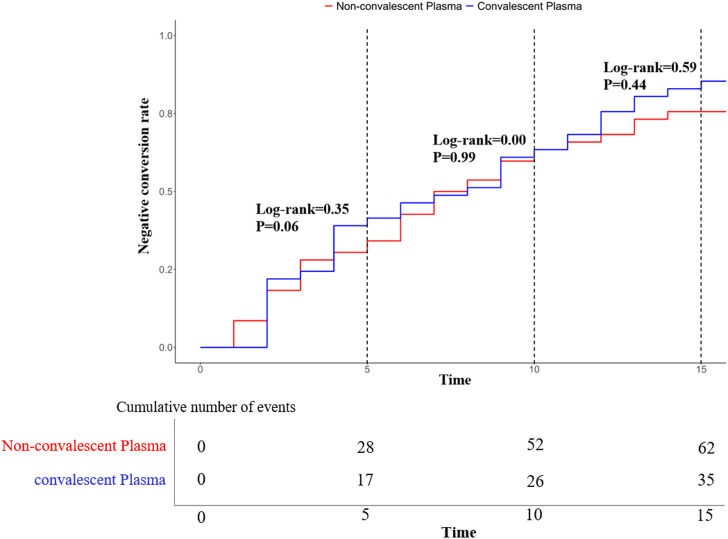
There was no statistically significant difference in the cumulative negative conversion rate between the convalescent plasma therapy group and the non-convalescent plasma therapy group on the fifth, tenth, and fifteenth days. Specifically, on day the fifth, the negative conversion rate was 41.46% in the convalescent plasma therapy group compared to 34.15% in the non-convalescent plasma therapy group (HR: 1.72, 95% CI: 0.82-3.61, = 0.15). On the tenth day, it was 63.41% in the convalescent plasma therapy group and 63.41% in the non-convalescent plasma therapy group (HR: 1.25, 95% CI: 0.69∼2.26, = 0.46). On the fifteenth day, the negative conversion rate was 85.37% in the convalescent plasma therapy group and 75.61% in the non-convalescent plasma therapy group (HR: 1.19, 95% CI: 0.71-1.97, = 0.51).
Our finding does not support the hypothesis that convalescent plasma therapy could accelerate the time to negative conversion in patients who consistently test positive for COVID-19.
本研究调查恢复期血浆疗法与持续新冠病毒检测呈阳性患者的转阴率之间的关联。
对重症或轻至中度新冠病毒肺炎且病毒核酸检测持续阳性超过30天的患者进行回顾性分析。患者分为两组:接受恢复期血浆疗法的患者和未接受该疗法的患者。收集的数据包括所采用的治疗策略(恢复期血浆、皮质类固醇、干扰素等)、患者的人口统计学特征、合并症、治疗用药以及核酸检测结果。恢复期血浆疗法组的患者与非恢复期血浆疗法组的患者按1:2的比例进行匹配。将治疗开始后第5天、第10天和第15天的累积转阴率作为因变量进行分析。自变量包括治疗策略、人口统计学特征、合并症和治疗用药情况。进行单因素分析,将P值小于0.2的因素纳入配对Cox比例风险模型。
恢复期血浆疗法组与非恢复期血浆疗法组在第5天、第10天和第15天的累积转阴率无统计学显著差异。具体而言,在第5天,恢复期血浆疗法组的转阴率为41.46%,而非恢复期血浆疗法组为34.15%(风险比:1.72,95%置信区间:0.82 - 3.61,P = 0.15)。在第10天,恢复期血浆疗法组和非恢复期血浆疗法组均为63.41%(风险比:1.25,95%置信区间:0.69 - 2.26,P = 0.46)。在第15天,恢复期血浆疗法组的转阴率为85.37%,非恢复期血浆疗法组为75.61%(风险比:1.19,95%置信区间:0.71 - 1.97,P = 0.51)。
我们的研究结果不支持恢复期血浆疗法可加速新冠病毒检测持续呈阳性患者转阴时间的假设。