Department of Medical Oncology, Centre Léon Bérard, Lyon, France.
GSK, Collegeville, USA.
ESMO Open. 2024 Aug;9(8):103645. doi: 10.1016/j.esmoop.2024.103645. Epub 2024 Aug 16.
To better understand the importance of the New York esophageal squamous cell carcinoma 1 (NY-ESO-1) and human leukocyte antigen (HLA) subtypes in treatment decision-making, further investigation of their prevalence and prognostic impact among patients with metastatic synovial sarcoma (mSS) is needed.
This was a retrospective clinico-biological cohort study of adults with mSS. Patient data were collected from the French Sarcoma Group NetSARC database and supplemented by electronic medical records. Primary tumor samples were collected and analyzed for NY-ESO-1 expression by immunohistochemistry (IHC) and HLA-A∗02 status by RNA sequencing (RNA-seq). The primary cohort included patients with available primary tumor samples; the impact of a larger sample size was explored by including patients who had either a primary or metastatic sample (termed the exploratory cohort). P values are provided for descriptive purposes.
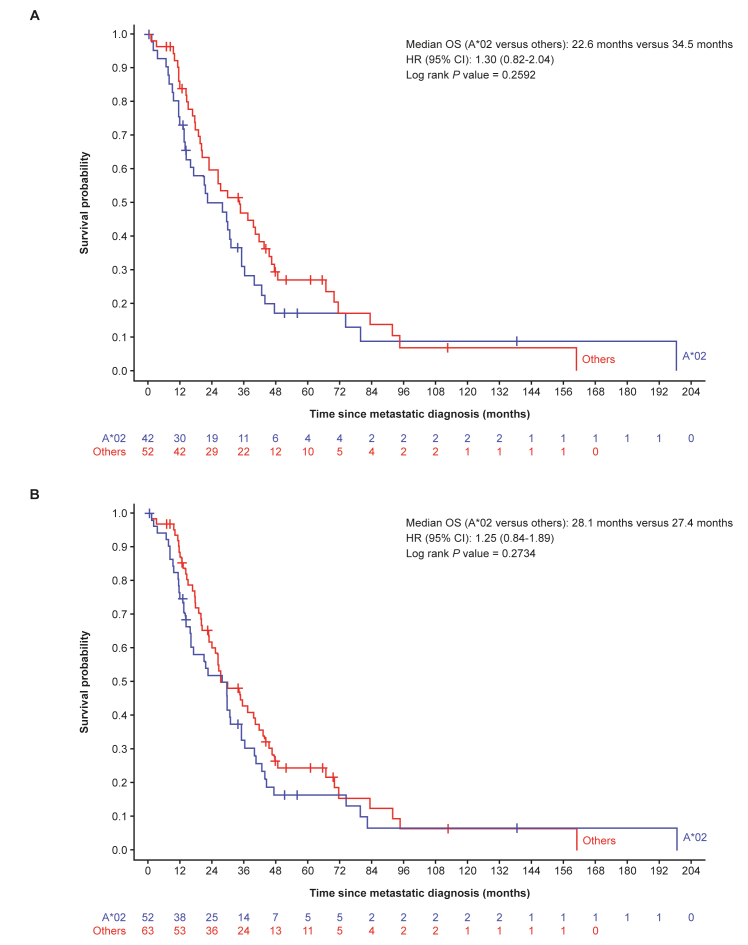
In 92 patients with primary tumor samples, ∼25% (n = 23) were positive for NY-ESO-1 and HLA-A∗02 expression (dual positive). Among 106 patients with IHC data, 61% (n = 65) were NY-ESO-1 positive, and among 94 patients with RNA-seq data, 45% (n = 42) were HLA-A∗02 positive. The median overall survival (OS) for positive versus negative NY-ESO-1 status was 35.3 and 21.7 months, respectively (unadjusted P = 0.0428). We observed no difference in median OS for HLA-A∗02-positive versus -negative and dual-positive patients versus others (both unadjusted P > 0.05). Multivariate analyses of OS showed no prognostic impact for NY-ESO-1 among primary tumor samples and in the exploratory cohort. However, in the latter we observed an association between NY-ESO-1 expression and OS in the first-line (P = 0.0041) but not in the second-line setting.
The primary tumor cohort showed no association between NY-ESO-1 expression and OS (including stratification by HLA-A∗02 subtype and treatment line) when adjusting for important prognostic factors, possibly due to small sample sizes.
为了更好地理解纽约食管鳞状细胞癌 1(NY-ESO-1)和人类白细胞抗原(HLA)亚型在治疗决策中的重要性,需要进一步研究其在转移性滑膜肉瘤(mSS)患者中的流行程度和预后影响。
这是一项回顾性临床生物学队列研究,纳入了成人 mSS 患者。患者数据来自法国肉瘤组 NetSARC 数据库,并通过电子病历进行补充。采集原发肿瘤样本,通过免疫组织化学(IHC)检测 NY-ESO-1 表达,通过 RNA 测序(RNA-seq)检测 HLA-A∗02 状态。主要队列纳入了有可用原发肿瘤样本的患者;通过纳入有原发或转移样本的患者(称为探索性队列),研究了更大样本量的影响。提供了 P 值用于描述性目的。
在 92 例有原发肿瘤样本的患者中,约 25%(n=23)NY-ESO-1 和 HLA-A∗02 表达阳性(双重阳性)。在 106 例有 IHC 数据的患者中,61%(n=65)NY-ESO-1 阳性,在 94 例有 RNA-seq 数据的患者中,45%(n=42)HLA-A∗02 阳性。NY-ESO-1 阳性与阴性患者的中位总生存期(OS)分别为 35.3 和 21.7 个月(未调整 P=0.0428)。我们未观察到 HLA-A∗02 阳性与阴性以及双重阳性患者与其他患者的中位 OS 存在差异(均未调整 P>0.05)。OS 的多变量分析显示,原发肿瘤样本和探索性队列中 NY-ESO-1 无预后影响。然而,在后一个队列中,我们观察到 NY-ESO-1 表达与一线治疗(P=0.0041)而非二线治疗的 OS 相关。
在调整重要预后因素后,原发肿瘤队列中 NY-ESO-1 表达与 OS 之间(包括按 HLA-A∗02 亚型和治疗线分层)无关联,这可能是由于样本量较小所致。