Uenoyama Yoshihisa, Nonogaki Miku, Tsuchida Hitomi, Takizawa Marina, Matsuzaki Sena, Inoue Naoko, Tsukamura Hiroko
Laboratory of Animal Reproduction, Graduate School of Bioagricultural Sciences, Nagoya University, Nagoya 464-8601, Japan.
J Reprod Dev. 2024 Oct 1;70(5):327-337. doi: 10.1262/jrd.2024-045. Epub 2024 Aug 16.
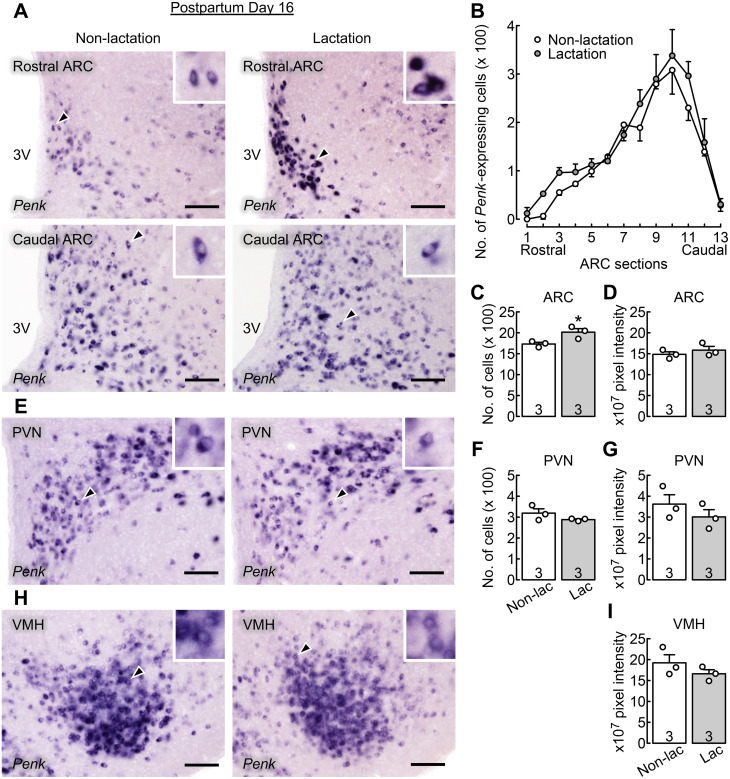
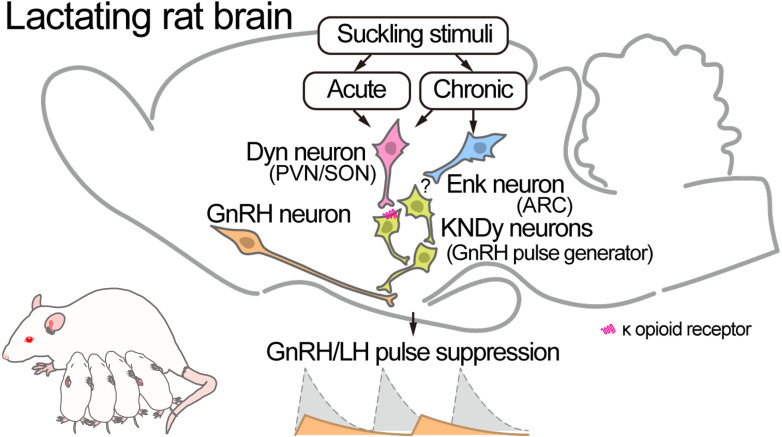
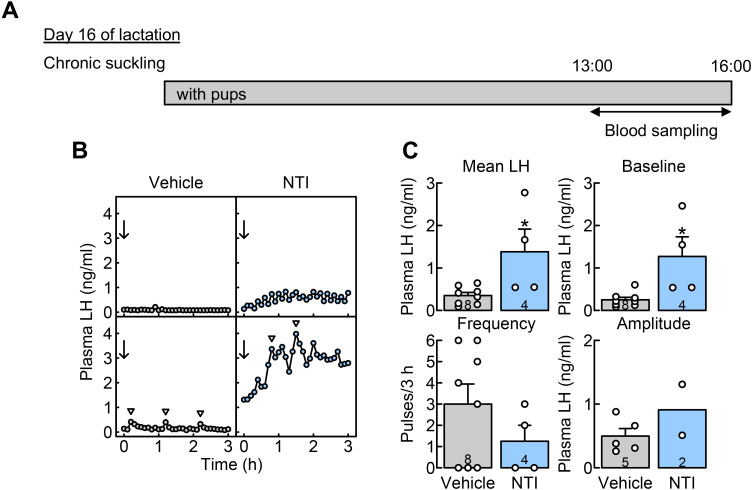
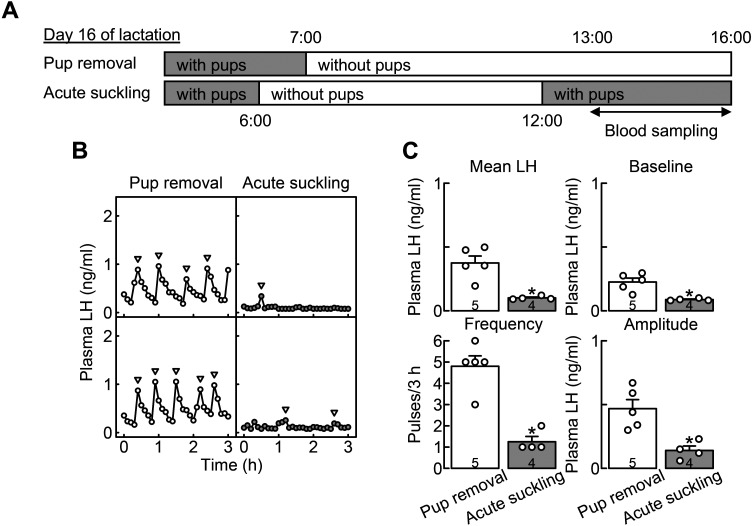
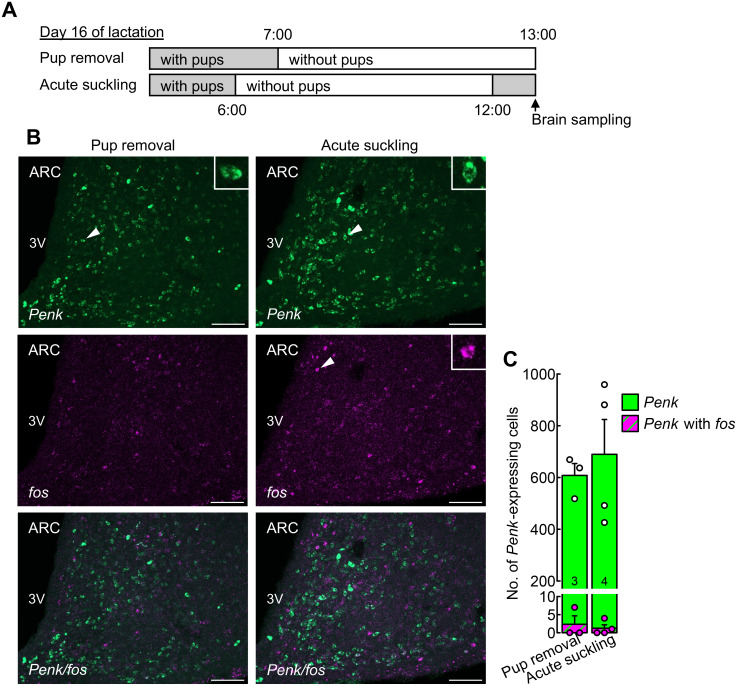
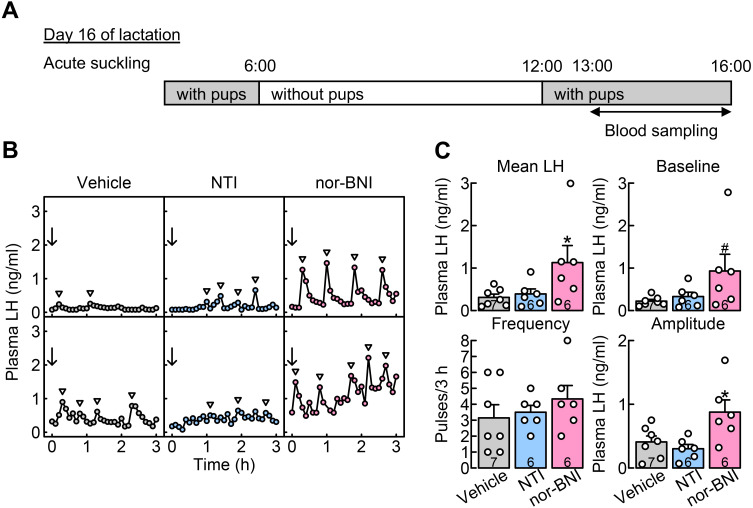
In mammals, secretion of tonic (pulsatile) gonadotropin-releasing hormone (GnRH)/luteinizing hormone (LH) is often suppressed during lactation. Suppression of GnRH/LH pulses in lactating dams is assumed to be caused by suckling stimuli and a chronic negative energy balance due to milk production. The present study aimed to investigate whether the central enkephalin-δ opioid receptor (DOR) signaling mediated the suppression of LH secretion by acute suckling stimuli and/or chronic negative energy balance due to milk production in rats during late lactation when dams were under a heavy energy demand. On postpartum day 16, the number of Penk (enkephalin mRNA)-expressing cells in the arcuate nucleus was significantly higher in lactating rats than in non-lactating control rats. Pulsatile LH secretion was suppressed in rats with chronic suckling or acute 1-h suckling stimuli 6 h after pup removal on day 16 of lactation. Central DOR antagonism significantly increased the mean LH concentrations and the baseline of LH pulses in rats with chronic suckling but not with acute suckling stimuli on day 16 of lactation. Besides, central κ opioid receptor (KOR) antagonism increased the amplitude of LH pulses in rats with the acute suckling stimuli on day 16 of lactation. These results suggest that central DOR signaling mediates the suppression of LH secretion caused by a negative energy balance in rats receiving chronic suckling during late lactation. On the other hand, central KOR signaling likely mediates acute suckling stimuli-induced suppression of LH secretion in rats during late lactation.
在哺乳动物中,哺乳期时促性腺激素释放激素(GnRH)/促黄体生成素(LH)的张力性(脉冲式)分泌通常会受到抑制。哺乳期母鼠GnRH/LH脉冲的抑制被认为是由哺乳刺激以及产奶导致的慢性负能量平衡所引起的。本研究旨在调查在哺乳后期母鼠能量需求很大时,中枢脑啡肽-δ阿片受体(DOR)信号是否介导了急性哺乳刺激和/或产奶导致的慢性负能量平衡对大鼠LH分泌的抑制作用。在产后第16天,哺乳期大鼠弓状核中表达Penk(脑啡肽mRNA)的细胞数量显著高于非哺乳期对照大鼠。在哺乳期第16天,移除幼崽6小时后,接受慢性哺乳或急性1小时哺乳刺激的大鼠中,LH的脉冲式分泌受到抑制。中枢DOR拮抗作用显著提高了慢性哺乳大鼠的平均LH浓度和LH脉冲的基线,但对哺乳期第16天接受急性哺乳刺激的大鼠没有影响。此外,中枢κ阿片受体(KOR)拮抗作用增加了哺乳期第16天接受急性哺乳刺激的大鼠LH脉冲的幅度。这些结果表明,中枢DOR信号介导了哺乳后期接受慢性哺乳的大鼠因负能量平衡导致的LH分泌抑制。另一方面,中枢KOR信号可能介导了哺乳后期大鼠急性哺乳刺激诱导的LH分泌抑制。